Online Ph Sensor
Online Ph Sensor
In industrial process control, the continuous monitoring of liquid acidity or alkalinity is vital for ensuring product quality, protecting equipment from corrosion, and meeting environmental discharge regulations. An online pH sensor provides real-time data, allowing automated systems to adjust chemical dosing or process parameters without the delays associated with manual sampling and laboratory analysis. While often discussed alongside other process instruments like level meters, pH sensors require a specific understanding of electrochemistry to ensure long-term reliability in harsh industrial environments.
Fundamental Principles of Online pH Measurement
Online pH measurement is based on the potentiometric method, which determines the hydrogen ion activity in a solution. The measurement system typically consists of two primary elements: a glass electrode (measuring electrode) and a reference electrode.
The Nernst Equation
The relationship between the electrical potential and the pH value is defined by the Nernst equation. At 25°C (298.15 K), a change of one pH unit corresponds to a change in electrical potential of 59.16 mV. The sensor measures the voltage difference between the internal glass electrode and the stable reference electrode. As the concentration of hydrogen ions ($H^+$) outside the glass membrane changes, the potential across the membrane shifts, which is then converted by a transmitter into a pH reading.
Temperature Compensation
Temperature significantly affects the pH measurement in two ways: it changes the chemical equilibrium of the process liquid and alters the sensitivity of the electrode (the Nernstian slope). Most industrial online pH sensors include an integrated temperature element, such as a PT100 or PT1000 resistor. This allows the transmitter to perform automatic temperature compensation (ATC), ensuring that the displayed pH value is corrected to a standard reference temperature, typically 25°C.
Components of an Online pH Sensor System
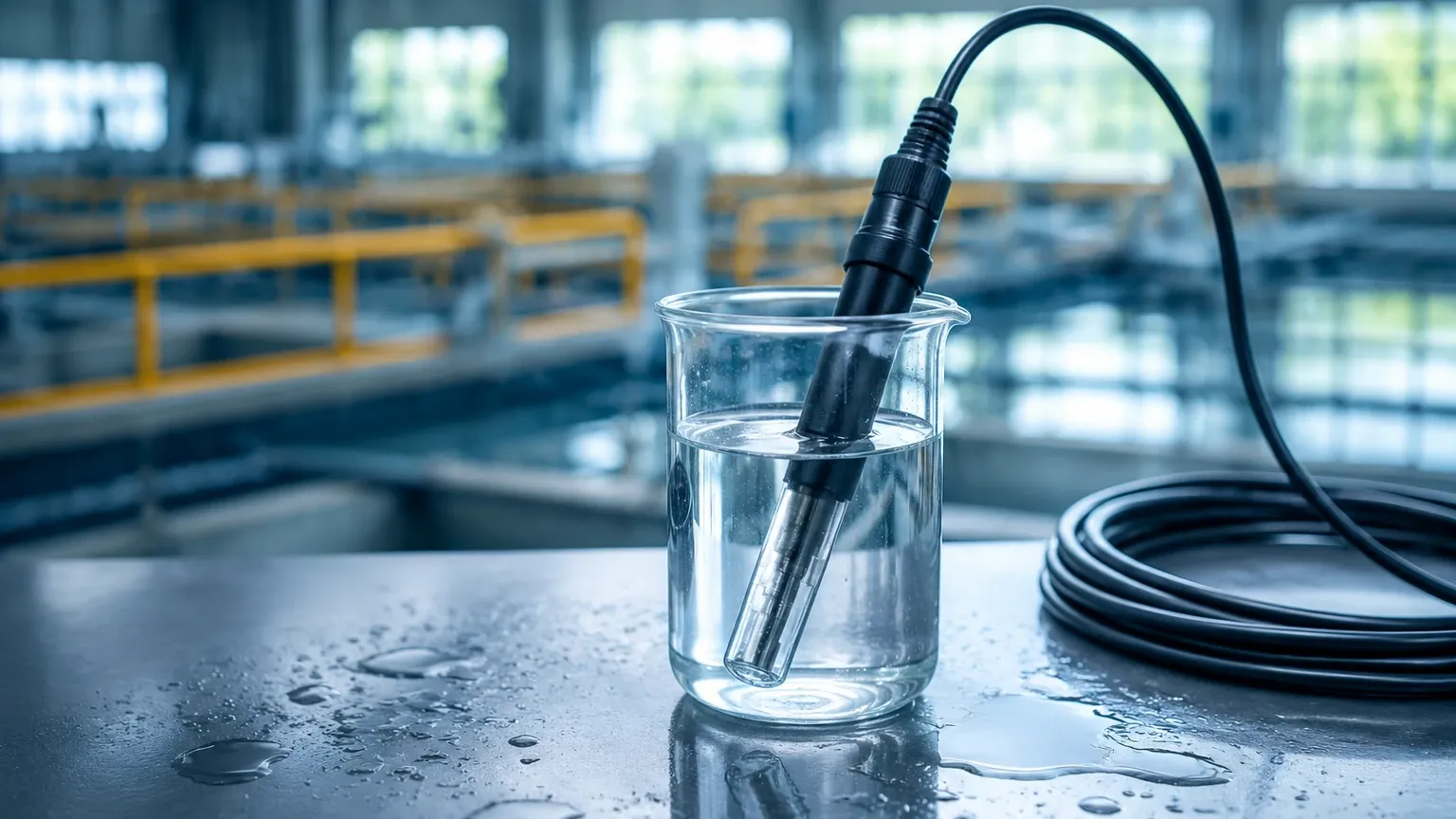
An industrial-grade online pH sensor is more complex than a laboratory probe, as it must withstand pressure, temperature fluctuations, and chemical attack.
1. Glass Membrane: The sensitive tip of the electrode, usually made of specialized lithium glass. Different glass formulations are used for high-temperature, low-temperature, or hydrofluoric acid-resistant applications.
2. Reference Junction: This is the interface where the internal reference electrolyte (usually KCl) meets the process liquid. Common materials include porous ceramic, Teflon (PTFE), or wood. The junction must allow a small, steady flow of electrolyte to maintain electrical continuity while resisting clogging.
3. Reference System: Usually an Ag/AgCl (Silver/Silver Chloride) system. In advanced sensors, a double-junction design is used to prevent process contaminants (like heavy metals or sulfides) from poisoning the reference electrode.
4. Sensor Body: Constructed from materials like Ryton (PPS), PVDF, or stainless steel to provide mechanical protection and chemical resistance.
Key Evaluation Criteria for Industrial Selection
Selecting the correct online pH sensor requires a thorough analysis of the process conditions. A sensor that works perfectly in a water treatment plant may fail within hours in a chemical reactor.
Chemical Compatibility
The sensor body, O-rings, and glass membrane must be compatible with the process media. For example, in processes containing hydrofluoric acid (HF), standard glass membranes will dissolve; specialized HF-resistant glass is mandatory. Similarly, in high-alkalinity processes, "sodium error" can occur, where the glass membrane responds to sodium ions instead of hydrogen ions, leading to inaccurate readings.
Pressure and Temperature
Standard sensors are often rated for pressures up to 6 bar (approx. 87 psi) and temperatures up to 80°C. However, many industrial processes exceed these limits. High-pressure environments require pressurized reference systems to prevent the process liquid from flowing backward into the electrode. High temperatures accelerate the aging of the glass membrane and the depletion of the electrolyte.
Installation Environment
Consider whether the sensor will be installed in a pipe (inline), a tank (immersion), or a bypass loop. This dictates the type of mounting hardware required, such as a flow cell, a submersible probe holder, or a retractable assembly that allows for sensor maintenance without shutting down the process line.
Industrial Selection Table
| Application Type | Recommended Sensor Features | Typical Junction Material | Temperature Range |
| :— | :— | :— | :— |
| Municipal Water Treatment | Standard composite electrode, low maintenance | Porous Ceramic | 0°C to 60°C |
| Chemical Processing | Double junction, high-temp glass, PTFE body | Teflon (PTFE) | -5°C to 110°C |
| Wastewater (Oily/Dirty) | Flat surface glass, solid polymer electrolyte | Open Aperture | 0°C to 80°C |
| Pure/Ultrapure Water | Refillable liquid electrolyte, stainless steel flow cell | Ceramic Triple Junction | 10°C to 50°C |
| Food & Beverage | Sanitary Tri-clamp fitting, FDA-compliant materials | Ceramic | 0°C to 130°C (CIP) |
Installation and Mounting Guidelines
Correct installation is critical for the longevity and accuracy of an online pH sensor. Unlike level measurement instruments, which are often non-contact, pH sensors are in direct contact with the media and are subject to physical wear.
* Orientation: Sensors should never be installed horizontally or upside down. They must be mounted at least 15° above the horizontal plane to ensure the internal electrolyte remains in contact with the glass membrane and that no air bubbles are trapped inside the electrode tip.
* Flow Velocity: In pipe installations, the flow should be steady. Excessive velocity can cause "streaming potentials" (static interference), while insufficient flow can lead to sediment buildup on the sensor tip. A velocity of 0.5 to 2 meters per second is generally ideal.
* Cable Management: pH sensors produce a high-impedance signal that is extremely sensitive to electrical noise. Use shielded cables and keep them away from high-voltage power lines or variable frequency drives (VFDs). For long distances (over 10-15 meters), a digital sensor or a pre-amplifier is recommended.
* Submersion Depth: For tank installations, ensure the sensor is submerged deep enough to represent the bulk liquid but not so deep that it rests in the sludge layer at the bottom.
In integrated automation projects, pH data is often combined with level data to manage tank volumes and chemical dosing simultaneously. For reliable level measurement solutions that complement your liquid analysis systems, you can review product options on our Main Page.
Maintenance, Calibration, and Troubleshooting
An online pH sensor is a consumable item; its sensitivity will naturally decline over time. A rigorous maintenance schedule is the only way to ensure data integrity.
Calibration Procedure
Calibration should be performed using at least two buffer solutions (e.g., pH 4.01 and pH 7.00).
1. Zero Point Calibration: Usually done at pH 7.0. This accounts for the offset of the electrode.
2. Slope Calibration: Done at a second pH value. This measures the efficiency of the glass membrane. A new electrode should have a slope between 95% and 102%. If the slope drops below 85% or 90%, the sensor should be replaced.
Cleaning Protocols
Fouling is the most common cause of sensor failure.
* Biofilms/Algae: Clean with a weak bleach solution or specialized surfactant.
* Calcium Scale: Use a 5% Hydrochloric Acid (HCl) soak.
* Oils and Greases: Use a non-abrasive detergent or isopropyl alcohol.
Always rehydrate the sensor in a storage solution (typically 3M KCl) for at least 30 minutes after chemical cleaning before recalibrating.
Limitations and Process Risks
While online pH sensors are powerful tools, they have inherent limitations that engineers must account for:
* Dehydration: If a pH sensor dries out, the hydrated gel layer on the glass membrane is damaged. In batch processes, sensors must be kept wet during empty cycles using a wet-storage boot or a bypass loop that remains full.
* Reference Poisoning: In the presence of ions like cyanide, bromide, or sulfide, the silver ions in the reference electrolyte can precipitate, clogging the junction and causing a massive drift in readings.
* Glass Fragility: Despite industrial housing, the sensing membrane is thin glass. It can be broken by large solids in the process stream or by cavitation in high-turbulence areas.
* Life Expectancy: In standard water applications, a sensor may last 12 to 24 months. In aggressive chemical processes at high temperatures, the lifespan may be reduced to 3 to 6 months.
Frequently Asked Questions
Q: How often should I calibrate my online pH sensor?
A: This depends on the process. In stable water treatment applications, once a month may suffice. In aggressive chemical or wastewater applications, weekly or even daily calibration checks may be necessary.
Q: Can I use a standard coaxial cable to extend the sensor wire?
A: It is not recommended. pH signals are high-impedance. Using non-specialized cables or improper splicing will introduce significant noise and signal loss. Always use the manufacturer’s specified low-noise cable or a digital communication protocol like Modbus or HART.
Q: Why does my pH reading drift even after calibration?
A: Drift is often caused by a clogged reference junction or a contaminated reference electrolyte. If the process pressure is higher than the internal pressure of the sensor, process fluid may be forced into the junction, changing the reference potential.
Q: What is the difference between an analog and a digital pH sensor?
A: Analog sensors send a raw millivolt signal to the transmitter. Digital sensors (like those using Memosens or similar protocols) convert the signal to a digital value within the sensor head itself. Digital sensors are immune to cable noise, allow for longer cable runs, and can store calibration data directly on the sensor chip.
By understanding these technical requirements and selection criteria, engineers can implement online pH monitoring that provides accurate, actionable data for process optimization. For further technical guidance on liquid measurement and automation, including radar and ultrasonic systems, refer to the resources available on our Main Page.