Process Gas and Sulfur Analyzers
Process Gas and Sulfur Analyzers
In the complex landscape of industrial process control, the ability to accurately monitor gas composition is as critical as measuring physical parameters like pressure, temperature, and liquid level. Process gas and sulfur analyzers serve as the "eyes" of a chemical or petrochemical plant, providing real-time data on gas streams to ensure product quality, protect expensive catalysts, and maintain compliance with increasingly stringent environmental regulations. This guide explores the fundamental principles, selection criteria, and practical installation considerations for these essential instruments, particularly within the context of heavy industrial automation.
Understanding Process Gas and Sulfur Analysis
Process gas analysis involves the continuous measurement of specific chemical components within a gas stream. Unlike laboratory analysis, which relies on discrete samples, process analyzers operate online or in-line, providing immediate feedback to control systems. Sulfur analysis is a specialized subset of this field, focusing on compounds such as hydrogen sulfide (H2S), sulfur dioxide (SO2), and total reduced sulfur (TRS). These compounds are often corrosive, toxic, and subject to strict emission limits.
In industries such as oil and gas, sulfur recovery units (SRUs) utilize the Claus process to convert gaseous H2S into elemental sulfur. Monitoring the H2S/SO2 ratio in the tail gas is vital for maximizing recovery efficiency. Similarly, in natural gas processing, sulfur must be removed to prevent pipeline corrosion and meet commercial specifications. These applications require robust measurement technologies that can withstand harsh chemical environments.
Core Measurement Principles
Before selecting an analyzer, it is necessary to understand the underlying measurement physics. Most modern process gas and sulfur analyzers utilize one of the following principles:
Ultraviolet (UV) Spectroscopy
UV-based analyzers are widely used for sulfur compounds because H2S and SO2 have strong absorption characteristics in the ultraviolet spectrum.
- UV Fluorescence: Used primarily for low-level SO2 measurement. The sample is exposed to UV light, causing SO2 molecules to reach an excited state. As they return to a ground state, they emit light at a different wavelength, which is measured by a photomultiplier tube.
- UV Absorption: Often used for higher concentrations of H2S and SO2 in tail gas treatment units. It operates on the Beer-Lambert law, where the amount of light absorbed is proportional to the concentration of the gas.
Non-Dispersive Infrared (NDIR)
NDIR is a standard technology for measuring gases like CO, CO2, and CH4. It uses an infrared source and an optical filter to isolate a specific wavelength absorbed by the target gas. While less common for H2S due to cross-interference from water vapor, NDIR remains a cost-effective solution for many process gas applications.
Tunable Laser Diode Absorption Spectroscopy (TDLAS)
TDLAS has gained significant market share due to its high selectivity and low maintenance requirements. A laser is tuned to a very specific absorption line of the target molecule. Because the laser line is extremely narrow, TDLAS is virtually immune to interference from other gases in the stream. This makes it ideal for measuring H2S in natural gas or moisture in corrosive process streams.
Gas Chromatography (GC)
Process GCs are the gold standard for multi-component analysis. They physically separate the gas mixture into individual components using a column and then measure each component with a detector, such as a Thermal Conductivity Detector (TCD) or Flame Photometric Detector (FPD). While highly accurate, GCs have longer cycle times (minutes rather than seconds) and require carrier gases.
Technical Selection Criteria
Choosing the right process gas and sulfur analyzer requires a detailed evaluation of the process conditions and the measurement objectives. The following table provides a comparison of common technologies used in sulfur and gas analysis.
| Technology | Common Target Gases | Detection Range | Typical Accuracy | Maintenance Level |
| :— | :— | :— | :— | :— |
| UV Absorption | H2S, SO2, COS | 0–100 ppm to % levels | ±1-2% FS | Moderate |
| TDLAS | H2S, H2O, NH3, CH4 | Low ppm to % levels | ±1% of reading | Low |
| NDIR | CO, CO2, CH4, SO2 | 0–50 ppm to % levels | ±2% FS | Moderate |
| GC-FPD | Total Sulfur, H2S, Mercaptans | ppb to ppm levels | ±1-2% FS | High |
| Electrochemical | H2S, O2, CO | 0–50 ppm | ±2-5% FS | High (Sensor replacement) |
Key Evaluation Factors
1. Selectivity: Can the analyzer distinguish the target gas from background components like methane, water vapor, or hydrogen?
2. Response Time: In safety-critical applications or fast-loop control, a T10-90 response time of a few seconds is required.
3. Dynamic Range: Does the process fluctuate between trace levels (ppm) and high concentrations (percentage)? Some sensors saturate at high levels.
4. Sample Conditioning Requirements: Many analyzers require the gas to be clean, dry, and at a specific temperature/pressure before it enters the measurement cell.
Integration with Level Measurement Systems
In many industrial settings, gas analysis is performed on the headspace of storage tanks or within processing vessels where liquid levels are also monitored. For example, in a sour water stripper or a sulfur storage pit, the gas phase contains high concentrations of H2S.
Reliable operation depends on the synergy between different instrument classes. While process gas and sulfur analyzers monitor the chemical composition, level measurement instruments—such as radar level meters or ultrasonic sensors—ensure the physical stability of the process. In a sulfur pit, a radar level meter must be capable of operating at temperatures above 130°C to prevent the sulfur from solidifying, while the gas analyzer monitors for potentially explosive or toxic gas build-up in the vapor space. For engineers designing these systems, reviewing comprehensive product options and application support on the Main Page can help in selecting the right combination of level and analytical instrumentation.
Installation and Engineering Considerations
The performance of a gas analyzer is often determined more by the installation and sample handling system than by the sensor itself.
Sample Conditioning Systems (SCS)
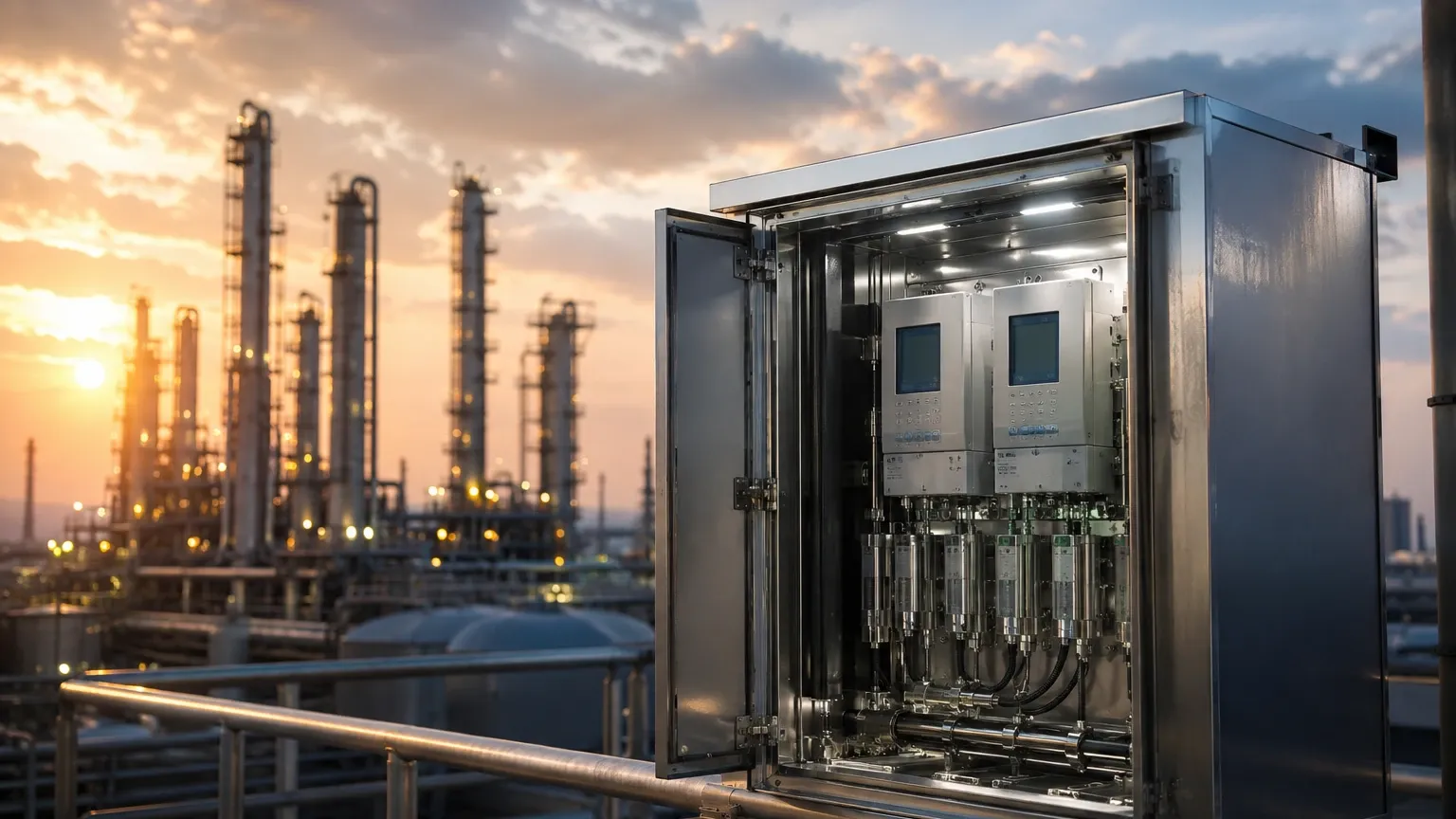
Most process gases cannot be fed directly into an analyzer. An SCS is required to:
- Filter Particulates: Remove dust, soot, or pipe scale that could foul optical windows.
- Manage Moisture: Use Peltier coolers or membrane dryers to remove water vapor, as condensation inside an analyzer can cause permanent damage.
- Pressure Regulation: Reduce high process pressures (e.g., 50 bar) to the near-atmospheric pressure (approx. 1 bar absolute) required by most sensing cells.
- Temperature Control: Use heat-traced sample lines (typically set to 120°C–150°C for sulfur applications) to prevent the deposition of elemental sulfur or the condensation of acid gases.
Probe Placement
The sample probe should be located in a representative section of the process piping, ideally in a straight run at least five pipe diameters downstream from any bends or valves. For gas streams, the probe should extend into the center third of the pipe diameter to avoid "wall effects" where flow is slower and contaminants may accumulate.
Operational Limitations and Risks
Despite technological advancements, process gas and sulfur analyzers face several operational challenges:
- Cross-Interference: In UV and IR systems, overlapping absorption spectra can lead to false readings. Modern digital signal processing and multi-wavelength analysis help mitigate this, but it remains a factor in complex chemical matrices.
- Sensor Poisoning: Electrochemical and some solid-state sensors can be "poisoned" by high concentrations of specific chemicals, leading to a permanent loss of sensitivity.
- Calibration Drift: All analyzers drift over time. Automated calibration cycles using certified span gases are necessary for maintaining accuracy in regulated environments.
- Corrosion: Sulfur compounds, especially in the presence of moisture, form sulfuric or sulfurous acids. Wetted parts of the analyzer and sampling system must be constructed from corrosion-resistant materials like 316L Stainless Steel, Hastelloy, or PTFE.
Frequently Asked Questions (FAQ)
Q: How often should a sulfur analyzer be calibrated?
A: This depends on the technology and the criticality of the measurement. TDLAS systems may only need checking every 6–12 months, whereas electrochemical sensors or GCs might require weekly or even daily calibration checks.
Q: Can a single analyzer measure multiple sulfur species?
A: Yes, Process Gas Chromatographs (GCs) can separate and measure H2S, SO2, COS, and mercaptans individually. Some advanced UV-spectrometers can also measure H2S and SO2 simultaneously using multi-wavelength detection.
Q: What is the difference between "In-Situ" and "Extractive" analysis?
A: In-situ analyzers measure the gas directly in the process pipe or stack, offering the fastest response time. Extractive analyzers pull a sample through a tube to a remote analyzer cabinet, allowing for better sample conditioning and easier maintenance access.
Q: Why is temperature control so important in sulfur analysis?
A: Sulfur has a narrow liquid range. If the temperature drops below approximately 115°C, it solidifies and plugs the sampling lines. If it rises too high, its viscosity increases dramatically, also causing flow issues. Maintaining a stable temperature (usually around 130°C–145°C) is critical for continuous operation.
Conclusion
Process gas and sulfur analyzers are indispensable tools for modern industrial operations, providing the data necessary for process optimization and environmental safety. By understanding the specific measurement principles—from UV fluorescence to TDLAS—and ensuring a robust sample conditioning system is in place, engineers can achieve reliable and accurate analysis even in the most demanding conditions. When integrated with high-quality level measurement and other process instruments, these analyzers form the backbone of a safe and efficient industrial facility.