Best Food Grade Flow Meter
Best Food Grade Flow Meter
In the food and beverage industry, precision and hygiene are the two pillars of successful processing. Selecting the best food grade flow meter is not merely a matter of measuring volume; it involves ensuring compliance with strict sanitary standards, maintaining product integrity, and optimizing production efficiency. From milk and fruit juices to viscous syrups and oils, the physical properties of the fluid dictate the measurement technology required.
This guide examines the core measurement principles used in food-grade applications, provides a framework for selection, and outlines the technical requirements for sanitary installation. For a broader overview of industrial instrumentation, engineers can refer to the Main Page for additional technical resources.
Understanding Food Grade Requirements
Before selecting a specific technology, it is essential to understand what constitutes a "food grade" instrument. Unlike standard industrial meters, food-grade flow meters must meet specific design criteria to prevent bacterial growth and contamination.
Material Compatibility
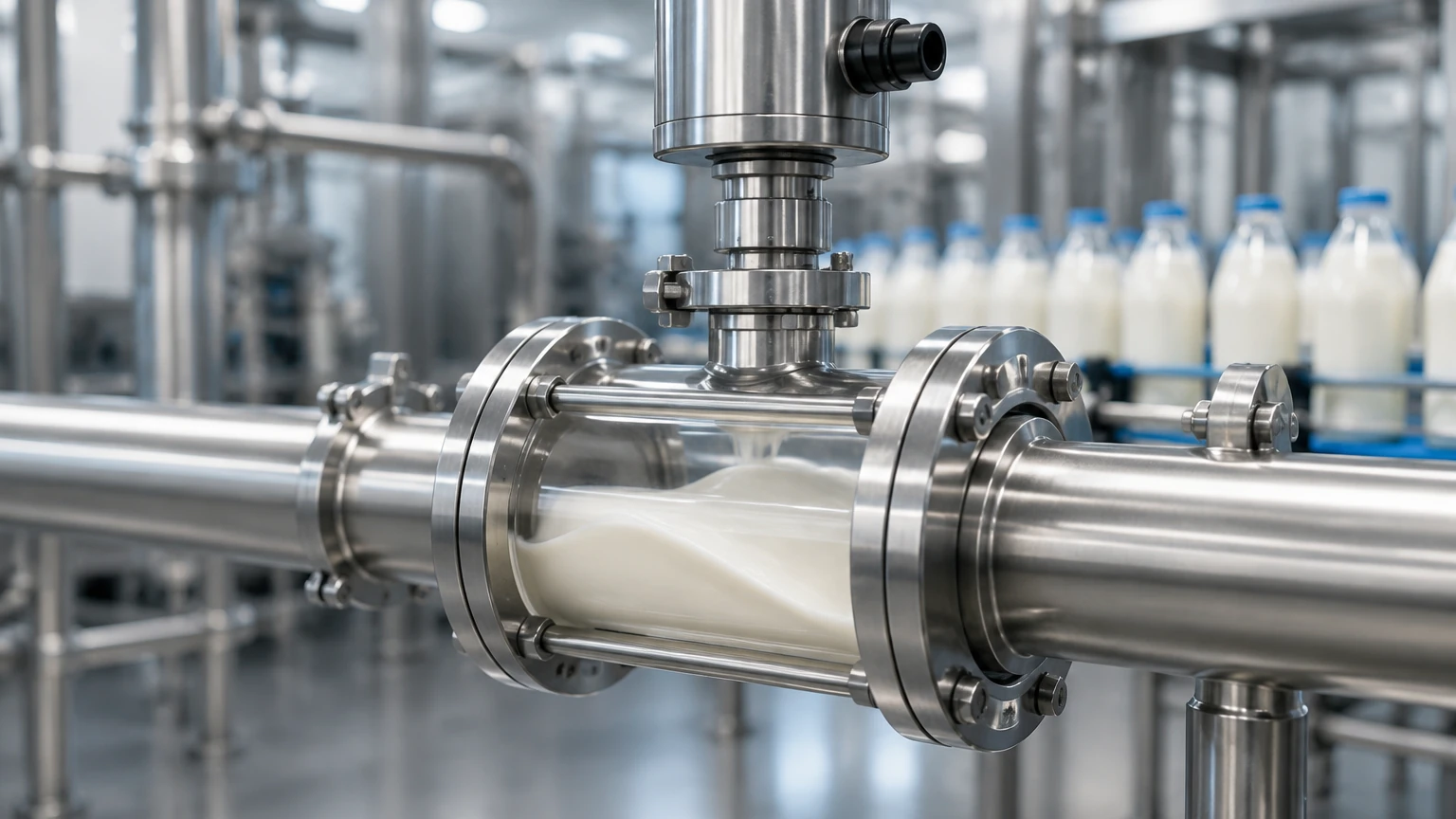
All wetted parts—the components that come into direct contact with the product—must be made from non-toxic, non-corrosive materials. Stainless steel 316L is the industry standard due to its resistance to corrosion from food acids and cleaning chemicals. Gaskets and liners must be made from FDA-approved materials such as PTFE (Teflon), PFA, or EPDM.
Surface Finish and Hygienic Design
The internal surfaces of the meter must be polished to a specific smoothness, typically measured as Ra (Roughness Average). A standard requirement is Ra ≤ 0.8 μm. This prevents microorganisms from adhering to microscopic pits in the metal. Furthermore, the design must be free of "dead zones" or crevices where product could stagnate and spoil.
CIP and SIP Capabilities
Most modern food processing lines utilize Cleaning-in-Place (CIP) and Sterilization-in-Place (SIP) protocols. The best food grade flow meter must withstand high-temperature caustic washes (CIP) and pressurized steam sterilization (SIP), often reaching temperatures up to 140°C (284°F), without losing calibration or sustaining damage.
Core Measurement Principles
Several technologies are used to measure flow in food processing. Each has distinct advantages depending on the fluid's conductivity, viscosity, and transparency.
1. Electromagnetic Flow Meters (Magmeters)
Electromagnetic flow meters operate on Faraday’s Law of Electromagnetic Induction. When a conductive liquid flows through a magnetic field generated by the meter, it creates a voltage proportional to the velocity of the liquid.
* Best For: Conductive liquids such as milk, beer, wine, juices, and sauces.
* Advantages: No moving parts in the flow stream, meaning zero pressure drop and minimal maintenance. They are highly resistant to solids (e.g., fruit pulp).
* Limitations: The fluid must have a minimum conductivity (usually >5 μS/cm). They cannot measure oils, fats, or demineralized water.
2. Coriolis Mass Flow Meters
Coriolis meters measure mass flow directly by monitoring the inertia of the fluid as it passes through vibrating tubes. As the fluid moves, it causes a slight twist in the tubes (the Coriolis effect), which is measured by sensors.
* Best For: High-value products, viscous fluids, and applications requiring extreme precision, such as dosing ingredients or measuring fats, oils, and chocolate.
* Advantages: Measures mass, density, and temperature simultaneously. It is independent of fluid properties like viscosity and pressure.
* Limitations: High initial capital cost and sensitivity to external mechanical vibration.
* Metric Note: Often used for flow rates ranging from 1 kg/h to over 500,000 kg/h.
3. Ultrasonic Flow Meters (Transit-Time)
Ultrasonic meters use sound waves to determine flow velocity. In the transit-time method, two transducers send signals back and forth. The difference in the time it takes for the signal to travel with the flow versus against the flow is proportional to the fluid velocity.
* Best For: Clean, non-aerated liquids like water, alcohol, and clear syrups.
* Advantages: Non-invasive options (clamp-on) are available, which eliminate the risk of contamination entirely. In-line versions offer a full-bore design with no obstructions.
* Limitations: Accuracy is affected by air bubbles or high concentrations of suspended solids which can scatter the ultrasonic signal.
* Metric Note: Typical accuracy is ±0.5% to ±1% of the flow rate.
4. Turbine Flow Meters
Turbine meters utilize a multi-bladed rotor suspended in the fluid stream. The fluid pushes the rotor, and the rotational speed is proportional to the flow velocity.
* Best For: Low-viscosity, clean liquids such as water or light solvents.
* Advantages: Fast response time and high repeatability.
* Limitations: Moving parts are susceptible to wear. They are generally not suitable for high-viscosity fluids or products with particulates that could jam the rotor.
Selection Criteria for Food Grade Flow Meters
Choosing the best food grade flow meter requires a systematic evaluation of the process conditions. The following table provides a comparison of the most common technologies.
| Feature | Electromagnetic (Magmeter) | Coriolis Mass Meter | Ultrasonic (Transit-Time) | Turbine Meter |
| :— | :— | :— | :— | :— |
| Primary Measurement | Volume Flow | Mass Flow | Volume Flow | Volume Flow |
| Accuracy | ±0.2% to ±0.5% | ±0.1% | ±0.5% to ±1.0% | ±0.25% to ±0.5% |
| Viscosity Limit | Low to Medium | Very High | Low | Low |
| Conductivity Req. | Required (>5 μS/cm) | Not Required | Not Required | Not Required |
| Pressure Drop | Negligible | Moderate | None | Significant |
| CIP/SIP Ready | Excellent | Excellent | Good | Moderate |
| Typical Fluids | Milk, Juice, Beer | Chocolate, Oils, Syrups | Water, Alcohol | Clean Water, Solvents |
Practical Installation Considerations
Even the best food grade flow meter will perform poorly if installed incorrectly. In a sanitary environment, installation must prioritize both measurement accuracy and hygiene.
1. Sanitary Fittings: Meters must be connected to the piping using hygienic couplings, such as Tri-clamp (ISO 2852) or DIN 11851 fittings. These allow for easy removal for manual cleaning or inspection.
2. Piping Orientation: For liquid applications, the meter should ideally be installed in a vertical pipe with the flow moving upwards. This ensures the pipe is always full and prevents air pockets from forming at the top of the sensor, which would cause measurement errors.
3. Straight Pipe Runs: Most flow meters (especially Magmeters and Ultrasonic) require a specific length of straight pipe upstream (typically 5 to 10 diameters) and downstream (2 to 5 diameters) to stabilize the flow profile. Without this, turbulence from elbows or valves can lead to erratic readings.
4. Grounding: For electromagnetic meters, proper grounding is critical. In stainless steel piping systems, grounding rings or electrodes are used to ensure the fluid and the meter are at the same electrical potential, preventing noise from interfering with the small voltage signals.
5. Self-Draining Design: The meter and its associated piping must be sloped to ensure they are self-draining. Any residual liquid left in the meter after a production run can lead to bacterial growth.
Limitations and Common Risks
While modern instrumentation is highly reliable, several factors can compromise performance in a food production environment:
* Entrained Air: Air bubbles in the line are a common problem in the dairy and juice industries. Air occupies volume but has negligible mass; therefore, it causes volume flow meters to over-read and can cause Coriolis meters to stall. Air eliminators should be installed upstream if aeration is a risk.
* Thermal Shock: Rapid temperature changes during SIP (e.g., moving from 20°C product to 130°C steam) can cause mechanical stress. Ensure the meter is rated for the specific temperature gradients of your cleaning cycle.
* Coating and Scaling: Some food products, like yogurt or heavy syrups, can leave a film on the inside of the meter. In Magmeters, a non-conductive coating on the electrodes will eventually cause the signal to fail. Regular CIP cycles are necessary to maintain accuracy.
Frequently Asked Questions (FAQ)
Q: Can I use a standard industrial flow meter for food if I clean it well?
A: No. Standard industrial meters often have internal threads, dead spaces, or non-compliant gaskets that trap bacteria. They also may not withstand the aggressive chemicals used in food-grade CIP processes.
Q: Which meter is best for measuring honey or molasses?
A: A Coriolis mass flow meter is typically the best choice for high-viscosity fluids like honey. It is not affected by changes in viscosity and provides highly accurate mass measurements despite the thickness of the fluid.
Q: How often should a food grade flow meter be calibrated?
A: Calibration frequency depends on the criticality of the process and local regulations. Most food manufacturers perform an annual calibration check. However, for high-value dosing or legal-for-trade applications (custody transfer), semi-annual calibration may be required.
Q: Does pipe vibration affect flow measurement?
A: Yes, particularly for Coriolis meters, which rely on tube vibration. If the meter is installed near a heavy pump or vibrating equipment, it may require specialized mounting or flexible couplings to isolate the sensor.
Conclusion
Selecting the best food grade flow meter requires a balance between technical specifications and hygienic requirements. For conductive, water-based liquids, the electromagnetic flow meter remains the industry workhorse due to its reliability and lack of moving parts. For high-precision applications involving viscous or non-conductive fluids, the Coriolis meter provides unmatched accuracy.
By ensuring that the chosen instrument meets 3-A or EHEDG standards and following rigorous installation practices, food processors can maintain high safety standards while optimizing their yields. For more detailed specifications on level and flow measurement technology, visit the Main Page to explore professional instrumentation solutions tailored for industrial automation.