Pressure Instruments
Pressure Instruments
In the landscape of industrial automation, pressure instruments serve as the foundational sensory components for monitoring and controlling process variables. While their primary function is the measurement of force exerted by a fluid per unit area, their utility extends significantly into the realm of level measurement. By leveraging the principles of hydrostatics, these instruments provide a reliable, cost-effective, and highly accurate method for determining the volume or height of liquids in tanks, vessels, and open reservoirs. For professional engineers and procurement specialists, understanding the technical nuances of these devices is essential for ensuring process safety and operational efficiency.
The Role of Pressure Instruments in Level Measurement
Pressure instruments are ubiquitous in sectors such as water treatment, chemical processing, oil and gas, and food production. In these environments, level measurement is often achieved indirectly by measuring the pressure at the bottom of a container. This method, known as hydrostatic level measurement, is favored because it involves no moving parts within the medium, reducing the risk of mechanical failure and simplifying maintenance requirements.
Welk, a professional manufacturer of industrial level measurement instruments, provides a range of solutions that utilize pressure-based technologies. These include hydrostatic level transmitters and differential pressure sensors designed to withstand harsh industrial conditions. For a broader view of the technical specifications and product categories available, engineers can visit the Main Page to review product options and application support.
Core Measurement Principles
Before selecting a specific instrument, it is critical to understand the physics governing pressure-based level measurement. The most fundamental principle is the hydrostatic pressure equation:
P = ρ × g × h
Where:
* P is the hydrostatic pressure (measured in Pascals or Bar).
* ρ (rho) is the density of the liquid (kg/m³).
* g is the gravitational constant (approximately 9.81 m/s²).
* h is the height of the liquid column above the sensor (meters).
The Density Factor
Because the pressure measured is directly proportional to the density of the liquid, any change in the medium's density will result in a measurement error if not properly compensated. For example, if a tank contains an oil that expands with temperature (becoming less dense), the pressure at the bottom will decrease even if the physical height of the liquid remains the same. Modern pressure instruments often include temperature compensation features or allow for manual density entry to mitigate these discrepancies.
Gauge vs. Differential Pressure
In atmospheric (open) tanks, a standard gauge pressure sensor is used. This sensor measures the pressure relative to the local atmospheric pressure, which effectively cancels out the air pressure acting on the surface of the liquid.
In pressurized (closed) tanks, a single gauge pressure sensor cannot distinguish between the pressure exerted by the liquid and the gas pressure (blanket pressure) above it. In these scenarios, differential pressure (DP) instruments are required. These devices measure the difference between two points: the high-pressure side at the bottom of the tank and the low-pressure side at the top. The resulting difference represents only the weight of the liquid column.
Types of Pressure Instruments for Industrial Applications
Industrial applications require different hardware configurations based on the mounting environment and the nature of the fluid.
1. Hydrostatic Level Transmitters
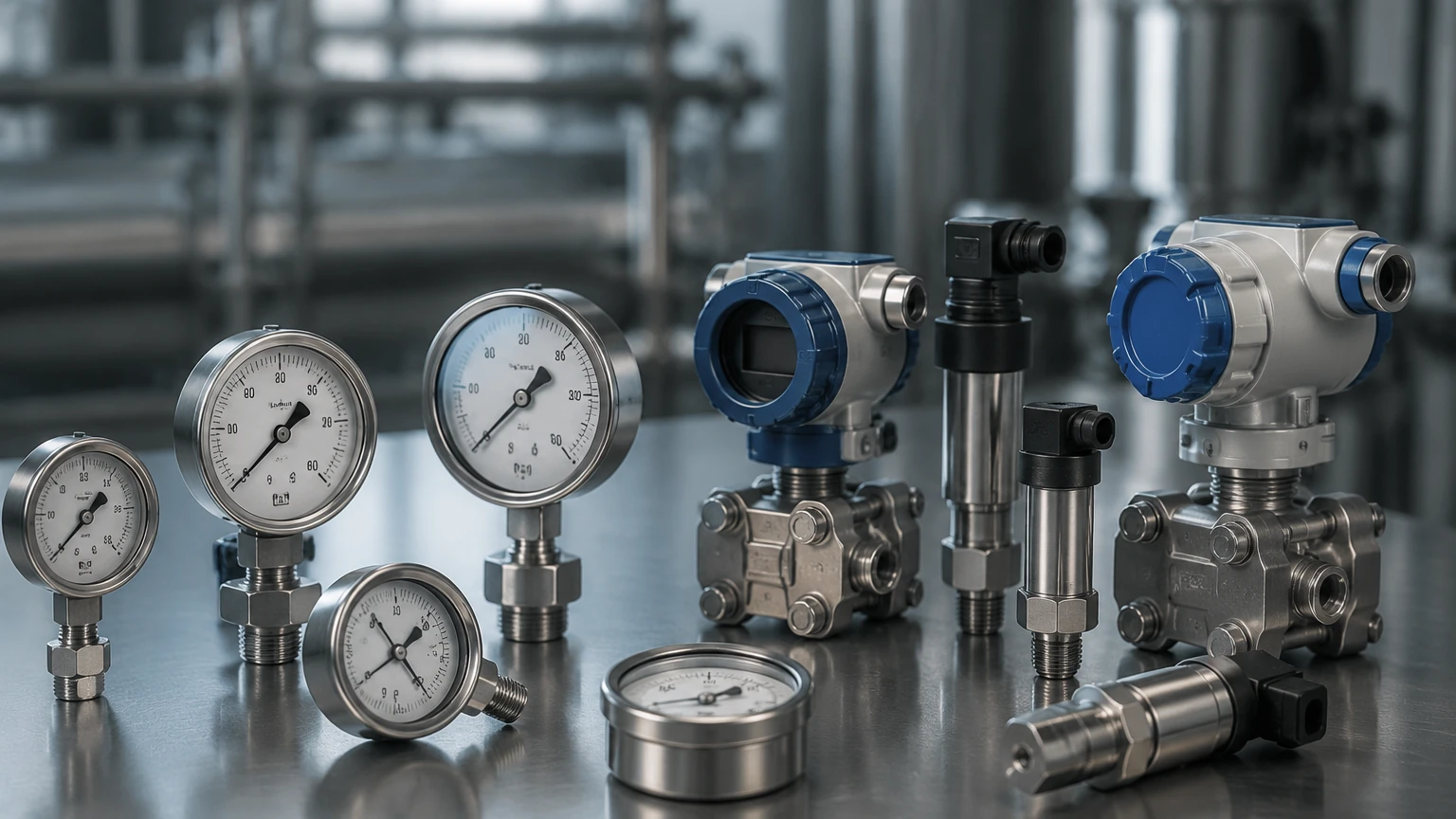
These are typically mounted to the side of a tank via a flange or threaded connection. They utilize a diaphragm that deflects under the weight of the liquid. This deflection is converted into an electrical signal (usually 4-20mA or a digital protocol like HART) proportional to the level.
2. Submersible Pressure Sensors
For wells, boreholes, and open-channel water treatment, submersible sensors are the preferred choice. These instruments are lowered into the liquid via a reinforced cable that contains a vent tube. The vent tube allows the internal side of the sensor's diaphragm to remain at atmospheric pressure, ensuring accurate gauge pressure readings regardless of changes in local weather or altitude.
3. Differential Pressure (DP) Transmitters
DP transmitters are the gold standard for pressurized vessels. They are often used with impulse lines or remote diaphragm seals. Remote seals are particularly useful when the process medium is corrosive, highly viscous, or likely to solidify in small-diameter impulse lines.
Selection Criteria and Practical Comparison Table
Choosing the right pressure instruments involves evaluating the chemical compatibility of the wetted parts, the expected pressure range, and the environmental conditions. The following table provides a general guide for technology selection based on common industrial scenarios.
| Application Scenario | Recommended Instrument Type | Key Advantage | Limitation |
| :— | :— | :— | :— |
| Open Water Reservoir | Submersible Pressure Sensor | Easy installation, no tank modification | Requires cable venting and protection |
| Pressurized Chemical Tank | Differential Pressure (DP) Transmitter | Compensates for blanket pressure | Complex installation with impulse lines |
| High-Viscosity Sludge | Flush Diaphragm Transmitter | Prevents clogging at the sensor face | More expensive than standard sensors |
| Corrosive Acid Storage | PTFE-Coated Hydrostatic Sensor | Chemical resistance | Limited to specific temperature ranges |
| Deep Borehole Monitoring | High-Pressure Submersible Sensor | Robust against high static heads | Difficult to retrieve for maintenance |
| Standard Diesel Tank | Gauge Pressure Transmitter | Cost-effective and reliable | Not suitable for pressurized tanks |
Installation and Engineering Considerations
Proper installation is as critical as instrument selection. Even the most accurate pressure instruments will yield poor data if installed incorrectly.
Tapping Point Location
The sensor should be installed at a point where the liquid is relatively calm. Avoid placing sensors near inlet pipes or agitators, as the kinetic energy of the moving fluid can create localized pressure spikes (dynamic pressure) that do not reflect the true static level.
Impulse Line Management
When using DP transmitters with impulse lines, the lines must be sloped to allow gas bubbles (in liquid service) or condensate (in gas service) to escape back into the process. A typical slope of 1:12 is recommended. For liquids that might freeze or crystallize, heat tracing or the use of remote diaphragm seals is necessary.
Atmospheric Venting
For gauge pressure and submersible sensors, the reference side of the diaphragm must be vented to the atmosphere. It is vital to ensure that moisture does not enter the vent tube, as this can lead to internal corrosion or blockage. Many Welk submersible sensors utilize desiccant cartridges or specialized gore-tex filters to protect the vent path.
Limitations and Common Operational Risks
While pressure instruments are versatile, they are not universal solutions. Engineers must be aware of the following limitations:
* Density Fluctuations: As noted, these instruments measure weight, not volume or height directly. If the process involves mixing liquids of different densities or significant temperature swings, the accuracy will degrade unless compensated.
* Turbulence and Aeration: If a liquid is heavily aerated (containing many air bubbles), its effective density decreases. The pressure sensor will report a lower level than what is physically present.
* Sediment Buildup: In applications like wastewater treatment, silt or sludge can accumulate at the bottom of the tank, covering the sensor diaphragm. This can lead to "signal drift" or a total loss of measurement. Periodic cleaning or the use of flush-mounted diaphragms can mitigate this.
* Overpressure Events: Selecting a sensor with an appropriate overpressure rating is essential. Sudden valve closures can cause "water hammer," which may permanently deform the sensing diaphragm.
Frequently Asked Questions (FAQ)
Q: Can pressure instruments be used for dry solids?
A: Generally, no. Pressure instruments rely on the fluid properties of liquids to transmit pressure equally in all directions (Pascal's Law). Solids do not behave this way due to internal friction and bridging, making pressure-based level measurement inaccurate for powders or granules.
Q: How often should pressure instruments be calibrated?
A: For most industrial applications, an annual calibration check is standard. However, in critical safety loops or highly corrosive environments, semi-annual checks may be required. Many modern transmitters feature self-diagnostics that can alert operators to potential sensor fatigue.
Q: What is the difference between a pressure transducer and a pressure transmitter?
A: In common industrial parlance, a transducer converts pressure into a low-level voltage signal (like 0-100mV), while a transmitter conditions that signal into a standardized industrial output like 4-20mA, which can be transmitted over long distances without significant signal loss.
Q: How do I handle measurement in a tank with a vacuum?
A: This requires an absolute pressure sensor or a differential pressure transmitter. A standard gauge sensor may be damaged or provide nonsensical readings if the process pressure drops significantly below atmospheric pressure.
Conclusion
Pressure instruments remain a cornerstone of industrial level measurement due to their reliability and the well-understood physics behind their operation. By carefully considering the liquid density, tank pressure, and installation environment, engineers can implement a measurement solution that provides years of accurate service. For those requiring specific hardware recommendations or custom OEM/ODM services, the Main Page serves as a primary resource for exploring the full range of Welk's industrial level and pressure measurement technologies.