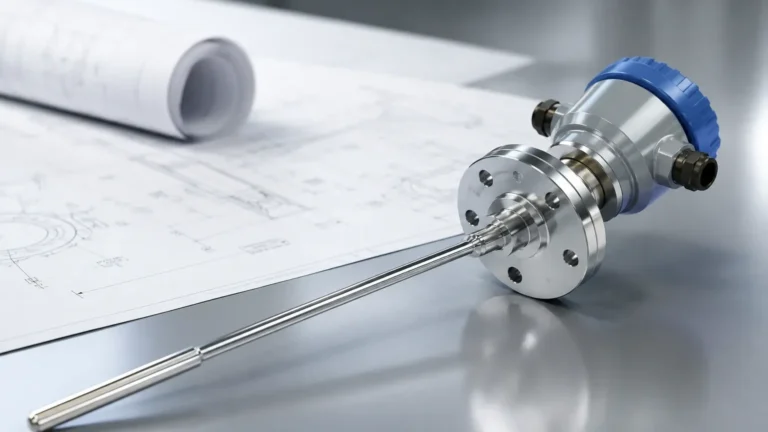
Thermal Conductivity Measurement Instrument
Thermal Conductivity Measurement Instrument
In the realm of industrial process control and material science, the ability to quantify how heat moves through a substance is critical for safety, efficiency, and quality assurance. A thermal conductivity measurement instrument is a specialized device designed to determine the thermal conductivity (k, λ, or κ) of solids, liquids, or gases. This property represents the rate at which heat passes through a specified thickness of a material under a temperature gradient.
While often associated with laboratory material characterization, thermal conductivity principles are increasingly integrated into industrial automation, particularly in the design of sophisticated level and flow switches. For engineers and plant managers, understanding the mechanics of these instruments is essential for selecting the right technology for applications ranging from chemical processing to HVAC systems and aerospace manufacturing.
Principles of Thermal Conductivity Measurement
Before selecting a thermal conductivity measurement instrument, it is vital to understand the physical principles that govern its operation. Thermal conductivity is measured in Watts per meter-Kelvin (W/m·K). Most instruments utilize one of two primary methodologies: steady-state or transient (non-steady-state).
Steady-State Methods
Steady-state techniques require the sample to reach a state of thermal equilibrium where the temperature at each point in the material no longer changes over time. Once equilibrium is established, the heat flow through the sample is measured. Common examples include the Guarded Hot Plate (GHP) and the Heat Flow Meter (HFM). While highly accurate, these methods can be time-consuming, often taking hours to reach the necessary stability.
Transient Methods
Transient methods measure the temperature response of a material to a heat pulse or a constant heat source over a short period. Because they do not require thermal equilibrium, these measurements are significantly faster. Common transient techniques include:
* Transient Plane Source (TPS): Uses a disk-shaped sensor that acts as both a heat source and a temperature sensor.
* Transient Hot Wire (THW): Primarily used for liquids and gases, involving a thin wire submerged in the medium.
* Thermal Dispersion (Industrial Application): This is the principle most relevant to level and flow monitoring. It utilizes the cooling effect of a fluid (liquid or gas) to determine its presence or movement. In a thermal dispersion level switch, two sensors are used: one is heated to a constant power, and the other measures the ambient temperature. The temperature difference between them is inversely proportional to the thermal conductivity and flow rate of the surrounding medium.
Industrial Applications and the Role of Process Instrumentation
In heavy industry, a thermal conductivity measurement instrument is rarely just a benchtop device. Instead, the technology is embedded into sensors that monitor real-time process conditions. For instance, in the oil and gas sector, these instruments help distinguish between oil, water, and gas layers in a separator based on their differing thermal conductivities.
For those managing complex fluid systems, the Main Page of instrumentation providers often highlights how thermal properties are leveraged to ensure accurate point level detection. Thermal dispersion switches are particularly favored because they contain no moving parts, making them highly reliable in viscous or aggressive media where mechanical floats might fail.
Key Evaluation Criteria for Selection
Choosing the correct thermal conductivity measurement instrument requires a thorough analysis of the material properties and the environmental conditions of the application. The following criteria should guide the selection process:
1. Material Phase: Is the substance a solid, liquid, gas, or paste? Some instruments, like the Transient Hot Wire, are optimized for fluids, while Guarded Hot Plates are designed for solid insulation materials.
2. Conductivity Range: Materials vary from low-conductivity insulators (e.g., aerogels at 0.015 W/m·K) to high-conductivity metals (e.g., copper at 400 W/m·K). Ensure the instrument's range covers your specific material.
3. Temperature and Pressure: Industrial processes often operate at extremes. Sensors must be rated for the maximum operating temperature (e.g., up to 500°C) and pressure (e.g., up to 100 bar) of the vessel.
4. Accuracy and Repeatability: Laboratory research requires high absolute accuracy (often within 1-3%), whereas industrial level switching prioritizes repeatability and response time.
Selection Table: Comparison of Measurement Technologies
| Technology | Typical Application | Material State | Accuracy | Speed | Pros | Cons |
| :— | :— | :— | :— | :— | :— | :— |
| Guarded Hot Plate | Insulation, Construction | Solids | Very High | Slow | Absolute measurement | Large sample size required |
| Transient Plane Source | R&D, Polymers, Ceramics | Solids, Pastes | High | Fast | Versatile, non-destructive | Sensitive to surface contact |
| Transient Hot Wire | Refrigerants, Chemicals | Liquids, Gases | High | Very Fast | Ideal for low-viscosity fluids | Not suitable for solids |
| Thermal Dispersion | Level/Flow Switching | Liquids, Slurries | Moderate | Fast | No moving parts, robust | Dependent on fluid properties |
Installation Considerations for Industrial Sensors
When a thermal conductivity measurement instrument is used as an industrial sensor (such as a thermal level switch), the installation quality directly impacts performance. Unlike radar or ultrasonic level meters, thermal sensors are contact-based and rely on the physical interaction between the probe and the medium.
* Immersion Depth: The probe must be fully immersed in the medium to ensure the heat dissipation occurs correctly. Partial immersion leads to false readings as the sensor may "see" the air or vapor space above the liquid.
* Orientation: In flow applications, the sensor should be oriented so that the fluid passes across both the heated and reference elements simultaneously. In level applications, vertical or horizontal mounting is possible, provided the sensor is clear of vessel walls and internal obstructions.
* Coating and Fouling: While thermal sensors are more resistant to buildup than mechanical switches, extreme scaling or thick coatings can insulate the probe, slowing the response time. In applications with high solids content, periodic cleaning or the use of specialized coatings may be necessary.
* Turbulence: High turbulence can cause fluctuations in the heat dissipation rate, potentially leading to "chatter" in the switch output. Installing the sensor in a stilling well can mitigate this issue.

Limitations and Challenges
No thermal conductivity measurement instrument is universal. Engineers must be aware of the following limitations:
* Contact Resistance: In solid-state measurements, any air gap between the sensor and the sample acts as an insulator, significantly skewing results. Thermal interface materials (TIMs) are often required to ensure a flush contact.
* Homogeneity: Many measurement techniques assume the material is isotropic (uniform in all directions). If the material is composite or layered (like carbon fiber), the thermal conductivity may vary depending on the direction of heat flow.
* Ambient Interference: For industrial sensors, rapid changes in the ambient temperature of the process fluid can interfere with the delta-T calculation. High-quality instruments incorporate advanced temperature compensation algorithms to maintain accuracy during process swings.
Frequently Asked Questions (FAQ)
Q: Can a thermal conductivity measurement instrument be used for both liquids and solids?
A: Some transient methods, like the Transient Plane Source (TPS), are versatile enough to measure both. However, most industrial sensors are optimized for a specific state—either fluids for level/flow or solids for material testing.
Q: How does viscosity affect thermal measurement?
A: In thermal dispersion sensors, higher viscosity fluids generally have lower convective heat transfer rates. This means the sensor might respond more slowly compared to water or thin solvents. Calibration for the specific fluid is recommended.
Q: Is thermal conductivity the same as thermal diffusivity?
A: No. Thermal conductivity measures how well a material conducts heat, while thermal diffusivity measures how fast heat spreads through the material. They are related by the material's density and specific heat capacity.
Q: What is the maintenance cycle for an industrial thermal sensor?
A: Because they lack moving parts, maintenance is minimal. Most plants perform a visual inspection for fouling every 6 to 12 months, depending on the cleanliness of the process.
Conclusion
The selection of a thermal conductivity measurement instrument is a strategic decision that affects both product development and process safety. Whether you are utilizing a laboratory-grade HFM for material R&D or deploying thermal dispersion sensors for robust level control in a chemical plant, understanding the underlying heat transfer principles is paramount. By considering the material phase, environmental conditions, and installation requirements, engineers can ensure long-term reliability and precision. For a broader look at how these technologies integrate into comprehensive process automation, professionals often consult the Main Page of industry leaders to compare thermal solutions against other measurement modalities like radar or ultrasonic sensing.
Download Thermal Conductivity Measurement Instrument as a PDF