Coriolis Flowmeters
Coriolis Flowmeters
In the landscape of industrial process control, the ability to measure mass flow directly, rather than inferring it from volume, represents a significant leap in precision. Coriolis flowmeters have emerged as the gold standard for applications requiring high accuracy, multi-variable measurement, and reliability across diverse fluid types. Unlike many other flow measurement technologies that are sensitive to changes in temperature, pressure, and viscosity, Coriolis meters operate on the fundamental principles of physics to provide a direct mass flow reading.
For engineers and procurement professionals seeking robust instrumentation, understanding the underlying mechanics and selection criteria of these devices is essential. This guide provides a technical overview of Coriolis flowmeters, their operational principles, and practical considerations for industrial implementation.
Measurement Principles of Coriolis Flowmeters
Coriolis flowmeters operate based on the Coriolis effect, an inertial force described by Gustave-Gaspard Coriolis in the 19th century. In a flowmeter, this effect is harnessed by inducing vibration in a flow tube or pair of tubes through which the process fluid passes.
The Coriolis Effect in Practice
When no fluid is flowing, the tube vibrates uniformly. However, when a fluid moves through the vibrating tube, the mass of the fluid moving toward the point of maximum vibration (the center of the tube) resists the upward or downward motion. Conversely, as the fluid moves away from the center, it resists the slowing of its vertical motion. This creates a twisting force on the tube.
This twist results in a phase shift between the inlet and outlet sides of the tube. Sensors located at both ends of the tube detect this time delay ($Δt$). The magnitude of this phase shift is directly proportional to the mass flow rate of the fluid. Because mass is a fundamental property that does not change with temperature or pressure, the measurement remains inherently accurate regardless of the fluid's physical state.
Density and Temperature Measurement
Beyond mass flow, Coriolis meters are unique in their ability to measure fluid density and temperature simultaneously.
1. Density Measurement: The resonant frequency at which the flow tubes vibrate is dependent on the total mass of the system (the tube plus the fluid inside). By measuring this frequency, the transmitter can calculate the density of the fluid in real-time.
2. Temperature Measurement: To account for the effect of temperature on the elasticity of the flow tubes, a built-in Resistance Temperature Detector (RTD) monitors the tube temperature. This data is used for internal compensation and can also be provided as a secondary process output.
Key Components and Design Variations
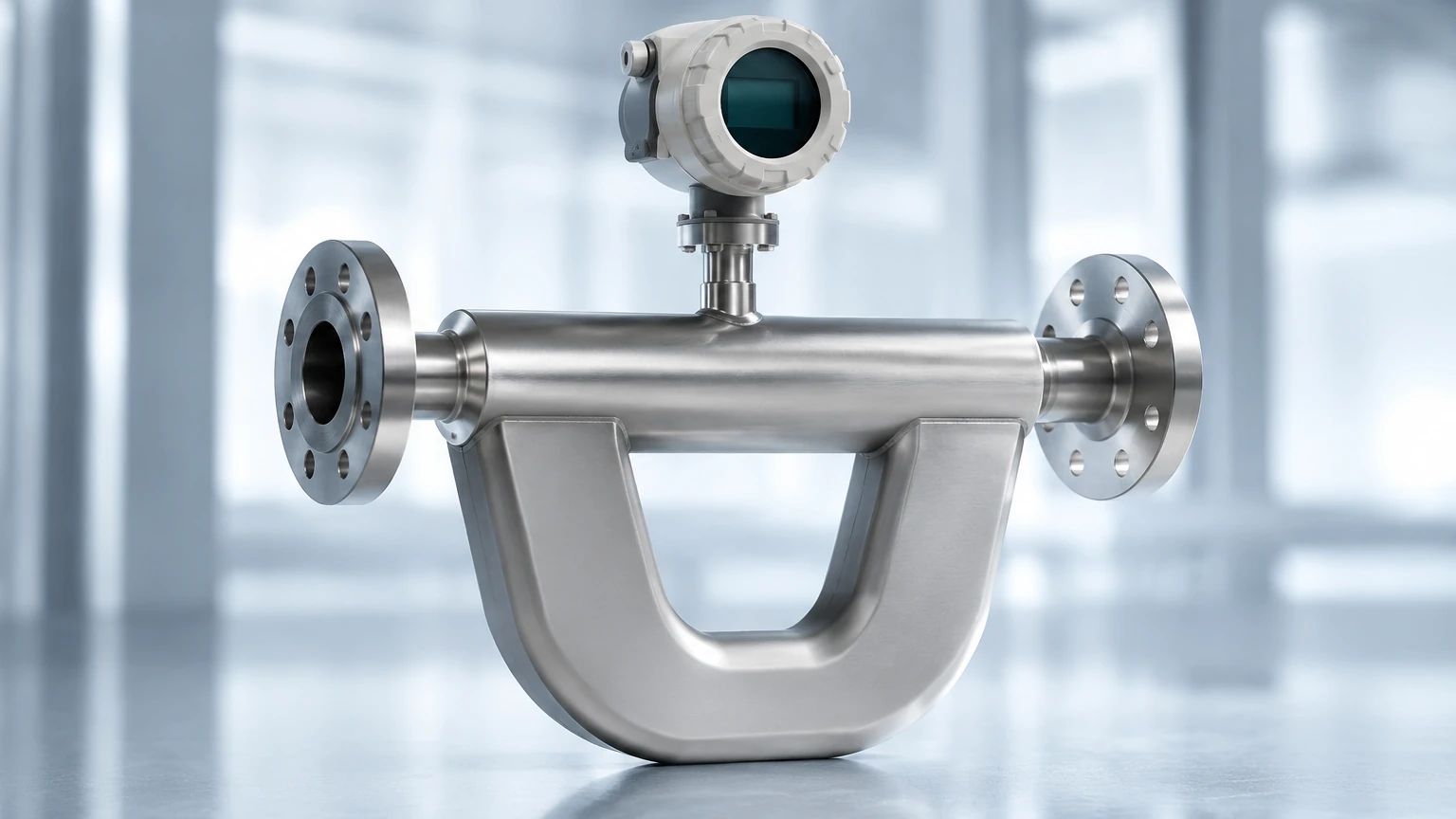
A standard Coriolis flowmeter system consists of two primary components: the sensor (the wetted part) and the transmitter (the electronics).
Tube Geometry
The geometry of the flow tubes significantly impacts the performance and application suitability of the meter:
* U-Shaped Tubes: These are the most common and offer the highest sensitivity and widest turndown ratios. They are ideal for low-flow applications and high-precision requirements.
* Straight-Tubes: These designs are easier to clean and have a lower pressure drop. They are preferred for sanitary applications in the food and beverage or pharmaceutical industries, as well as for fluids containing solids that might clog curved tubes.
* Dual-Tube vs. Single-Tube: Dual-tube designs are generally more sensitive and less affected by external pipeline vibrations, while single-tube designs are often used in smaller sizes or applications where mechanical simplicity is prioritized.
Materials of Construction
Selection of wetted materials is critical for longevity, especially in corrosive chemical environments. Common options include:
* 316L Stainless Steel: The standard for most industrial liquids and gases.
* Hastelloy C-22: Used for highly corrosive chemicals like hydrochloric acid.
* Titanium: Chosen for its high strength-to-weight ratio and resistance to specific chemical attacks.
Practical Selection Table
When evaluating Coriolis flowmeters for a specific project, use the following table to align process requirements with meter capabilities.
| Feature | Specification / Requirement | Engineering Consideration |
| :— | :— | :— |
| Accuracy (Liquid) | ±0.1% to ±0.2% of rate | Critical for custody transfer and high-value blending. |
| Accuracy (Gas) | ±0.5% of rate | Higher uncertainty due to the low density of gases. |
| Repeatability | ±0.05% | Essential for consistent batching processes. |
| Temperature Range | -200°C to +350°C | Check for cryogenic or high-heat process compatibility. |
| Pressure Rating | Up to 400 bar (40 MPa) | Ensure the sensor body meets piping safety codes. |
| Turndown Ratio | 20:1 to 100:1 | The range over which accuracy is maintained. |
| Outputs | 4-20mA, Modbus, HART, Profibus | Integration with existing PLC/SCADA systems. |
Industrial Applications
Coriolis flowmeters are favored in industries where mass balance is more critical than volume measurement.
* Oil and Gas: Used for custody transfer, where high precision is required for financial transactions. They are also used in well-head monitoring and blending operations.
* Chemical Processing: Ideal for measuring aggressive chemicals, catalysts, and additives where density measurement helps verify concentration levels.
* Food and Beverage: Employed in the production of syrups, dairy products, and alcoholic beverages, where sanitary straight-tube designs ensure hygiene and precise ingredient dosing.
* Water Treatment: While often more expensive than magnetic meters, Coriolis units are used for chemical dosing (e.g., polymer or coagulant injection) to ensure exact mass ratios regardless of chemical concentration changes.
For comprehensive process control solutions, including level measurement and flow monitoring, engineers often visit the Main Page of specialized manufacturers to coordinate instrument specifications.
Installation Considerations
While Coriolis meters are robust, their performance is highly dependent on proper installation. Unlike many flow technologies, they do not require long straight runs of pipe upstream or downstream, but other factors must be managed.
1. Orientation
Orientation depends on the fluid type:
* Liquids: The meter should ideally be installed in a vertical pipe with upward flow. This ensures the tubes remain full and prevents air bubbles from being trapped. If installed horizontally, U-tubes should point downward to prevent gas accumulation.
* Gases: For gas flow, the meter should be installed in a way that prevents liquid condensate from collecting in the tubes. In horizontal pipes, U-tubes should point upward.
2. Vibration Isolation
Because the meter operates on vibration, external mechanical noise from pumps or heavy machinery can interfere with the sensor's signal. Meters should be securely supported on both the inlet and outlet sides using rigid pipe hangers or supports. Flexible couplings are generally discouraged as they can introduce unpredictable resonance.
3. Zero Calibration
After installation and once the meter is filled with the process fluid at operating temperature and pressure, a "zero calibration" must be performed. This involves stopping the flow completely (using valves) and allowing the transmitter to record the sensor signal at a true zero-flow state. This step is vital for achieving the stated accuracy of the device.
Limitations and Challenges
Despite their versatility, Coriolis flowmeters are not a universal solution for every application.
* Initial Cost: The capital expenditure for a Coriolis meter is significantly higher than for vortex, turbine, or electromagnetic meters. The ROI must be justified by the need for high accuracy or multi-variable data.
* Pressure Drop: Curved tube designs can introduce a significant pressure drop in the system, which may require larger pumps or affect process flow rates.
* Gas Entrainment: The presence of gas bubbles in a liquid (slug flow) can dampen the tube vibration, leading to measurement errors or "fault" conditions. Advanced digital signal processing has mitigated this, but it remains a concern for highly aerated fluids.
* Size and Weight: Large-diameter Coriolis meters (above 200 mm or 8 inches) are extremely heavy and bulky, making them difficult to install in existing piping networks.
Frequently Asked Questions (FAQs)
Q: Can Coriolis flowmeters measure the flow of non-conductive liquids?
A: Yes. Unlike electromagnetic flowmeters, Coriolis meters do not rely on electrical conductivity. They work perfectly with hydrocarbons, deionized water, and other non-conductive fluids.
Q: How often should a Coriolis meter be recalibrated?
A: In most stable applications, Coriolis meters have excellent long-term stability. However, for custody transfer or regulated industries, annual calibration or verification using a master meter or weigh scale is common practice. Many modern units also offer "on-board" verification diagnostics.
Q: Are they suitable for high-viscosity fluids?
A: Yes, Coriolis meters are excellent for high-viscosity fluids like molasses, resins, or crude oil. Because they measure mass directly, the increased drag of viscous fluids does not affect the measurement principle, though it will increase the pressure drop.
Q: Can one meter be used for different fluids?
A: Yes, provided the materials of construction are compatible with all fluids. The meter does not need to be recalibrated for different densities or viscosities, making it ideal for multi-product pipelines.
Conclusion
Coriolis flowmeters provide an unparalleled level of data for modern process automation. By delivering direct mass flow, density, and temperature in a single device, they simplify instrumentation architectures and improve process efficiency. While the initial investment is higher than traditional technologies, the reduction in measurement uncertainty and the elimination of secondary sensors often result in a lower total cost of ownership over the life of the project.
When selecting instrumentation for complex industrial environments, it is recommended to consult with technical experts to ensure the chosen meter meets the specific chemical, mechanical, and data requirements of the application. For further information on integrating flow and level measurement systems, professionals can Review product options and application support to find the most cost-effective and reliable solutions for their facilities.