Flow Meter for Co2
Flow Meter for Co2
Carbon dioxide (CO2) is a versatile gas used across a spectrum of industrial applications, ranging from beverage carbonation and food preservation to enhanced oil recovery and carbon capture, utilization, and storage (CCUS). However, measuring CO2 flow presents unique challenges compared to inert gases like nitrogen or compressed air. The physical properties of CO2—specifically its high compressibility, low sonic velocity, and the potential to exist in gas, liquid, or supercritical states—require careful selection of measurement technology.
For engineers and plant managers, selecting the correct flow meter for CO2 is essential for process efficiency, cost control, and safety. This guide explores the measurement principles, selection criteria, and installation requirements for CO2 flow instrumentation in industrial environments.
Understanding the Physics of CO2 Flow Measurement
Before selecting a flow meter for CO2, it is critical to understand how the fluid behaves under different process conditions. Unlike many other industrial gases, CO2 has a relatively low critical point: 31.1°C (87.9°F) and 73.8 bar (1070 psi). If a process operates near these parameters, the CO2 may transition between phases, which can lead to significant measurement errors or instrument damage.
Gas Phase Measurement
In most industrial venting or aeration applications, CO2 is measured in its gaseous state at low to medium pressures. Here, the focus is often on mass flow or standardized volume flow (Nm³/h or SCFM) because the density of CO2 changes significantly with temperature and pressure variations.
Liquid and Supercritical Phase Measurement
In refrigeration or high-pressure injection systems, CO2 is often handled as a liquid. In CCUS applications, CO2 is frequently transported in a supercritical state—a dense phase that exhibits the properties of both a gas and a liquid. Measuring flow in these states requires high-pressure ratings and instruments capable of handling high fluid density.
Primary Measurement Technologies for Carbon Dioxide
Several technologies are commonly employed to measure CO2 flow. Each operates on a different physical principle, making them suitable for specific process conditions.
1. Thermal Mass Flow Meters
Thermal mass flow meters operate on the principle of heat transfer. A heated sensor is placed in the flow stream, and the gas molecules carry heat away as they pass. The amount of cooling is directly proportional to the mass flow rate of the gas.
* Advantages: They provide direct mass flow measurement without needing external temperature or pressure compensation. They are highly sensitive to low flow rates and have no moving parts.
* Limitations: They are primarily used for dry CO2 gas. Moisture or droplets in the gas stream can cause significant measurement spikes.
2. Vortex Shedding Flow Meters
Vortex meters utilize the Karman Vortex Street principle. As CO2 flows past a bluff body (a non-streamlined object) in the meter, vortices are shed alternately from each side. The frequency of these vortices is proportional to the fluid velocity.
* Advantages: Vortex meters are robust and can handle high-temperature and high-pressure CO2. They are excellent for gaseous CO2 and steam applications.
* Limitations: They require a minimum Reynolds number to function, meaning they may not be accurate at very low flow velocities.
3. Coriolis Flow Meters
Coriolis meters measure mass flow by detecting the inertia created by fluid flowing through vibrating tubes. This is often considered the "gold standard" for CO2 measurement.
* Advantages: They provide extremely high accuracy (often ±0.1%) and measure mass flow, density, and temperature simultaneously. They are the preferred choice for liquid and supercritical CO2.
* Limitations: High initial cost and significant pressure drop across the meter in some high-velocity gas applications.
4. Differential Pressure (DP) Meters
DP meters, such as orifice plates or Venturi tubes, measure the pressure drop across a restriction in the pipe. The square root of the pressure drop is proportional to the flow rate.
* Advantages: Well-understood technology with a low initial purchase price.
* Limitations: Limited turndown ratio (usually 3:1 or 4:1) and requires separate temperature and pressure sensors to calculate mass flow.
Selection Criteria: Matching Technology to CO2 State
When evaluating a flow meter for CO2, engineers must define the specific parameters of the application. The following table provides a general comparison of common technologies used in CO2 service.
| Technology | Typical State | Accuracy (Typical) | Turndown Ratio | Maintenance |
| :— | :— | :— | :— | :— |
| Thermal Mass | Gas | ±1.0% of Reading | 100:1 | Low |
| Vortex | Gas / Liquid | ±1.0% of Rate | 20:1 | Low |
| Coriolis | Liquid / Supercritical | ±0.1% to 0.5% | 50:1 | Low |
| Differential Pressure | Gas / Liquid | ±1.0% to 2.0% | 4:1 | Medium |
| Ultrasonic (Transit Time)| Gas / Liquid | ±1.0% to 2.0% | 30:1 | Low |
Key Evaluation Factors
1. Operating Pressure: CO2 density changes rapidly with pressure. Ensure the meter body is rated for the maximum possible system pressure, especially in high-pressure gas or liquid lines.
2. Temperature Range: Thermal mass meters are sensitive to rapid temperature shifts. In cryogenic CO2 applications, Coriolis meters must be specified with appropriate insulation and materials.
3. Allowable Pressure Drop: In low-pressure CO2 distribution, a high pressure drop across a meter (like an orifice plate) can lead to insufficient pressure at the point of use.
4. Accuracy Requirements: For custody transfer (buying or selling CO2), Coriolis meters are almost always required. For process monitoring, vortex or thermal mass meters are usually sufficient.
For those managing complex industrial sites, integrating flow data with level measurement is often necessary for inventory reconciliation. You can Review product options and application support on our Main Page to see how different industrial instruments can be harmonized in a single process control strategy.
Installation Best Practices for CO2 Flow Systems
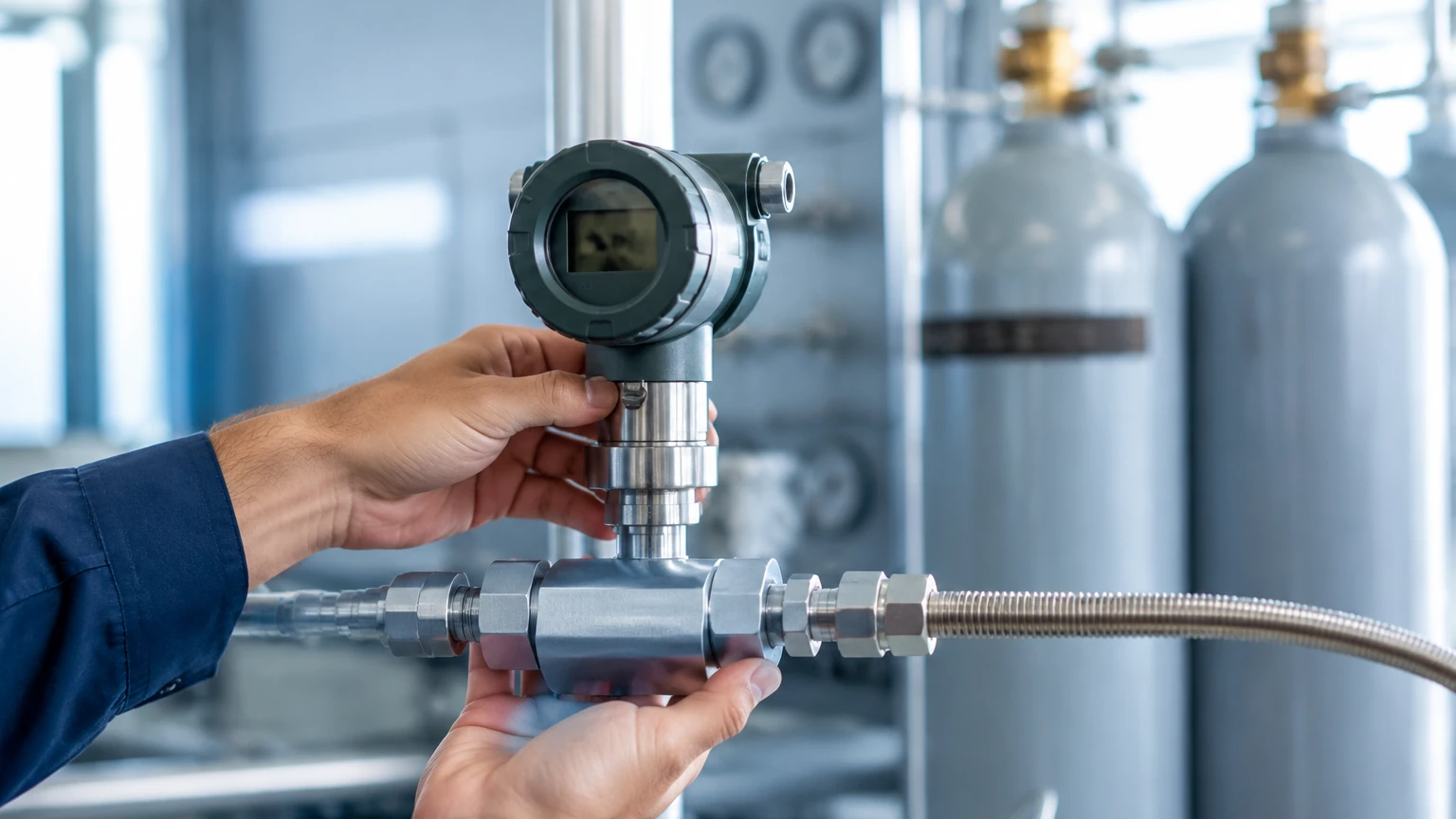
Even the most accurate flow meter for CO2 will fail to perform if installed incorrectly. CO2 systems require specific attention to piping geometry and phase stability.
Straight Pipe Requirements
Most flow technologies (especially Vortex and DP) require a specific length of straight pipe upstream and downstream of the meter to ensure a fully developed, non-turbulent flow profile. A common rule of thumb is 10 diameters (10D) upstream and 5 diameters (5D) downstream, though this varies by manufacturer and the presence of elbows or valves.
Avoiding Phase Change (Flashing)
When measuring liquid CO2, the pressure must remain high enough to prevent the liquid from "flashing" into gas inside the meter. Flashing causes massive measurement errors and can lead to cavitation damage. It is generally recommended to maintain a backpressure of at least two times the vapor pressure of the CO2 at the operating temperature.
Orientation and Drainage
For CO2 gas lines, meters should be installed in a way that prevents moisture from pooling on the sensors. In horizontal pipes, thermal mass sensors should be installed at the 10 o'clock or 2 o'clock position. For liquid CO2, the meter should be installed at a low point in the piping to ensure it remains full of liquid.
Technical Limitations and Operational Risks
While modern instrumentation is highly reliable, CO2 presents specific risks that must be mitigated during the design phase.
The Risk of Dry Ice Formation
If CO2 pressure is allowed to drop rapidly (Joule-Thomson effect), the temperature can plummet, leading to the formation of solid CO2 (dry ice). This can clog flow meters, damage internal components, and create dangerous pressure build-ups. Proper pressure regulation and heat tracing are often required in CO2 expansion stages.
Material Compatibility
While CO2 itself is not highly corrosive to most metals, it can become acidic (carbonic acid) if moisture is present. For "wet" CO2 applications, 316 Stainless Steel is the standard material of construction. Furthermore, CO2 can cause explosive decompression in certain elastomeric seals (like standard O-rings). Specialized seals (AED – Anti-Explosive Decompression) should be specified for high-pressure CO2 service.
Impurities and Calibration
Industrial CO2 is rarely 100% pure. It may contain traces of nitrogen, methane, or moisture. Thermal mass flow meters are particularly sensitive to gas composition; if the CO2 purity changes, the meter must be recalibrated or the gas composition factor adjusted in the transmitter settings.
Frequently Asked Questions (FAQs)
Q: Can I use a standard air flow meter for CO2?
A: Not without recalibration. CO2 is much denser than air and has different thermal properties. A meter calibrated for air will typically read significantly lower than the actual flow when used on CO2.
Q: Why is Coriolis preferred for supercritical CO2?
A: In the supercritical phase, CO2 density changes drastically with even tiny fluctuations in pressure or temperature. Since Coriolis meters measure mass directly, they are unaffected by these density swings, whereas volumetric meters would require complex, real-time compensation.
Q: Is a straight run always necessary?
A: Not for Coriolis meters, which are generally immune to flow profile disturbances. However, for Vortex, DP, and Ultrasonic meters, a straight run is essential for accuracy.
Q: How do I handle CO2 flow in a 1-inch pipe vs. a 12-inch pipe?
A: For small pipes (under 2 inches), inline meters (where the meter body is part of the pipe) are standard. For large pipes (above 6 inches), insertion-style thermal mass or vortex meters may be used to reduce costs, though they are generally less accurate than inline versions.
Conclusion
Selecting a flow meter for CO2 requires a deep understanding of the process conditions—specifically whether the fluid is in a gas, liquid, or supercritical state. While Coriolis meters offer the highest precision for high-value or high-pressure applications, thermal mass and vortex meters provide cost-effective and reliable solutions for gas distribution and process monitoring.
By following strict installation guidelines and accounting for the unique thermodynamic properties of carbon dioxide, engineers can ensure long-term accuracy and safety in their measurement systems. For additional technical resources on industrial measurement and to explore a wide range of sensing technologies, visit the Main Page for comprehensive product specifications and engineering support.