Rosemount Thermowell
Rosemount Thermowell
In industrial process control, temperature is a critical variable that influences product quality, safety, and efficiency. However, temperature sensors—such as Resistance Temperature Detectors (RTDs) and thermocouples—are often delicate and susceptible to damage from high pressures, corrosive chemicals, and high-velocity fluid flows. The Rosemount thermowell serves as a robust pressure-tight receptacle that protects these sensors while allowing for accurate thermal transfer. This guide explores the engineering principles, selection criteria, and installation best practices for these essential components within industrial instrumentation.
Measurement Principles and Functionality
A thermowell functions as a heat exchanger and a protective barrier. The primary measurement principle relies on thermal conduction. The process fluid transfers heat to the outer wall of the thermowell, which then conducts that heat to the internal sensing element.
Thermal Lag and Accuracy
Because the sensor is isolated from the process by a metal wall, there is an inherent "thermal lag" or delay in response time. The magnitude of this lag depends on the thermowell's material, wall thickness, and the presence of any air gaps between the sensor and the inner well wall. To minimize this, engineers often use heat-conductive paste or ensure a tight fit between the sensor probe and the thermowell bore.
Structural Integrity
Beyond heat transfer, a Rosemount thermowell must maintain the pressure boundary of the vessel or pipe. It is designed to withstand the static pressure of the process and the dynamic forces exerted by fluid flow. Failure to select the correct thermowell can lead to mechanical fatigue, sensor destruction, or catastrophic process leaks.
Key Evaluation Criteria for Rosemount Thermowells
Selecting the appropriate thermowell requires a balance between rapid thermal response and mechanical durability. Engineers must evaluate several design parameters to ensure the component survives the process environment.
1. Stem Profile and Geometry
The shape of the thermowell stem significantly impacts its performance in flowing media.
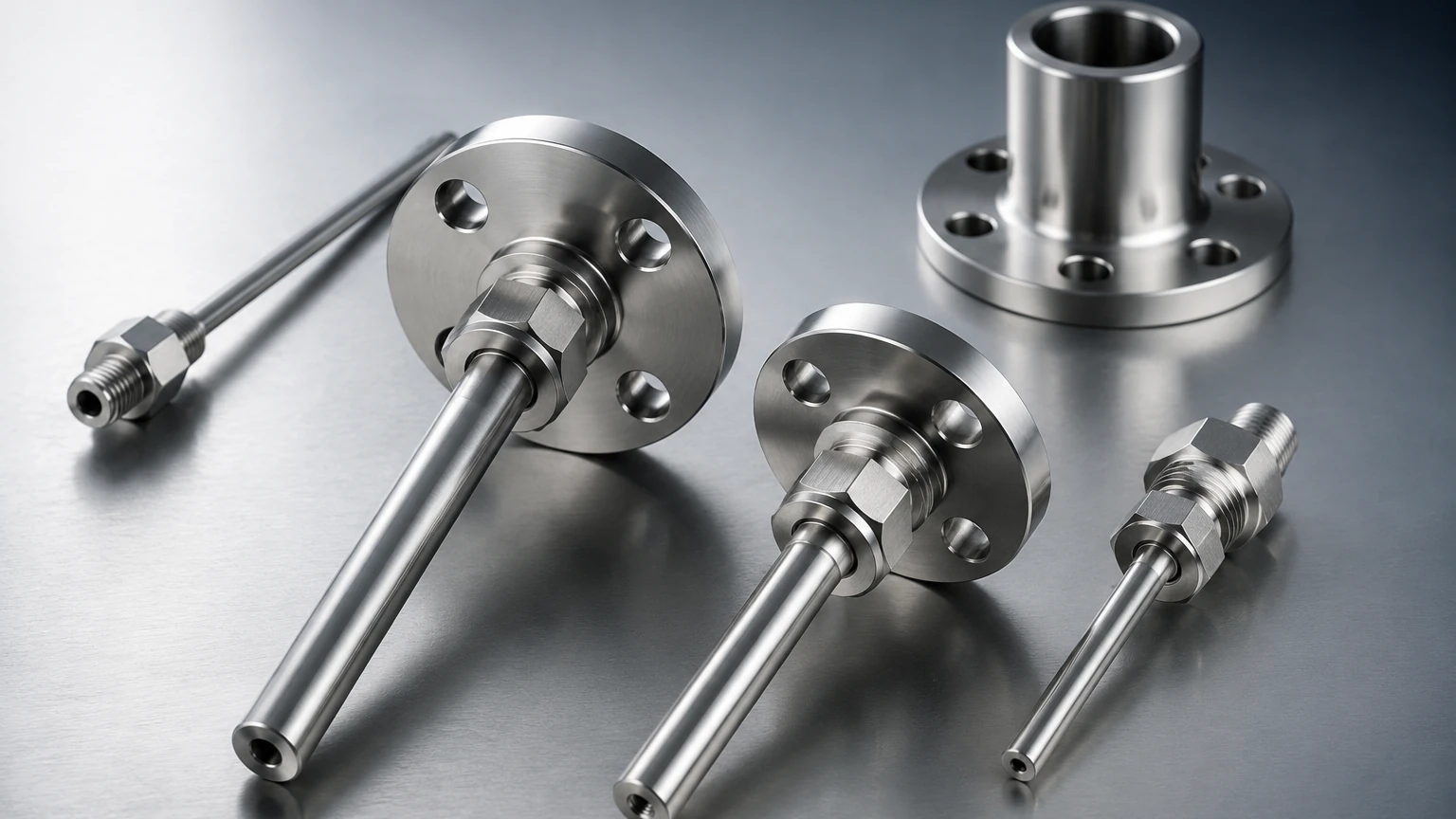
* Straight Stems: These have a uniform diameter throughout the immersion length. They are easy to manufacture and provide consistent strength but may have a slower response time due to the larger mass of material at the tip.
* Stepped Stems: These feature a reduced diameter at the tip (typically 12.7 mm or 0.5 inches). This design reduces the thermal mass, allowing for a faster response to temperature changes while maintaining a thick, strong base at the process connection.
* Tapered Stems: Tapered designs offer the best compromise between strength and response time. The diameter decreases gradually toward the tip, which provides a high natural frequency to resist flow-induced vibrations while maintaining a small tip for thermal sensitivity.
2. Material Selection
Material compatibility is the most critical factor for longevity. The thermowell must resist corrosion from the process medium and erosion from suspended solids.
| Material | Common Applications | Temperature Range (Approx.) |
| :— | :— | :— |
| 316/316L Stainless Steel | Water treatment, general chemicals, food and beverage. | Up to 850°C (1562°F) |
| Hastelloy® C-276 | Highly corrosive acids, chlorine, and sour gas. | Up to 1000°C (1832°F) |
| Monel® 400 | Sea water, hydrofluoric acid, and salt solutions. | Up to 538°C (1000°F) |
| Inconel® 600 | High-temperature furnace environments and steam. | Up to 1150°C (2102°F) |
| Tantalum (Sleeve) | Extremely aggressive acids (e.g., concentrated HCl). | Up to 150°C (302°F) |
3. Process Connections
The method by which the thermowell attaches to the piping or vessel determines its pressure rating and ease of maintenance.
* Threaded: Common for low-pressure applications and smaller pipe sizes. Usually NPT or BSPT threads.
* Flanged: The industry standard for high-pressure and critical applications. Flanges (ANSI/ASME or DIN) provide a secure, leak-proof seal and are easier to remove for inspection.
* Welded (Socket or Full Penetration): Used when a permanent, leak-proof connection is required, often in high-pressure steam or hazardous chemical lines where gaskets are a liability.
Wake Frequency and Structural Limits
One of the most common causes of thermowell failure is flow-induced vibration, known as vortex shedding. As fluid flows past the thermowell, vortices form on alternating sides. If the frequency of this vortex shedding matches the natural frequency of the thermowell, resonance occurs, leading to rapid fatigue and breakage.
ASME PTC 19.3 TW Standards
Rosemount thermowells are typically evaluated using the ASME PTC 19.3 TW standard. This calculation considers:
1. Static Stress: The ability to withstand process pressure.
2. Steady-State Stress: The bending force exerted by the fluid flow.
3. Dynamic Stress: The cyclic stress caused by vortex shedding.
If a calculation indicates a risk of failure, engineers may need to shorten the immersion length, increase the root diameter, or change the stem profile to a tapered design. For comprehensive instrumentation support and to view compatible sensors, engineers often refer to the Main Page of specialized measurement providers.
Installation and Maintenance Guidelines
Correct installation is as vital as correct selection. Improperly placed thermowells can result in measurement errors of several degrees.
Immersion Depth
To avoid "stem conduction error" (where heat is lost or gained through the wall of the pipe), the thermowell must be immersed deeply enough into the process.
* Liquids: A minimum immersion of 8 to 10 times the thermowell tip diameter is recommended.
* Gases/Steam: A minimum immersion of 15 to 20 times the tip diameter is often required due to lower heat transfer coefficients.
* Pipe Placement: In small pipes, the thermowell should be installed in an elbow or at an angle to ensure the tip is in the center of the flow stream where the temperature is most representative.
Lagging Extensions
In insulated piping systems, a "lagging extension" is used. This is an extra length of the thermowell hex or neck that extends through the insulation. This prevents the sensor head (transmitter) from overheating and allows for easier access without stripping the insulation.
Maintenance Checklist
1. Visual Inspection: Check for pitting, erosion, or scaling on the outer surface.
2. Bore Cleanliness: Ensure the internal bore is free of moisture or debris, which can cause sensor corrosion or thermal insulation.
3. Wake Frequency Re-calculation: If process conditions change (e.g., increased flow rate or change in fluid density), the thermowell's structural suitability must be re-verified.
Integration with Level Measurement Systems
While thermowells are temperature-specific, they play a supporting role in accurate level measurement. In many industrial tanks, the density of a liquid changes with temperature. For hydrostatic level transmitters or magnetic level gauges, accurate temperature data is required to calculate the true level or volume.
Integrating a Rosemount thermowell alongside level instruments ensures that the control system can compensate for these density fluctuations. For example, in a boiler drum, precise temperature measurement via a thermowell allows the level system to account for the varying density of water and steam, preventing false readings that could lead to dry-firing or carryover.
Frequently Asked Questions (FAQs)
Q: Can I use a thermowell with a smaller bore for any sensor?
No. The bore size (typically 6.5 mm or 0.260 inches for standard Rosemount models) must match the sensor probe diameter. A gap that is too large will result in significant measurement lag, while a bore that is too small will prevent the sensor from being inserted or removed.
Q: What is the difference between a wake frequency report and a material cert?
A material certificate (e.g., 3.1 cert) proves the chemical composition of the metal used. A wake frequency report is a mathematical validation that the thermowell's dimensions are safe for the specific flow velocity, pressure, and temperature of your process.
Q: When should I use a Velocity Collar?
Velocity collars were historically used to support thermowells in high-flow applications. However, modern ASME PTC 19.3 TW standards discourage their use because they require an extremely tight fit with the nozzle, which is difficult to achieve in practice. It is generally better to optimize the thermowell geometry (shorter or thicker) than to rely on a collar.
Conclusion
The Rosemount thermowell is a critical component for ensuring the longevity and accuracy of temperature measurement in demanding industrial environments. By understanding the principles of thermal conduction and the mechanical risks of vortex shedding, engineers can select the right material and geometry to protect their instrumentation. Proper installation, adhering to immersion depth guidelines, and performing regular inspections will ensure the thermowell provides a reliable pressure barrier and accurate data for years of service. For those managing complex industrial sites, ensuring all measurement points—from temperature to level—are properly engineered is the key to operational excellence. Reviewing product options and application support on the Main Page can help in selecting the right mix of technologies for specific industrial challenges.