Flow Meter Straightening Technology
Flow Meter Straightening Technology
In industrial process control, the accuracy of flow measurement is often the determining factor in operational efficiency, safety, and fiscal accountability. However, achieving high-precision measurement is rarely as simple as installing a meter into a pipe. The primary challenge lies in the fluid's velocity profile. Most flow measurement technologies, including ultrasonic, turbine, and differential pressure meters, require a "fully developed" flow profile to function within their specified accuracy limits.
Flow meter straightening technology refers to the mechanical components and engineering principles used to eliminate flow disturbances—such as swirl, turbulence, and asymmetry—before the fluid reaches the sensing element. By utilizing flow conditioners and straighteners, engineers can significantly reduce the required straight-run piping, saving space and reducing installation costs while maintaining high measurement integrity.
The Principles of Fluid Dynamics in Piping Systems
Before selecting or implementing flow meter straightening technology, it is essential to understand why flow profiles become distorted. In an ideal scenario, fluid moves through a long, straight pipe until it reaches a steady state where the velocity is highest at the center and lowest at the pipe walls due to friction. This is known as a fully developed flow profile.
Swirl and Profile Distortion
In real-world industrial environments, piping layouts are rarely straight. Elbows, T-junctions, valves, pumps, and reducers introduce two main types of disturbances:
1. Swirl: A rotational component of velocity where the fluid moves in a corkscrew fashion. This is common after two out-of-plane elbows.
2. Velocity Profile Distortion: An asymmetrical distribution of velocity across the pipe cross-section. For example, after a single elbow, the fluid velocity is higher on the outer radius of the bend.
Reynolds Number and Flow Regime
The behavior of the fluid is also governed by the Reynolds number (Re), a dimensionless value representing the ratio of inertial forces to viscous forces.
- Laminar Flow (Re < 2000): Fluid moves in smooth layers.
- Transitional Flow (2000 < Re < 4000): A mix of laminar and turbulent characteristics.
- Turbulent Flow (Re > 4000): Most industrial applications fall here, characterized by chaotic eddies and rapid mixing.
Flow meter straightening technology is primarily designed to manage turbulent flow disturbances, ensuring that the meter sees a predictable and repeatable profile regardless of the upstream piping configuration.
Types of Flow Meter Straightening Technology
There are two primary categories of devices used to correct flow: flow straighteners and flow conditioners. While the terms are often used interchangeably, they serve distinct technical functions.
1. Vane-Type Straighteners
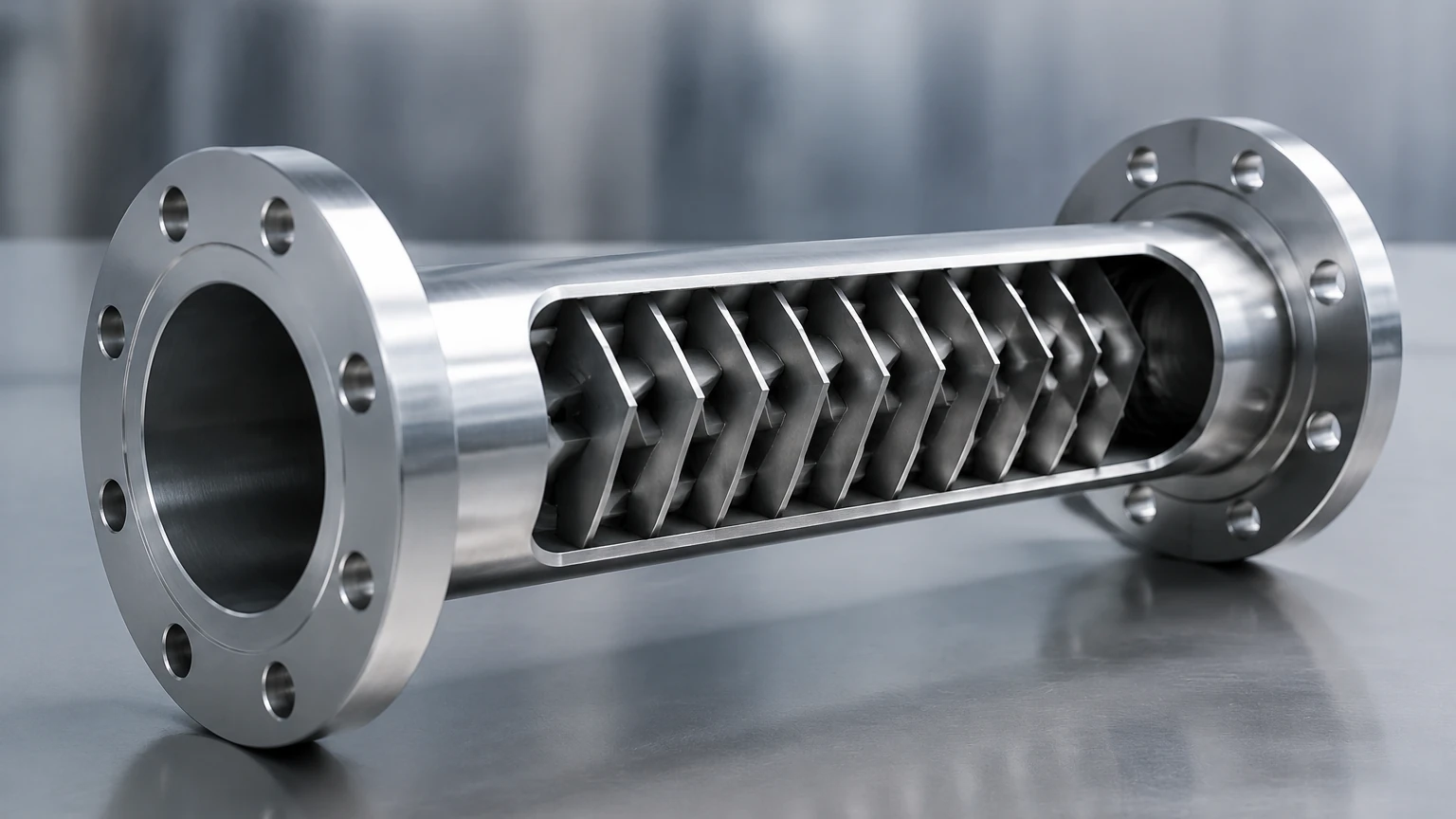
These consist of several thin plates (vanes) arranged parallel to the flow direction inside the pipe. They are highly effective at breaking up large-scale swirl but do little to correct an asymmetrical velocity profile. They are often used in large-diameter gas pipelines where swirl is the primary concern.
2. Tube Bundles (19-Tube Design)
As specified in standards like ISO 5167 and AGA 3, the 19-tube bundle is a classic example of flow meter straightening technology. It consists of 19 small-diameter tubes nested together and welded into a cluster. The fluid is forced through these small channels, which effectively kills rotational swirl. However, like vane-type straighteners, tube bundles have limited ability to correct severe velocity profile asymmetry.
3. Perforated Plate Flow Conditioners
Modern flow conditioners use a single plate with a specific pattern of holes of varying diameters. These are designed to both eliminate swirl and redistribute the velocity profile into a fully developed state. Common designs include:
- Zanker Plate: Features a combination of a perforated plate and a honeycomb-like structure. It is excellent for profile correction but carries a higher pressure drop.
- Laws Plate: Uses a specific arrangement of circular holes to produce a high-quality profile in very short distances.
- Gallagher Conditioner: Often used in natural gas custody transfer, this design uses a multi-hole pattern to ensure the highest possible measurement repeatability.
Technical Comparison Table
| Technology Type | Swirl Reduction | Profile Correction | Pressure Drop | Typical Application |
| :— | :— | :— | :— | :— |
| Vane Straightener | High | Low | Very Low | Large gas mains |
| 19-Tube Bundle | High | Moderate | Low | Orifice meters, Gas flow |
| Zanker Plate | High | Very High | Moderate/High | High-precision liquid/gas |
| Perforated Plate | High | High | Moderate | Ultrasonic & Turbine meters |
| Honeycomb | Moderate | Low | Very Low | Wind tunnels, Low-velocity air |
Integration with Level Measurement Systems
While flow meter straightening technology focuses on the movement of fluids through pipes, it is often part of a broader process control strategy that includes level measurement. In many industrial applications, such as chemical processing or water treatment, flow data is cross-referenced with vessel levels to ensure mass balance and leak detection.
For example, accurate flow measurement into a tank, combined with reliable data from a radar level meter or ultrasonic level sensor, allows operators to verify that the volume entering the system matches the change in level. As a professional manufacturer, Welk provides the necessary instrumentation to manage these complex environments. For more information on integrating these sensors into your process, visit the Main Page.
Installation Considerations and Best Practices
To maximize the effectiveness of flow meter straightening technology, precise installation is required. Failure to follow manufacturer guidelines can result in "dead zones" or secondary turbulence that may actually worsen meter performance.
Upstream and Downstream Distances
The goal of a flow conditioner is to reduce the "straight run" requirement. Without a conditioner, a meter might require 20 to 50 pipe diameters (D) of straight pipe upstream. With advanced flow meter straightening technology, this can often be reduced to 5D to 10D.
- Placement: Most conditioners are installed between 2D and 8D upstream of the flow meter.
- Orientation: Some perforated plates are sensitive to orientation relative to the upstream disturbance (e.g., the plane of an elbow).
Pressure Drop (Head Loss)
Every mechanical device placed in a flow stream causes a loss in pressure. Engineers must calculate the permanent pressure loss (PPL) to ensure the system's pumps or gravity-fed lines can handle the additional resistance. Perforated plates generally have a higher PPL than tube bundles.
Material Selection
Since flow conditioners are exposed to the full force and chemistry of the process fluid, material compatibility is critical.
- 316L Stainless Steel: Standard for most water and chemical applications.
- Exotic Alloys (Hastelloy, Monel): Required for highly corrosive media.
- Surface Finish: In hygienic applications (food/pharma), the conditioner must meet specific Ra (roughness average) requirements to prevent bacterial growth.
Limitations of Straightening Technology
While highly effective, flow meter straightening technology is not a universal solution for all piping problems:
- Slurry and Dirty Fluids: Perforated plates and tube bundles can become clogged by solids or fibrous materials. In these cases, it is better to use a flow meter that is inherently less sensitive to profile distortions, such as an electromagnetic flow meter, or to increase the straight pipe run.
- Cavitation Risk: In liquid systems, the pressure drop across a conditioner can cause the local pressure to drop below the vapor pressure, leading to cavitation. This can damage both the conditioner and the downstream flow meter.
- Cost vs. Benefit: For low-criticality applications where ±5% accuracy is acceptable, the cost of a high-end flow conditioner may not be justified compared to simply adding more pipe.
Frequently Asked Questions (FAQ)
Q: Can I use a flow conditioner to fix a meter that is already installed and giving bad readings?
A: Yes, adding a flow conditioner is a common retrofit to solve accuracy issues caused by poor piping layouts. However, you must ensure there is enough space to meet the conditioner's own upstream/downstream requirements.
Q: Does every flow meter need a straightener?
A: No. Some meters, like Coriolis mass flow meters, are largely immune to velocity profile distortions. Always check the manufacturer's technical specifications.
Q: How do I maintain a flow conditioner?
A: Maintenance involves periodic inspection for erosion, corrosion, or debris buildup. In steam or high-velocity gas lines, checking the structural integrity of the welds or mounting pins is vital to prevent the device from breaking loose and damaging downstream equipment.
Conclusion
Flow meter straightening technology is an indispensable tool in the modern engineer's toolkit. By understanding the fluid dynamics at play—specifically swirl and profile asymmetry—and selecting the appropriate conditioning device, industrial facilities can achieve laboratory-grade measurement accuracy in compact, real-world piping configurations. Whether managing water treatment, chemical processing, or oil and gas transport, the synergy between precise flow conditioning and reliable level measurement ensures optimal process control and resource management.