K Tek Level Gauge Distributors
K Tek Level Gauge Distributors
In the realm of industrial process control, the demand for reliable, high-visibility level indication has led many engineers to seek out specialized instrumentation. Historically, K-Tek (now a part of the ABB measurement portfolio) established a significant market presence with its magnetic level gauge technology. For procurement professionals and plant engineers, identifying K tek level gauge distributors is often the first step in maintaining legacy systems or specifying new installations that require robust, non-invasive level monitoring.
However, the landscape of Magnetic & Local Level Gauges has evolved. While distributors provide a vital link to established brands, understanding the underlying measurement principles and the technical requirements of modern applications is essential for making an informed investment. This guide explores the technical foundations of magnetic level gauges, the criteria for evaluating distributors, and the practical considerations for implementing these instruments in demanding environments.
Principles of Magnetic Level Measurement
Before engaging with K tek level gauge distributors or alternative manufacturers, it is critical to understand how these instruments function. Magnetic level gauges operate on the physical principles of buoyancy and magnetic coupling. Unlike traditional glass sight gauges, which expose the operator to the process fluid, magnetic gauges provide a sealed, leak-proof solution.
The Buoyancy Principle
The core component of the gauge is a float, which is engineered to have a density lower than the process liquid. This float resides inside a non-magnetic bypass chamber (typically stainless steel or plastic) connected to the side of the storage tank. As the liquid level in the tank rises or falls, the float moves accordingly within the chamber.
Magnetic Coupling and Local Indication
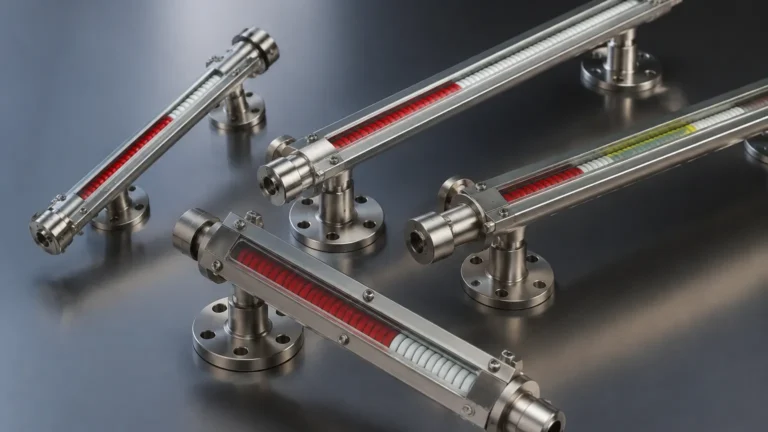
Inside the float is a permanent magnet assembly. Outside the chamber, a local indicator—often consisting of a series of bi-color magnetic flaps or a magnetic follower—is mounted. The magnetic field from the float penetrates the chamber wall and couples with the indicator. As the float moves, the magnetic force flips the flaps (usually from white to red) or moves the follower, providing a clear, high-contrast visual representation of the liquid level.
This "local level gauge" functionality is entirely mechanical, requiring no external power for visual indication. This makes it an ideal safety backup for electronic transmitters in critical applications.
Evaluating K Tek Level Gauge Distributors and Suppliers
When sourcing instrumentation through K tek level gauge distributors, the focus should extend beyond simple availability. A distributor’s value lies in their technical expertise and their ability to bridge the gap between the manufacturer and the end-user's specific site requirements.
Technical Support and Specification Assistance
Industrial level measurement is rarely a "one size fits all" scenario. A reputable distributor should be able to assist with:
* Specific Gravity (SG) Calculations: Ensuring the float is custom-weighted for the exact density of the process fluid.
* Material Compatibility: Advising on the use of 316L stainless steel, Hastelloy, or lined chambers (such as PTFE) for corrosive media.
* Pressure and Temperature Ratings: Verifying that the gauge construction meets the design pressure of the vessel.
Certification and Compliance
In industries such as oil and gas or chemical processing, compliance is non-negotiable. Distributors should provide documentation for ATEX/IECEx (for hazardous areas), ASME B31.3 or B31.1 (for pressure piping), and PED (Pressure Equipment Directive) certifications. If a distributor cannot provide material mill test reports or hydrostatic test certificates, the reliability of the instrument may be at risk.
Technical Selection and Specification Table
When comparing options from various suppliers, engineers should use a standardized set of parameters to evaluate performance. The following table outlines typical specifications for high-quality Magnetic & Local Level Gauges.
| Parameter | Standard Specification | High-Performance Option |
| :— | :— | :— |
| Measuring Range | 300 mm to 6,000 mm | Up to 15,000 mm (Sectional) |
| Operating Pressure | Up to 4.0 MPa (580 PSI) | Up to 32.0 MPa (4,640 PSI) |
| Process Temperature | -40°C to 150°C | -196°C to 450°C |
| Medium Density | > 0.45 g/cm³ | > 0.38 g/cm³ |
| Chamber Material | 304 / 316L Stainless Steel | Titanium, Hastelloy, PTFE Lined |
| Accuracy | ±10 mm | ±5 mm |
| Indication Type | Bi-color Flaps (Aluminium/Plastic) | Magnetic Follower / LED Indicator |
Installation and Maintenance Considerations
Proper installation is paramount to the longevity and accuracy of a magnetic level gauge. Whether you are working with a new unit from a distributor or a custom-manufactured solution from Welk, the following engineering guidelines apply:
Vertical Alignment
The bypass chamber must be installed perfectly vertical. Any significant tilt can cause the float to rub against the chamber walls, leading to friction, inaccurate readings, or the float becoming stuck. Most manufacturers recommend a vertical tolerance of less than 3mm per meter of length.
Magnetic Interference
Because the gauge relies on magnetic coupling, it must be kept away from large ferrous structures or high-voltage cables that generate electromagnetic fields. If the gauge is installed too close to a steel support beam, the magnetic field of the float may be distorted, causing the indicator to fail.
Venting and Draining
Standard installations should include a vent valve at the top and a drain valve at the bottom of the chamber. This allows for the safe isolation and cleaning of the gauge without shutting down the entire process. Regular flushing is especially important in applications where the liquid may contain sediment or where crystallization can occur.

Limitations and Application Boundaries
While magnetic level gauges are highly versatile, they are not suitable for every application. Engineers should be aware of the following limitations:
1. Magnetic Particles: If the process fluid contains ferromagnetic particles (e.g., iron filings), these will adhere to the float’s magnets. Over time, this buildup will increase the float's weight and eventually cause it to sink or jam.
2. Extremely High Viscosity: In very thick liquids, the float’s response time may be significantly delayed. If the viscosity exceeds 500 cP, a larger diameter chamber or a specialized float design may be required.
3. Coating and Scaling: If the process fluid tends to coat surfaces or form scale, the float may become stuck to the chamber wall. In these instances, internal liners or regular maintenance schedules are necessary.
Transitioning to Welk Level Measurement Solutions
While many users search for K tek level gauge distributors out of brand familiarity, Welk offers a robust alternative as a professional manufacturer of industrial level measurement instruments. Welk provides a comprehensive range of Magnetic & Local Level Gauges that are engineered to meet the same rigorous standards required in chemical, water treatment, and oil and gas applications.
By working directly with a manufacturer like Welk, customers benefit from:
* Custom Engineering: Direct access to design engineers who can customize gauges for unique tank geometries or extreme process conditions.
* Cost-Effectiveness: Eliminating the middleman markup often found with large-scale brand distributors.
* Rapid Lead Times: Streamlined production processes that allow for faster delivery of custom-built units compared to standard distribution channels.
* OEM/ODM Services: For equipment integrators requiring white-label or specialized level measurement components.
Welk’s commitment to strict quality control ensures that every magnetic level gauge provides the accuracy and reliability demanded by modern industrial automation.
Frequently Asked Questions (FAQ)
Can I add a remote signal to a local magnetic level gauge?
Yes. One of the primary advantages of this technology is the ability to mount a reed switch or a magnetostrictive transmitter to the exterior of the chamber. This allows the gauge to provide both a local visual indication and a 4-20mA/HART signal for the control room without additional tank penetrations.
How do I choose the right float material?
The float material must be chemically compatible with the process fluid and strong enough to withstand the operating pressure without collapsing. 316L Stainless Steel is the standard, but Titanium is often used for high-pressure, low-density applications due to its high strength-to-weight ratio.
What is the minimum specific gravity required for a magnetic gauge?
Typically, standard floats require a minimum specific gravity of 0.5. However, for liquefied gases or light hydrocarbons, specialized high-buoyancy floats can be designed to operate with densities as low as 0.38 g/cm³.
Do magnetic level gauges require calibration?
No. Since the measurement is based on physical buoyancy and magnetic coupling, there are no electronic components in the local indicator to calibrate. If a remote transmitter is attached, only the transmitter requires periodic calibration, which can often be done without removing it from the gauge.
By understanding these technical nuances, industrial professionals can better navigate their options when contacting K tek level gauge distributors or exploring advanced manufacturing solutions from Welk.