Noise Level Gauge
Noise Level Gauge
In the complex landscape of industrial process control, the term "noise level gauge" often serves a dual purpose. For safety officers and environmental engineers, it refers to instruments designed to measure acoustic sound pressure levels (decibels) within a facility to ensure regulatory compliance and worker safety. However, for instrumentation and process engineers, "noise" represents a significant challenge in level measurement—referring to signal interference, surface turbulence, or mechanical vibration that can compromise the accuracy of liquid level data.
Understanding the intersection of acoustic monitoring and signal integrity is vital for maintaining efficient operations in sectors like oil and gas, chemical processing, and water treatment. This guide explores the principles of noise measurement and, more importantly, how robust Magnetic & Local Level Gauges provide a reliable, "noise-immune" solution for liquid level monitoring in high-interference environments.
Understanding Noise in Industrial Environments
Before selecting an instrument, it is essential to distinguish between the two primary types of noise encountered in industrial settings: acoustic noise and signal noise.
Acoustic Noise
An acoustic noise level gauge, or sound level meter, measures the physical pressure of sound waves. In power plants or refineries, high decibel levels are not just a safety hazard; they can also indicate mechanical distress in pumps or valves. These gauges utilize a calibrated microphone to convert pressure variations into electrical signals, typically displayed in dB(A) to mimic the human ear's sensitivity.
Signal and Process Noise
In the context of level measurement, "noise" refers to any unwanted disturbance that obscures the true measurement of a liquid surface. This includes:
* Electrical Noise (EMI/RFI): Interference from heavy motors, variable frequency drives (VFDs), or radio equipment that disrupts electronic sensors like radar or ultrasonic transmitters.
* Mechanical Noise: High-frequency vibrations from nearby machinery that can cause jitters in sensitive electronic readings.
* Process Noise: Surface turbulence, foam, or splashing within a tank that creates "chatter" in the output signal of non-contact level meters.
For many engineers, the solution to high-noise environments is the implementation of local, mechanical measurement systems that are inherently immune to these disturbances.
Measurement Principles: How Magnetic Gauges Overcome Noise
While an electronic noise level gauge is essential for environmental monitoring, a magnetic level gauge is the preferred choice for reliable liquid level visualization in noisy process conditions. The principle of operation is based on buoyancy and magnetism, which are unaffected by acoustic or electrical interference.
The Magnetic Float Principle
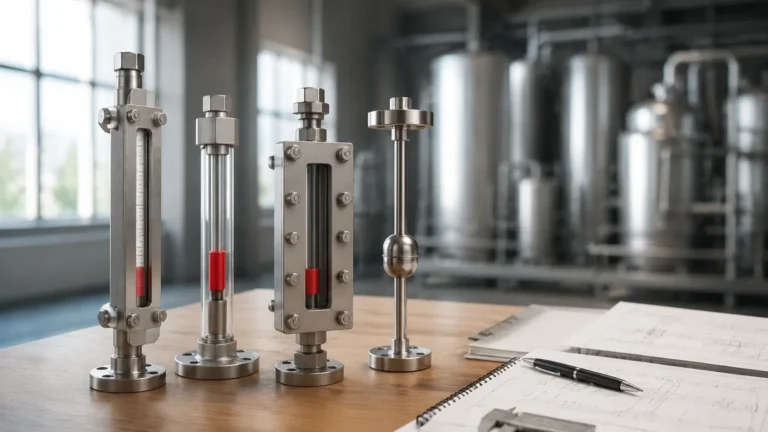
A magnetic level gauge consists of a non-magnetic bypass chamber (usually stainless steel) connected to the process vessel. Inside this chamber, a float containing a high-intensity internal magnet assembly rises and falls with the liquid level. On the outside of the chamber, a visual indicator—typically consisting of bi-color magnetic flaps or a follower—interacts with the float's magnetic field.
Because this interaction is purely magnetic and mechanical:
1. Acoustic Immunity: High decibel levels (acoustic noise) do not affect the movement of the float or the orientation of the indicator flaps.
2. Electrical Immunity: Unlike ultrasonic or radar sensors, magnetic gauges do not rely on electromagnetic waves or transducers, making them immune to EMI/RFI "noise."
3. Physical Damping: The bypass chamber itself acts as a natural stilling well, damping the "noise" of surface turbulence and providing a steady, accurate reading even when the liquid inside the main tank is agitated.
Selection Criteria for Level Gauges in High-Noise Applications
When selecting between a digital noise level gauge (for sound) and a level measurement solution for a noisy process, engineers must evaluate the environmental conditions of the installation site. The following table provides a comparison of how different level measurement technologies handle various forms of "noise."
Technology Comparison Table
| Feature | Magnetic Level Gauge | Ultrasonic Level Sensor | Radar (GWR/Non-Contact) |
| :— | :— | :— | :— |
| Acoustic Noise Resistance | Excellent (Immune) | Poor (Can interfere with pulse) | Excellent |
| Electrical Noise (EMI) Resistance | Excellent (Mechanical) | Moderate (Requires shielding) | Moderate |
| Surface Turbulence Handling | Excellent (Chamber-damped) | Poor (Signal scattering) | Good (Software filtering) |
| Foam Interference | Excellent (Float penetrates foam) | Poor (Absorbs signal) | Variable (Depends on dielectric) |
| Local Visualization | High-visibility mechanical flags | Digital display only | Digital display only |
| Power Requirement | None (Passive) | 24V DC / Loop Powered | 24V DC / Loop Powered |
The Role of Local Level Gauges in Safety and Redundancy
In many B2B applications, such as chemical storage or boiler drum monitoring, a local level gauge serves as a critical backup to electronic systems. If a facility's control network experiences excessive electrical noise or a power failure, electronic sensors may fail or provide erratic data.
A Magnetic & Local Level Gauge provides a continuous, real-time visual reference that requires no external power. This "local" aspect is vital for operators who need to verify tank levels manually during routine inspections or emergency shutdowns, regardless of the ambient noise level or electronic interference in the plant.

Installation Considerations to Minimize Measurement Noise
To ensure that your level measurement remains accurate and "noise-free," proper installation of the gauge is paramount. Even mechanical systems can be affected by extreme mechanical vibration if not installed correctly.
1. Support and Bracing: In environments with high mechanical vibration (mechanical noise), ensure the bypass chamber is supported with robust mounting brackets. For gauges exceeding 3 meters (approx. 10 feet) in length, intermediate supports are mandatory to prevent resonance.
2. Vibration Damping: If the gauge is mounted near high-vibration equipment like large compressors, use vibration-dampening gaskets or mounts to isolate the indicator assembly from the chamber.
3. Isolation Valves: Always install high-quality isolation valves between the process vessel and the level gauge. This allows for maintenance without shutting down the process and helps in bleeding off any air pockets that could cause "noisy" or erratic float movement.
4. Magnetic Interference: Ensure that the gauge is installed away from large localized magnetic fields (such as those generated by high-voltage transformers), as these can interfere with the magnetic coupling between the float and the indicator.
Limitations and Practical Boundaries
While magnetic gauges are excellent for overcoming signal noise, they have specific physical limitations:
* Specific Gravity: The float must be precisely engineered for the liquid's density. If the specific gravity changes significantly, the float may not track the level accurately.
* Viscosity: Extremely viscous liquids or those that tend to crystallize can impede the float's movement within the chamber, leading to a "stuck" reading.
* Particulates: Magnetic particles in the process fluid can adhere to the float's internal magnet, increasing its weight and affecting buoyancy. In these cases, magnetic traps or filters are recommended.
Frequently Asked Questions (FAQs)
1. Can a noise level gauge be used to detect leaks in a tank?
In an acoustic sense, yes. Ultrasonic noise level gauges are often used to detect the high-frequency "hiss" of pressurized gas or liquid escaping through a small orifice. However, for monitoring the actual volume of liquid lost during a leak, a magnetic level gauge or hydrostatic transmitter is required.
2. How do I choose between a visual magnetic gauge and an electronic transmitter?
Ideally, you should use both. A magnetic level gauge provides the local, noise-immune visual reference, while an attached reed chain transmitter or magnetostrictive sensor provides a 4-20mA signal for the control room. This combination offers the best of both worlds: local reliability and remote automation.
3. Does ambient plant noise affect ultrasonic level sensors?
Yes, it can. While most modern ultrasonic sensors operate at frequencies above the human hearing range (e.g., 40 kHz to 70 kHz), high-intensity industrial noise at similar frequencies can create interference, leading to "lost echo" errors. In such environments, a magnetic gauge or guided wave radar is a more stable choice.
4. What units are used for measuring noise in these gauges?
Acoustic noise is measured in decibels (dB). For level measurement "noise," the impact is usually measured in terms of "percent of span" error or signal-to-noise ratio (SNR). Magnetic gauges effectively eliminate the SNR concern by providing a direct physical measurement.
Conclusion
Whether you are managing the acoustic environment with a noise level gauge or ensuring the precision of your process with Magnetic & Local Level Gauges, the goal remains the same: clarity and safety. In the challenging conditions of modern industrial automation, selecting instruments that can withstand both physical and signal noise is the key to operational excellence. By prioritizing mechanical reliability and understanding the principles of interference, engineers can ensure that their level data remains accurate, visible, and dependable, even in the loudest environments.