Process Conductivity
Process Conductivity
In industrial process automation, process conductivity serves as a critical parameter for monitoring water quality, chemical concentration, and the presence of liquids in storage tanks. Conductivity is a measure of a solution's ability to conduct an electrical current, which is directly proportional to the concentration of dissolved ions. For engineers and plant managers, understanding the nuances of conductivity measurement is essential for optimizing process efficiency and ensuring the longevity of instrumentation.
This guide explores the fundamental principles of process conductivity, its application in level measurement, and the technical criteria necessary for selecting the right instrumentation for demanding industrial environments.
Understanding the Principles of Process Conductivity Measurement
Conductivity in a liquid occurs because of the presence of electrolytes—dissolved salts, acids, or bases that dissociate into ions. These ions act as charge carriers. The measurement of process conductivity is typically expressed in Siemens per meter (S/m), though in industrial applications, it is more commonly reported in milliSiemens per centimeter (mS/cm) or microSiemens per centimeter (µS/cm).
The Contacting Method
The contacting conductivity measurement principle involves placing two or more electrodes (usually made of stainless steel, graphite, or titanium) in direct contact with the process fluid. An alternating voltage is applied between the electrodes, and the resulting current is measured. According to Ohm’s Law, the resistance of the solution is calculated, and its reciprocal is the conductance.
To standardize the measurement regardless of the sensor's physical size, a "cell constant" (k) is used. The cell constant is the ratio of the distance between the electrodes to the area of the electrodes. Contacting sensors are highly sensitive and are the preferred choice for low-conductivity applications, such as ultrapure water or boiler condensate monitoring.
The Inductive (Toroidal) Method
Inductive or toroidal conductivity measurement does not use electrodes in contact with the fluid. Instead, it utilizes two wire-wound metal toroids encapsulated in a plastic or ceramic housing. One toroid acts as a transmitter, creating an alternating magnetic field that induces an electric current in the conductive fluid. The second toroid acts as a receiver, measuring the magnitude of this induced current, which is proportional to the conductivity of the liquid.
This method is ideal for high-conductivity liquids, highly corrosive chemicals, or fluids containing suspended solids that would foul or corrode traditional metal electrodes. Because there is no direct electrical contact, the sensor is less susceptible to polarization or coating issues.
The Relationship Between Conductivity and Industrial Level Control
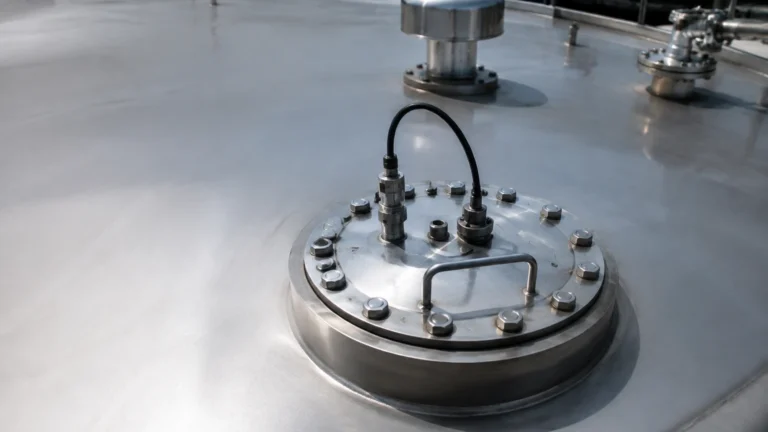
While conductivity is often viewed as a water quality metric, it is also a foundational principle for point-level detection in industrial tanks. Conductive level switches utilize the process conductivity of the medium to complete an electrical circuit when the liquid reaches a specific height.
In a typical setup, a low-voltage AC signal is applied to an electrode. When the conductive liquid (such as water, milk, or an acid) touches the electrode, it creates a path to the tank wall (if metal) or a reference electrode. This change in state triggers a relay, providing a reliable "high" or "low" level alarm. This technology is widely utilized because it contains no moving parts, making it significantly more durable than mechanical float switches in turbulent or high-pressure environments.
For complex systems requiring comprehensive measurement, engineers often consult the Main Page to evaluate how conductivity-based switches integrate with other technologies like radar or ultrasonic sensors to provide redundant level monitoring.
Key Evaluation Criteria for Conductivity Sensors
Selecting a sensor for process conductivity requires an analysis of the chemical and physical properties of the medium. The following factors are critical for ensuring measurement accuracy:
1. Cell Constant (k-factor)
Selecting the correct cell constant is the most important step for contacting sensors.
- k = 0.01 to 0.1: Used for pure and ultrapure water (0.055 µS/cm to 20 µS/cm).
- k = 1.0: Used for general purpose water and wastewater (20 µS/cm to 2,000 µS/cm).
- k = 10.0: Used for high-conductivity industrial processes and concentrated chemicals (>2,000 µS/cm).
2. Temperature Compensation
Conductivity is highly temperature-dependent. As temperature increases, the mobility of ions increases, typically resulting in a conductivity rise of approximately 2% per degree Celsius. Most modern industrial transmitters include an Integrated Temperature Detector (RTD), such as a Pt100 or Pt1000, to provide automatic temperature compensation (ATC), normalizing the reading to a reference temperature (usually 25°C).
3. Material Compatibility
The sensor body and electrode materials must withstand the process chemistry. For aggressive acids, PEEK (Polyetheretherketone) or PFA (Perfluoroalkoxy) housings are preferred for inductive sensors. For contacting sensors in food and beverage applications, 316L stainless steel with sanitary fittings is the industry standard.
Selection Guide for Process Conductivity Instrumentation
| Feature | Contacting Sensors | Inductive (Toroidal) Sensors |
| :— | :— | :— |
| Measurement Range | Very Low to Medium (0.01 µS/cm to 20 mS/cm) | Medium to Very High (50 µS/cm to 2,000 mS/cm) |
| Best Applications | RO Water, Distillation, Boiler Feed | Acids, Caustics, Slurries, Brine |
| Fouling Resistance | Low (Susceptible to scaling) | High (Non-contacting design) |
| Maintenance Requirement | Moderate (Cleaning required) | Low (Minimal cleaning) |
| Installation | Inline or Immersion | Inline, Immersion, or Large Pipe |
Installation Guidelines and Best Practices
Correct installation is vital to prevent measurement errors caused by air bubbles, sediment, or electrical interference.
1. Avoid Air Pockets: Sensors should be installed in a location where they are always fully submerged. In horizontal pipes, the sensor should be mounted on the side or bottom (if sediment is not an issue) to avoid air pockets that often gather at the top of the pipe.
2. Flow Direction: For contacting sensors, the liquid should flow into the open face of the electrodes to ensure a representative sample and to help flush out any debris.
3. Wall Effects: Inductive sensors generate a magnetic field that extends beyond the sensor body. If the sensor is installed too close to a metallic pipe wall, the field can be distorted, leading to inaccurate readings. Manufacturers typically recommend a minimum clearance (e.g., 20 mm to 50 mm) from the pipe wall.
4. Cable Integrity: Conductivity signals are high-impedance and sensitive to electromagnetic interference (EMI). Always use shielded cables and avoid routing them near high-voltage power lines or variable frequency drives (VFDs).
Common Risks, Limitations, and Maintenance
Despite its reliability, process conductivity measurement faces several challenges in industrial environments.
Polarization
In contacting sensors, if a Direct Current (DC) were used, ions would migrate toward the electrodes and form a capacitive layer, creating a "polarization" effect that artificially increases resistance. This is why industrial transmitters use Alternating Current (AC). However, at very high conductivities, even AC may not fully prevent polarization, which is why inductive sensors are preferred for high-concentration solutions.
Coating and Scaling
In wastewater or mineral-rich processes, calcium carbonate or biological films can coat the electrodes of a contacting sensor. This coating acts as an insulator, leading to lower-than-actual conductivity readings. Regular calibration and cleaning with a mild acid or detergent are necessary to maintain accuracy. If the process is known to be "dirty," an inductive sensor or a conductive level switch with a self-cleaning design should be prioritized.
Non-Conductive Fluids
It is a fundamental limitation that conductivity-based measurement cannot be used for non-polar liquids such as oils, hydrocarbons, or pure solvents. For these applications, hydrostatic or radar level transmitters are required. You can Review product options and application support to find alternative technologies for non-conductive media.
Frequently Asked Questions (FAQs)
Q: How often should a process conductivity sensor be calibrated?
A: Calibration frequency depends on the process. In clean water applications, once every six months may suffice. In corrosive or fouling chemical processes, monthly or even weekly verification against a standard solution may be required.
Q: Can conductivity be used to measure the concentration of a specific chemical?
A: Yes, if the solution consists of only one major electrolyte (e.g., Sodium Hydroxide in water). Since conductivity is non-specific, it measures the total ion concentration. If multiple chemicals are present, conductivity cannot distinguish between them.
Q: What is the difference between conductivity and TDS?
A: Total Dissolved Solids (TDS) is a measure of the mass of dissolved material in a volume of water. It is usually estimated by multiplying the conductivity (in µS/cm) by a factor (typically 0.5 to 0.7), depending on the types of salts present.
Q: What units are used for very high conductivity?
A: For highly concentrated acids or brines, conductivity is often expressed in mS/cm (milliSiemens per centimeter). 1,000 µS/cm equals 1 mS/cm.
Conclusion
Process conductivity is a versatile and essential parameter for both fluid analysis and level control. By understanding the differences between contacting and inductive measurement principles, engineers can select instrumentation that balances sensitivity with durability. Whether monitoring the purity of pharmaceutical-grade water or managing the level of corrosive chemicals in a storage tank, the correct application of conductivity technology ensures process safety and operational efficiency. For those seeking to implement these solutions, exploring a wide range of industrial level and analytical instruments on the Main Page is the recommended starting point for technical procurement.