Automatic Water Sampler
Automatic Water Sampler
In industrial wastewater management, municipal treatment, and environmental monitoring, the ability to collect representative liquid samples is fundamental to regulatory compliance and process control. An automatic water sampler is a programmable instrument designed to collect, store, and often preserve liquid samples from a source—such as a sewer, river, or process tank—without manual intervention. By automating this process, facilities ensure that samples are taken at precise intervals or in direct response to specific hydraulic conditions, significantly reducing the margin of human error and labor costs.
For engineers and plant managers, selecting the right automatic water sampler requires an understanding of how these devices interface with other instrumentation, particularly level and flow meters. Accurate sampling often depends on real-time data from primary sensors to determine when and how much liquid to draw. When designing a monitoring station, reviewing comprehensive Main Page resources for level measurement is a critical first step in ensuring the sampler receives accurate trigger signals.
Core Measurement and Sampling Principles
Automatic water samplers operate based on three primary transport mechanisms. Each has specific advantages depending on the suspended solids content, the required lift height, and the chemical nature of the medium.
Peristaltic Pump Technology
This is the most common sampling method. A peristaltic pump uses rotating rollers to compress a flexible tube, creating a vacuum that draws the liquid into the sample container.
* Advantages: The liquid only touches the inside of the tubing, minimizing cross-contamination and making the system easy to clean. It is highly effective for toxic or corrosive fluids.
* Limitations: The maximum vertical lift is typically limited to 8–9 meters (26–29 feet). High-viscosity fluids or those with large abrasive particles can accelerate tube wear.
Vacuum/Pressure Technology
Vacuum samplers use a vacuum pump to draw the sample into a volumetric chamber. Once the chamber is full, the vacuum is released, and the sample is discharged into the bottle.
* Advantages: This method often achieves higher transport velocities than peristaltic pumps, which is crucial for keeping heavy solids in suspension. It is generally more accurate for fixed-volume sampling.
* Limitations: The mechanical complexity is higher, and the volumetric chamber requires regular cleaning to prevent residue buildup.
Compensation and Purging
Regardless of the pump type, industrial-grade samplers utilize a "pre-purge" and "post-purge" cycle. Before a sample is taken, the pump runs in reverse to clear the intake line of any stagnant liquid or debris. After the sample is delivered, the line is purged again to ensure no residual liquid remains to contaminate the next sample.
Sampling Modes and Logic
An automatic water sampler is only as effective as its programming logic. There are three primary modes used in B2B industrial applications:
1. Time-Proportional Sampling: The sampler collects a fixed volume of water at regular time intervals (e.g., every 30 minutes). This is suitable for sources with stable flow rates and consistent chemical compositions.
2. Flow-Proportional Sampling: The sampler collects volumes based on the totalized flow. For instance, a sample is taken every time 1,000 liters (264 gallons) of water passes the monitoring point. This requires an external input from a flow meter or a level sensor used in conjunction with a weir or flume.
3. Event-Triggered Sampling: The sampler remains idle until a specific condition is met, such as a pH spike, a temperature threshold, or a sudden rise in liquid level. This is vital for "first flush" storm water monitoring or detecting illegal industrial discharges.
Integration with Level Measurement Systems
In many open-channel applications, flow rate is derived from level measurement. An ultrasonic level sensor or a radar level meter is mounted above a primary device (like a Parshall flume). The level data is converted into a flow rate via a standard formula (e.g., the Manning equation).
The automatic water sampler receives this data through a 4-20mA analog signal or a digital pulse. If the level sensor detects a surge, it can trigger the sampler to increase the frequency of collection. Without accurate level measurement, flow-proportional sampling is impossible, leading to data that does not accurately represent the total mass loading of pollutants. For technical specifications on the sensors that drive these triggers, engineers should consult the Main Page of their equipment provider to ensure signal compatibility.
Hardware Configurations: Portable vs. Stationary
| Feature | Portable Samplers | Stationary Samplers |
| :— | :— | :— |
| Power Source | Battery / Solar | AC Mains (110V/220V) |
| Housing | Lightweight, high-impact plastic | Stainless steel or heavy-duty GRP |
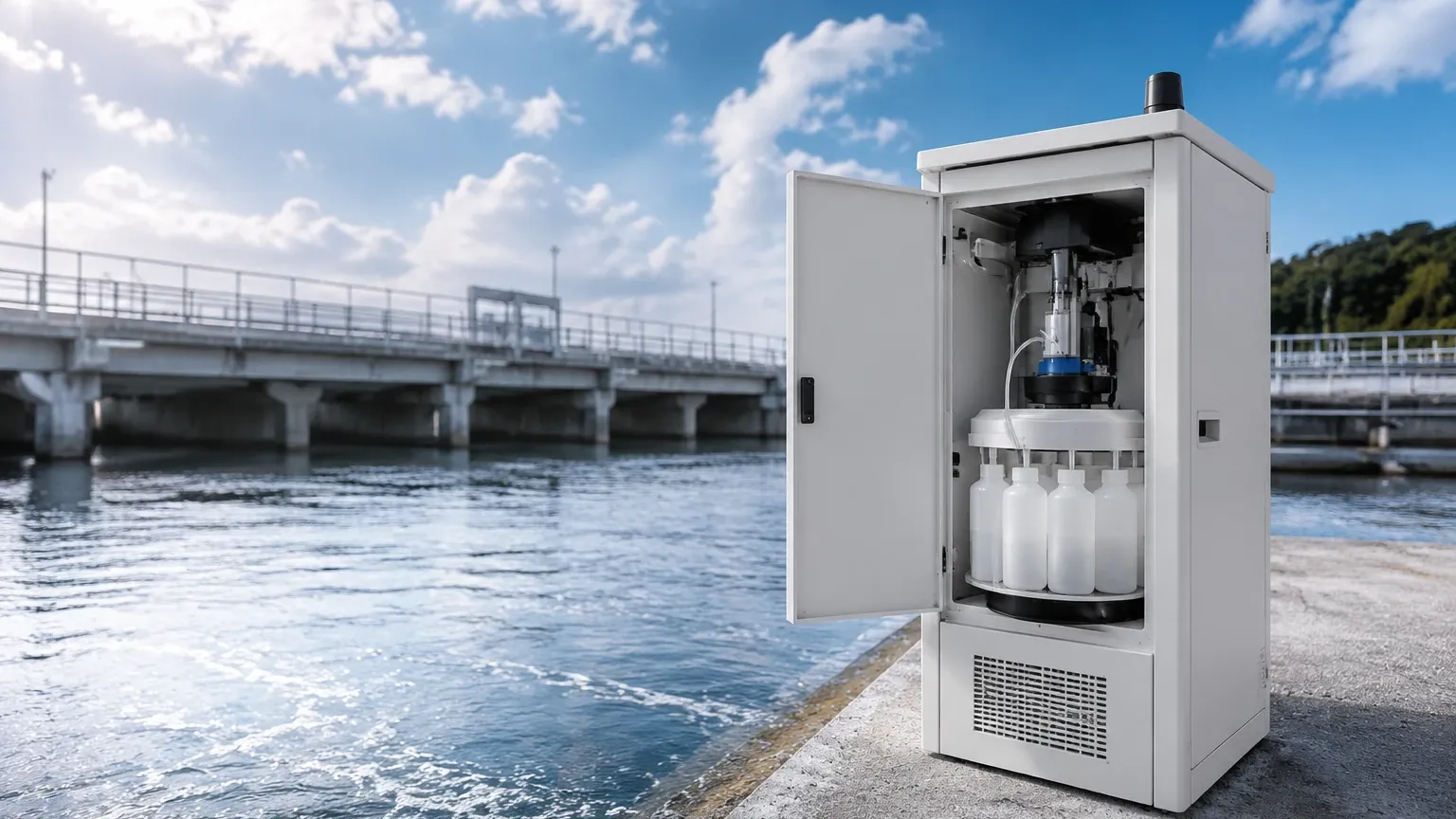
| Cooling | Ice or passive insulation | Active refrigeration (compressor-based) |
| Application | Field studies, remote manholes | Permanent treatment plant inlets |
| Sample Capacity | Typically 1 to 24 bottles | Up to 24 x 1L or large composite carboys |
The Importance of Refrigeration
For many regulatory parameters (such as BOD, COD, or nutrient analysis), samples must be maintained at a temperature between 0°C and 4°C (32°F to 39°F) to inhibit biological activity and chemical degradation. Stationary samplers equipped with active refrigeration are the standard for compliance monitoring, whereas portable samplers rely on ice, which requires frequent manual replacement.
Technical Selection Criteria
When specifying an automatic water sampler for an industrial project, consider the following technical parameters:
* Suction Lift: Measure the vertical distance from the lowest water level to the sampler intake. If the lift exceeds 8 meters (26 feet), a specialized high-lift pump or a vacuum-based system may be required.
* Bottle Configuration: Determine if you need "Composite" sampling (all samples in one large container) or "Discrete" sampling (each sample in its own bottle for time-stamped analysis).
* Materials of Construction: For general wastewater, PVC or silicone tubing is standard. For sampling trace organics or hydrocarbons, Teflon-lined tubing and glass bottles are mandatory to prevent leaching or adsorption.
* Controller Interface: Look for samplers with backlit LCDs, data logging capabilities, and USB/Modbus outputs for integration into SCADA systems.
Installation Considerations
Proper installation is critical to obtaining a representative sample. If the intake is poorly positioned, the sampler may only collect surface oils or bottom sediments, rather than a representative cross-section of the flow.
1. Intake Placement: The strainer (the end of the suction line) should be placed in the center of the flow stream, ideally at a depth of 60% from the surface. It should be positioned in an area of high turbulence to ensure the liquid is well-mixed.
2. Line Slope: The suction line must have a continuous downward slope toward the source. Any "loops" or "dips" in the tubing will trap liquid, leading to cross-contamination between samples.
3. Protection: In manhole installations, ensure the sampler is secured against high-flow events. In stationary outdoor installations, a sunshade or secondary enclosure is recommended to protect the electronics and refrigeration unit from extreme UV and heat.
Limitations and Common Risks
While automatic samplers are robust, they are not "set and forget" devices. Several factors can compromise data integrity:
* Biofilm Growth: Over time, algae and bacteria can grow inside the suction tubing. This biofilm can alter the chemical composition of the sample (especially dissolved oxygen and nitrogen levels). Tubing should be replaced every 3 to 6 months.
* Clogging: Even with a strainer, fibrous materials (like wipes or rags) can block the intake. Regular inspection of the intake point is necessary in raw sewage applications.
* Power Failure: Portable samplers are dependent on battery health. In cold climates, battery capacity can drop by 50% or more. Always calculate the power budget for the intended sampling duration.
* Cross-Contamination: If the purge cycle is insufficient, remnants of a high-concentration "slug" of waste may remain in the pump, artificially inflating the concentration of the subsequent sample.
Frequently Asked Questions (FAQ)
Q: How often should I calibrate the sample volume?
A: It is recommended to calibrate the volume at the start of every sampling program or monthly for permanent installations. Changes in suction lift or tube wear will affect the volume delivered.
Q: Can I use an automatic sampler for volatile organic compounds (VOCs)?
A: Standard peristaltic or vacuum samplers are generally not recommended for VOCs because the vacuum created can cause the volatile compounds to "outgas." Specialized bladder pumps or discrete manual sampling are preferred for these parameters.
Q: What is the maximum distance I can run a suction line?
A: While some pumps can pull from 20–30 meters (65–100 feet) horizontally, the longer the line, the higher the risk of settling solids and the longer the purge time required. Keep lines as short as possible.
Q: How does the sampler know when a bottle is full?
A: Most modern samplers use either an infrared sensor in the distributor arm or a liquid-level sensor in the bottle compartment to prevent overfilling and potential damage to the electronics.
Q: Is it possible to integrate a pH sensor directly into the sampler?
A: Yes, many high-end stationary samplers have auxiliary ports for pH, ORP, or conductivity probes. The sampler can be programmed to take a "trigger sample" if the pH exceeds a set limit.
For engineers seeking to build a complete monitoring station, integrating an automatic water sampler with reliable level measurement technology is essential. By ensuring that the hydraulic triggers are accurate, facilities can trust that their samples truly represent their environmental impact. Detailed information on the sensors required for these integrations can be found by visiting the Main Page for professional level measurement solutions.