Coriolis Flow Meter Endress Hauser
Coriolis Flow Meter Endress Hauser
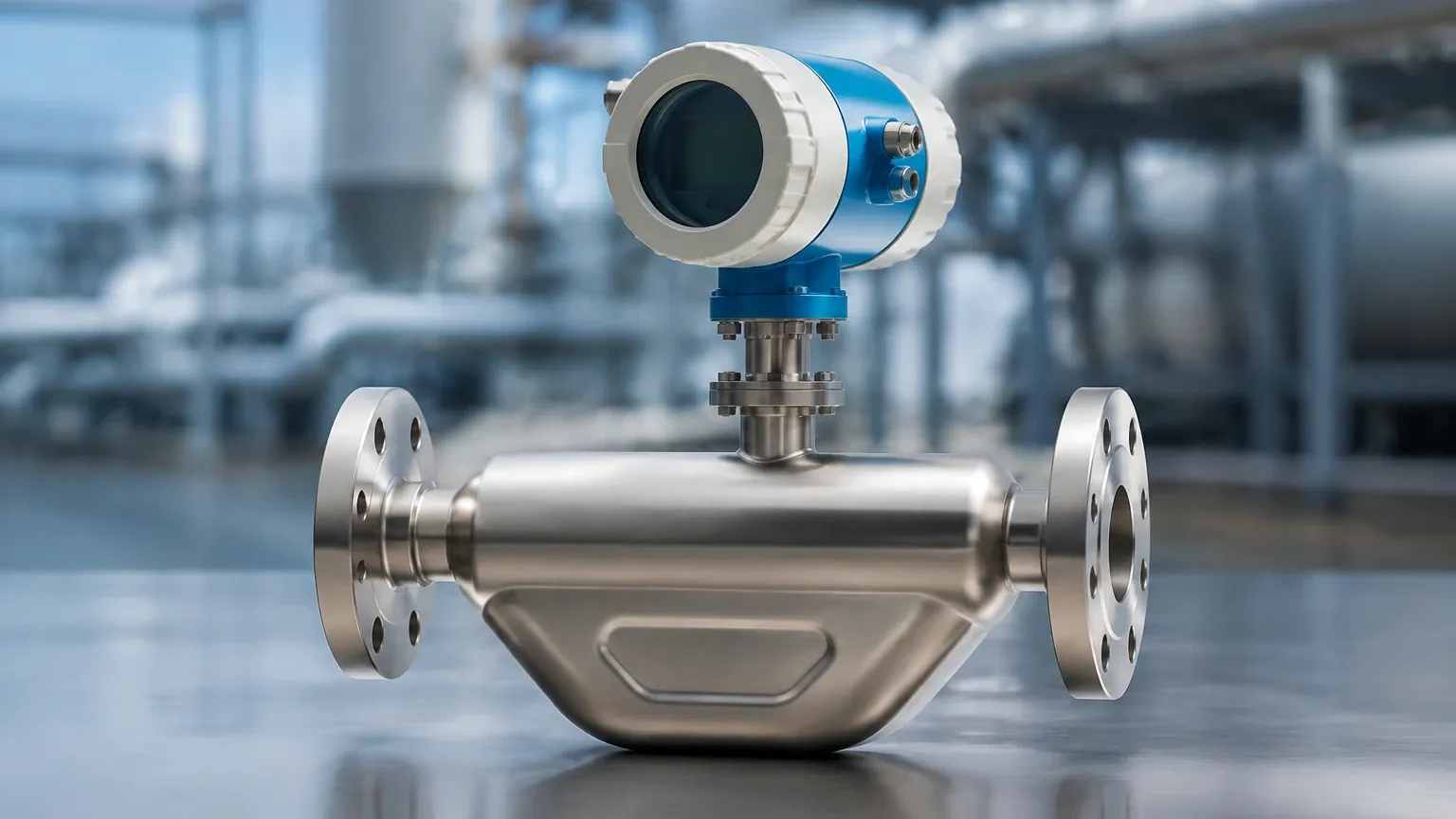
In the landscape of industrial process control, the Coriolis flow meter stands as one of the most versatile and accurate instruments available. Specifically, the Coriolis flow meter Endress Hauser (E+H) range, known as the Proline Promass series, has become a benchmark for mass flow measurement across the chemical, food and beverage, and oil and gas industries. Unlike traditional volumetric flow meters, Coriolis technology measures mass directly, providing a high degree of immunity to changing fluid properties such as density and viscosity.
This guide examines the fundamental principles of Coriolis measurement, the specific technical advantages of the Endress+Hauser portfolio, and the critical selection criteria for engineering teams tasked with integrating these devices into complex automation systems.
Understanding the Coriolis Measurement Principle
Before selecting a specific model, it is essential to understand the physics governing the device. The Coriolis flow meter operates on the principle of the Coriolis effect, which describes the inertial force acting on an object in motion within a rotating frame of reference.
The Vibrating Tube Mechanism
Inside a Coriolis meter, one or more measuring tubes are induced to oscillate at their resonant frequency by an electro-dynamic driver. When a fluid (liquid or gas) flows through these vibrating tubes, the mass flow causes a secondary twisting or "Coriolis force" to act on the tube.
1. Phase Shift: As the fluid moves through the inlet side, it resists the upward motion of the tube, while on the outlet side, it resists the downward motion. This creates a phase shift (a time delay) between the sensors located at the inlet and outlet. This phase shift is directly proportional to the mass flow rate.
2. Density Measurement: The resonant frequency at which the tubes vibrate is dependent on the total mass of the tube and the fluid inside it. Since the tube volume is constant, the frequency can be used to calculate the fluid's density in real-time.
3. Temperature Compensation: Because the elasticity of the measuring tubes changes with temperature, a built-in Pt100 sensor monitors the tube temperature to ensure the mass flow and density calculations remain accurate.
By measuring these three variables simultaneously, a Coriolis flow meter Endress Hauser device can provide mass flow, volume flow, density, and temperature outputs from a single process connection.
Key Features of Endress+Hauser Coriolis Technology
Endress+Hauser has refined the Coriolis design through its Proline Promass series. These instruments are designed to meet the rigorous demands of modern Industry 4.0 environments.
Heartbeat Technology
One of the defining features of modern E+H meters is Heartbeat Technology. This is an integrated diagnostic and verification suite that allows the device to perform self-monitoring without interrupting the process. It provides documented proof that the meter is performing within specification, which is critical for regulated industries like pharmaceuticals where periodic calibration verification is mandatory.
Multi-Parameter Measurement
The ability to measure multiple variables simplifies piping design. Instead of installing a flow meter, a density meter, and a temperature transmitter, a single Coriolis unit handles all three. This reduces the number of potential leak points and lowers the overall cost of installation.
Digital Communication
Most units are equipped with advanced communication protocols, including HART, PROFIBUS DP/PA, PROFINET, EtherNet/IP, and Modbus RS485. This allows for seamless integration into PLC and SCADA systems, providing detailed diagnostics beyond simple flow rates.
Technical Selection Criteria for Process Engineers
Selecting the right Coriolis flow meter Endress Hauser model requires a detailed analysis of the process conditions. While these meters are highly accurate, they are not universal "one-size-fits-all" solutions.
Fluid Properties and Accuracy
Standard Coriolis meters offer mass flow accuracy typically between ±0.1% and ±0.05% of the reading. However, if the fluid contains entrained gas (slug flow), the accuracy can degrade. Specialized models like the Promass Q are specifically engineered to handle fluids with gas bubbles or micro-bubbles, utilizing advanced signal processing to maintain measurement integrity.
Pressure Drop and Tube Geometry
Coriolis meters often have a higher pressure drop than ultrasonic or electromagnetic meters because the fluid must be diverted through the measuring tubes. Engineers must calculate the allowable pressure drop (Δp) at maximum flow rates.
* Bent Tube Designs: Offer higher sensitivity and better turndown ratios but may be harder to drain.
* Straight Tube Designs: Lower pressure drop and easier to clean (CIP/SIP), making them ideal for hygienic applications in the food industry.
Comparison of Common Coriolis Meter Configurations
The following table outlines the primary applications and characteristics of various Endress+Hauser Coriolis series to assist in the initial selection process.
| Series | Primary Application | Key Characteristic | Tube Design |
| :— | :— | :— | :— |
| Promass F | Universal / Chemical | High accuracy, robust against process changes | Dual Bent |
| Promass Q | Oil & Gas / Custody Transfer | Superior performance with entrained gas | Dual Bent |
| Promass E | Basic Utility / Food | Cost-effective, entry-level mass flow | Dual Bent |
| Promass H | High Corrosion Resistance | Chemically resistant (Zirconium/Tantalum) | Single/Dual |
| Promass I | Viscous Fluids / Hygienic | Straight tube, low shear, easy to drain | Single Straight |
| Promass S | Food & Beverage | Hygienic design, easy to clean | Dual Bent |
| Promass X | High Volume / Bulk Loading | Maximum throughput (up to 4,100 t/h) | Four-tube |
Installation and Maintenance Guidelines
To achieve the stated accuracy of a Coriolis flow meter Endress Hauser, strict adherence to installation best practices is required. Unlike magnetic flow meters, Coriolis meters do not strictly require long straight runs of pipe, but they are sensitive to mechanical stress and vibration.
Mechanical Mounting
* Support: The meter must be supported by the piping, but the piping itself must be anchored to prevent external vibrations from being transmitted to the measuring tubes.
* Orientation: For liquids, the meter should ideally be installed in a vertical pipe with upward flow to ensure the tubes remain full. For gases, horizontal installation with the tubes pointing upward is preferred to allow any condensate to drain out.
* Stress-Free Installation: The meter should never be used to pull misaligned pipes together. Flange bolts should be tightened evenly to avoid introducing mechanical stress into the sensor housing.
Zero Point Adjustment
After installation and under full process pressure and temperature, a zero-point adjustment must be performed. This is done by ensuring the fluid is completely stationary (using shut-off valves) while the meter is full. This calibration accounts for the specific installation environment and is vital for maintaining low-end accuracy.
Limitations and Application Risks
While Coriolis meters are often considered the "gold standard," they have specific limitations that must be managed:
1. Initial Cost: The capital expenditure for a Coriolis meter is significantly higher than for a vortex or ultrasonic meter. The ROI must be justified by the need for high accuracy or direct mass measurement.
2. Size Constraints: Coriolis meters become very heavy and expensive at larger line sizes (above 12 inches / 300 mm). In these cases, ultrasonic or differential pressure meters may be more practical.
3. External Vibration: If the process plant has significant floor vibration or pipe resonance near the meter's operating frequency (typically 100–1000 Hz), it can cause measurement errors or even prevent the meter from oscillating.
Integrating Flow and Level Measurement in Industrial Automation
In many industrial processes, flow measurement is only one part of the equation. For comprehensive inventory management and tank farm automation, mass flow data from a Coriolis meter is often paired with precise level measurement data.
For example, in a chemical blending tank, a Coriolis flow meter Endress Hauser might measure the mass of the incoming raw materials, while a high-precision radar or ultrasonic level sensor monitors the total volume and provides overfill protection. This dual-verification approach ensures mass balance accuracy and process safety. To explore the full range of level measurement technologies that complement flow instrumentation, engineers can Review product options and application support on our main site.
Frequently Asked Questions (FAQ)
Q: Can a Coriolis meter measure steam?
A: Generally, no. Coriolis meters are highly effective for liquids and high-pressure gases, but the low density of steam usually results in insufficient mass to create a measurable Coriolis force. Vortex meters are typically preferred for steam applications.
Q: How often should a Coriolis flow meter be calibrated?
A: This depends on the industry and the criticality of the measurement. In many chemical applications, a yearly verification using Heartbeat Technology is sufficient, while custody transfer applications in oil and gas may require more frequent physical proving.
Q: Does viscosity affect the accuracy of the Coriolis flow meter Endress Hauser?
A: One of the main advantages of Coriolis technology is that it is largely independent of viscosity. However, extremely high viscosity can lead to a significant pressure drop across the meter, which must be accounted for in the system design.
Q: What is the difference between mass flow and volume flow in these meters?
A: Mass flow is the actual weight of the fluid passing through (e.g., kg/h), which is constant regardless of temperature or pressure. Volume flow (e.g., m³/h) is calculated by dividing the mass flow by the measured density. Because density changes with temperature, mass flow is a more reliable metric for chemical reactions and billing.
Q: Are Coriolis meters suitable for hazardous areas?
A: Yes, most Endress+Hauser Coriolis meters are available with ATEX, IECEx, and FM/CSA certifications for use in Zone 0, 1, or 2 hazardous environments, featuring intrinsically safe or explosion-proof electronics.