Coriolis Flowmeter
Coriolis Flowmeter
In the landscape of industrial process control, the Coriolis flowmeter stands as one of the most versatile and accurate instruments available for measuring fluid dynamics. Unlike traditional volumetric flowmeters that require secondary measurements for temperature and pressure to calculate mass, a Coriolis flowmeter provides a direct mass flow reading. This capability is critical in industries where precision is paramount, such as chemical processing, oil and gas, and food production. Understanding the fundamental principles, selection criteria, and installation nuances is essential for engineers tasked with optimizing process efficiency and ensuring fiscal accuracy in custody transfer.
Measurement Principles of the Coriolis Flowmeter
The operation of a Coriolis flowmeter is based on the principles of classical mechanics, specifically the Coriolis effect. This effect describes the inertial force acting on an object that is in motion within a frame of reference that rotates or oscillates. In the context of a flowmeter, this principle is applied to a fluid moving through vibrating tubes.
The Oscillation Mechanism
Inside the sensor housing, one or two measuring tubes are driven to vibrate at their resonant frequency by an electromagnetic drive coil. When there is no fluid flowing through the tubes, they vibrate in a uniform, symmetrical manner. Sensors located at the inlet and outlet of the tubes (often called pick-off sensors) detect this vibration as a sine wave. In a static state, the sine waves from the inlet and outlet are perfectly in phase.
The Coriolis Force and Phase Shift
When a fluid (liquid or gas) begins to flow through the vibrating tubes, the mass of the moving fluid introduces an inertial force. As the fluid moves toward the point of maximum vibration (the center of the tube loop), it resists being accelerated upward. Conversely, as it moves away from the center toward the outlet, it resists being decelerated. This resistance creates a twisting motion or "phase shift" in the measuring tubes.
This phase shift is directly proportional to the mass flow rate of the fluid. The pick-off sensors detect the time delay between the inlet and outlet vibrations. Because mass is an intrinsic property that does not change with temperature or pressure, the Coriolis flowmeter provides an exceptionally stable and accurate measurement regardless of changing process conditions. Furthermore, the resonant frequency of the tube vibration changes depending on the density of the fluid, allowing the instrument to simultaneously measure mass flow, density, and temperature.
Key Evaluation Criteria for Selection
Selecting the appropriate Coriolis flowmeter requires a detailed analysis of the process environment and the specific properties of the fluid being measured. Because these instruments represent a significant capital investment, engineers must evaluate several technical factors to ensure long-term reliability.
Accuracy and Turndown Ratio
Coriolis meters are renowned for their high accuracy, often reaching ±0.1% or better for liquids and ±0.5% for gases. However, accuracy is often tied to the turndown ratio—the range from the maximum flow rate to the minimum flow rate that the meter can accurately measure. While some meters boast a 100:1 turndown, the uncertainty typically increases at the lower end of the flow scale. It is vital to confirm that the expected operating flow rates fall within the meter’s high-accuracy band.
Material Compatibility and Pressure Ratings
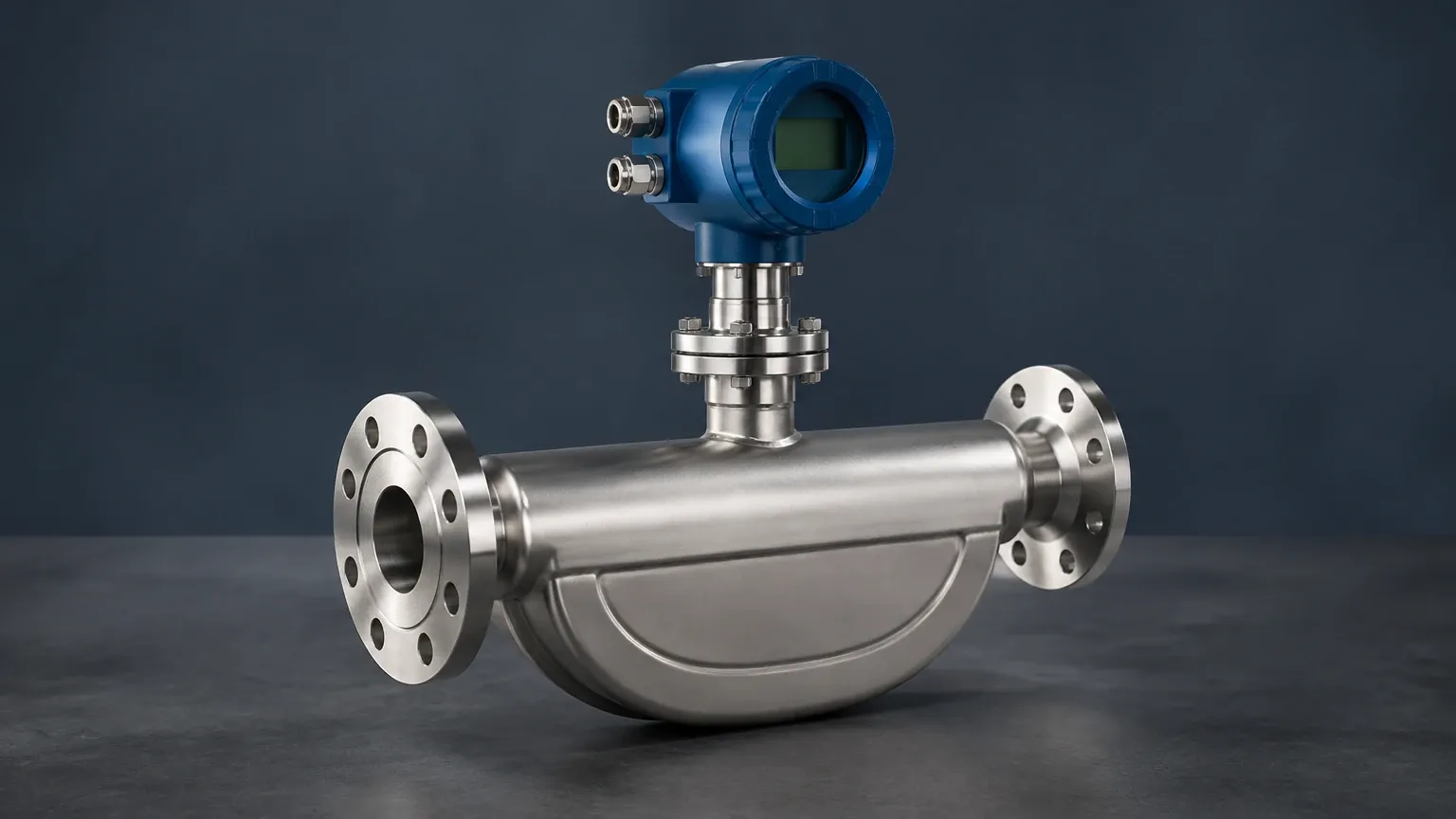
The measuring tubes are the most critical component of the meter. They must be compatible with the process fluid to prevent corrosion or erosion. Common materials include 316L stainless steel, Hastelloy C-22, and Titanium. Additionally, the wall thickness of the tubes dictates the maximum operating pressure. While thinner walls improve sensitivity and accuracy, they may limit the meter's use in high-pressure applications common in the oil and gas sector.
Fluid Properties: Viscosity and Solids
One of the primary advantages of the Coriolis flowmeter is its ability to handle high-viscosity fluids, such as resins, syrups, and heavy crude oil, which often cause issues for turbine or vortex meters. However, extremely high viscosity can lead to significant pressure drops across the meter. If the fluid contains suspended solids, the tube geometry must be considered; curved tubes may be prone to clogging or erosion, whereas straight-tube designs are generally more robust for slurries.
Comparison of Flow and Level Measurement Technologies
In many industrial applications, flow measurement and level measurement are used in tandem to maintain mass balance. While level meters (such as radar or ultrasonic sensors) provide volume-based inventory data, the Coriolis flowmeter provides the mass-based data necessary for precise dosing and mixing.
| Feature | Coriolis Flowmeter | Ultrasonic Flowmeter | Radar Level Transmitter |
| :— | :— | :— | :— |
| Primary Measurement | Mass Flow, Density, Temp | Flow Velocity | Level / Distance |
| Typical Accuracy | ±0.1% of rate | ±0.5% to ±2.0% | ±1 mm to ±5 mm |
| Fluid Dependency | Independent of density/viscosity | Dependent on sound speed | Independent of density |
| Pressure Loss | Moderate (due to tube geometry) | None (non-invasive) | None (non-contact) |
| Maintenance | Low (no moving parts) | Low | Very Low |
| Initial Cost | High | Medium | Medium |
For a comprehensive overview of how these technologies integrate into a complete automation system, engineers can Review product options and application support on our Main Page.
Installation Considerations and Best Practices
Even the most advanced Coriolis flowmeter will underperform if it is installed incorrectly. Because the meter relies on detecting minute vibrations and phase shifts, external factors can introduce significant errors.
Orientation and Entrained Air
The orientation of the meter is determined by the phase of the fluid. For liquid applications, the meter should ideally be installed in a vertical pipe with the flow moving upward. This ensures that the tubes remain full and prevents the accumulation of air bubbles. Entrained air is a common enemy of Coriolis meters; bubbles can dampen the tube vibration, leading to "slug flow" errors. If horizontal installation is necessary, the tubes should be oriented downward (flag position) for liquids to prevent sediment buildup, and upward for gases to prevent condensate accumulation.
Vibration and Mechanical Stress
External mechanical vibrations from pumps, motors, or vibrating machinery can interfere with the meter’s resonant frequency. It is essential to support the piping on both sides of the meter using rigid brackets. These supports should be placed as close to the meter flanges as possible to decouple the sensor from pipe-borne vibration. Furthermore, the meter should never be used to support the weight of the piping; thermal expansion and contraction can introduce mechanical stress on the sensor tubes, shifting the zero point and degrading accuracy.
Zero Calibration
Upon installation and under process conditions (temperature and pressure), a "zero trim" must be performed. This involves filling the meter with the process fluid, ensuring there is absolutely no flow, and then calibrating the transmitter to recognize this state as zero. This step is critical for maintaining accuracy, especially at low flow rates.
Limitations and Potential Risks
While highly capable, Coriolis flowmeters are not a universal solution for every application. Engineers must be aware of their limitations to avoid costly misapplications.
1. Initial Cost: Coriolis meters are among the most expensive flow measurement technologies. For simple water flow applications where high accuracy is not required, electromagnetic or ultrasonic meters are often more cost-effective.
2. Size and Weight: As pipe sizes increase, Coriolis meters become exceptionally large and heavy. For pipes larger than 250 mm (10 inches), the physical footprint and the structural support required can be prohibitive.
3. Pressure Drop: The flow must be diverted through the measuring tubes, which often have a smaller diameter than the process piping. This constriction creates a pressure drop that must be accounted for in the system's hydraulic calculations.
4. Gas Entrainment: While modern digital signal processing (DSP) has improved performance in two-phase flow (gas/liquid mixtures), high levels of entrained air can still cause the meter to stall or provide erratic readings.
Industrial Application Scenarios
Chemical Dosing and Blending
In chemical manufacturing, the ratio of reactants is critical to product quality and safety. Because chemical reactions occur on a molecular (mass) basis, using a Coriolis flowmeter allows for precise dosing regardless of temperature-induced volume changes. This eliminates the need for complex compensation algorithms.
Custody Transfer in Oil and Gas
When high-value fluids like crude oil or liquefied natural gas (LNG) change hands, even a 0.5% error can result in massive financial discrepancies. The high repeatability and direct mass measurement of Coriolis technology make it the industry standard for custody transfer skids.
Food and Beverage Processing
Hygiene is paramount in food production. Straight-tube Coriolis meters are often preferred here because they are self-draining and compatible with Clean-in-Place (CIP) procedures. They are used to measure everything from the flow of chocolate and corn syrup to the density of milk to determine fat content.
Frequently Asked Questions (FAQ)
Q: Can a Coriolis flowmeter measure gas?
A: Yes, Coriolis meters are highly effective for gas measurement. However, because gas has much lower mass than liquid, the phase shift is smaller, which may result in slightly lower accuracy (typically ±0.5%) compared to liquid applications.
Q: Does the viscosity of the fluid affect the accuracy?
A: Generally, no. The Coriolis principle is independent of Reynolds number and viscosity. However, very high viscosity will increase the pressure drop across the meter, which must be managed.
Q: How often does a Coriolis flowmeter need recalibration?
A: Because there are no moving parts to wear out, the calibration of a Coriolis meter is exceptionally stable. Many users find that the meter remains within specification for years. However, regular "zero checks" and periodic verification against a master meter or weigh scale are recommended for critical applications.
Q: What is the impact of pipe vibration on the meter?
A: Significant external vibration can interfere with the sensor's ability to detect the phase shift. This is mitigated through proper installation, rigid mounting, and the use of advanced digital filtering in the transmitter.
Conclusion
The Coriolis flowmeter represents the pinnacle of flow measurement technology, offering unparalleled accuracy and multi-parameter data. By providing direct mass flow, density, and temperature readings, it simplifies process architectures and reduces the uncertainty associated with volumetric calculations. While the initial investment is higher than other technologies, the reduction in maintenance, improvement in product quality, and elimination of secondary sensors often result in a lower total cost of ownership. For engineers looking to integrate high-precision flow data with their existing level measurement systems, understanding these principles is the first step toward a more efficient and reliable process. For further technical specifications and to explore our full range of industrial instrumentation, please visit our Main Page.