G E Booth
G E Booth
In the complex landscape of industrial process automation, the procurement of precise instrumentation is a critical factor for operational safety and efficiency. Organizations often look toward established regional distributors like G E Booth to bridge the gap between global manufacturing excellence and local engineering requirements. For professionals in the Canadian industrial sector, particularly in Ontario, G E Booth has historically served as a key supplier of valves, instrumentation, and control solutions.
However, selecting the right level measurement technology requires more than just a procurement channel; it demands a deep understanding of the physical principles governing different sensor types. Whether sourcing through a specialized distributor or directly evaluating manufacturer specifications on a Main Page, engineers must align instrument capabilities with specific process conditions such as pressure, temperature, and chemical compatibility.
Principles of Industrial Level Measurement
Before finalizing a bill of materials for a project involving G E Booth or similar technical distributors, it is essential to review the core measurement principles utilized in modern industrial level sensors. Level measurement is generally categorized into non-contact and contact methods.
Radar Level Measurement (ToF)
Radar level meters operate on the Time-of-Flight (ToF) principle. The sensor emits high-frequency microwave pulses (typically in the 26 GHz or 80 GHz range) that travel at the speed of light. When these pulses hit the surface of the medium, they are reflected back to the antenna. The instrument calculates the distance based on the time interval between transmission and reception.
* Non-Contact Radar: Ideal for corrosive or high-temperature liquids where sensor contact is undesirable. It is unaffected by vacuum or high pressure.
* Guided Wave Radar (GWR): Uses a probe to lead the microwave signal. This is highly effective for low-dielectric liquids and applications with heavy foam or turbulence.
Ultrasonic Level Sensors
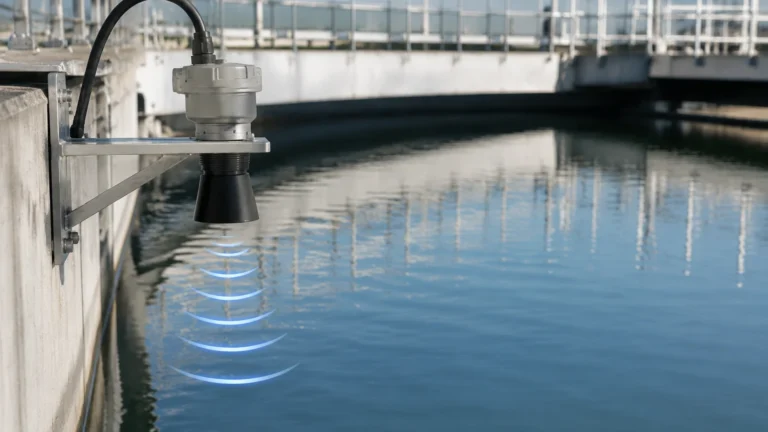
Ultrasonic sensors function similarly to radar but use sound waves instead of electromagnetic waves. A transducer emits an ultrasonic pulse that reflects off the material surface. The time taken for the echo to return is proportional to the distance.
* Limitations: Because sound requires a medium to travel, ultrasonic sensors cannot be used in a vacuum. They are also sensitive to air temperature fluctuations, requiring integrated temperature compensation.
Hydrostatic Level Transmitters
Hydrostatic measurement relies on the principle that the pressure at a specific depth in a static liquid is proportional to the height of the liquid column above it. The formula used is $P = \rho \cdot g \cdot h$, where $P$ is pressure, $\rho$ is the density of the liquid, $g$ is gravity, and $h$ is the height.
* Application: These are commonly used in water treatment and open tanks. They are cost-effective but require the density of the liquid to remain relatively constant for high accuracy.
Magnetic Level Gauges
Magnetic level gauges utilize a float containing a high-intensity magnet that moves with the liquid level inside a bypass chamber. This magnet interacts with an external indicator (flaps or a tracker) to provide a visual representation of the level without the need for power.
Technical Selection Criteria
When evaluating products from a distributor like G E Booth, technical teams should utilize a structured selection matrix. The choice of technology is often dictated by the physical properties of the substance being measured.
| Technology | Typical Accuracy | Max Temperature | Pressure Range | Best For |
| :— | :— | :— | :— | :— |
| Radar | ±2 mm | Up to 450°C | Up to 16 MPa | Chemicals, hydrocarbons, solids |
| Ultrasonic | ±0.25% of range | Up to 80°C | Atmospheric | Water, wastewater, open channels |
| Hydrostatic | ±0.1% to 0.5% | Up to 100°C | Depth dependent | Deep wells, water reservoirs |
| Magnetic Gauge | ±5 mm (visual) | Up to 400°C | Up to 42 MPa | High-pressure boilers, toxic liquids |
Dielectric Constant (εr) Considerations
For radar-based systems, the dielectric constant of the medium is the most critical factor. Materials with high dielectric constants (like water, εr ≈ 80) reflect signals strongly. Materials with low dielectric constants (like oils or plastic pellets, εr < 2) reflect very little energy, often requiring Guided Wave Radar or specialized high-sensitivity antennas found on a manufacturer's Main Page.
The Role of G E Booth in Industrial Distribution
In the context of the Canadian market, G E Booth functions as a technical intermediary. For an EPC (Engineering, Procurement, and Construction) firm, working with a distributor provides several advantages:
1. Local Support: Immediate access to technical sales representatives who understand regional regulatory standards (such as CSA or CRN for pressure vessels).
2. Inventory Management: Reducing lead times for standard components like level switches or pressure gauges.
3. Integrated Solutions: The ability to bundle level sensors with valves, actuators, and manifolds into a single procurement package.
While G E Booth provides the logistical and commercial framework, the engineering responsibility remains focused on the accuracy and reliability of the primary sensing element. For specialized applications—such as high-frequency 80 GHz radar or customized magnetic level gauges—direct consultation with manufacturers like Welk ensures that the specific chemical resistance and signal processing requirements are met.
Installation and Engineering Best Practices
Regardless of whether an instrument is sourced via G E Booth or directly, improper installation is the leading cause of device failure in the field. Engineers should adhere to the following guidelines:
Avoiding False Reflections
In radar and ultrasonic installations, the "beam angle" must be considered. If a sensor is installed too close to a tank wall or near internal obstructions like ladders or agitators, the signal may reflect off these objects rather than the liquid.
* Metric Guideline: Maintain a minimum distance of 200 mm to 500 mm from the tank wall depending on the sensor's beam angle.
Standoff Pipe and Nozzle Dimensions
For non-contact sensors, the nozzle height should be kept as short as possible. If a long nozzle is required, the inner diameter must be large enough to prevent the signal from interfering with the nozzle walls. For radar, a nozzle diameter-to-length ratio of at least 1:3 is often recommended.
Environmental Protection
In outdoor installations, especially in the variable Canadian climate where G E Booth operates, sunshades and heaters may be necessary. For hydrostatic transmitters in freezing environments, ensure that the sensing diaphragm is protected from ice formation, which can cause permanent damage to the silicon cell.

Common Risks and Mitigation
When specifying level instruments for a project, several risks can compromise the integrity of the data:
* Vapor and Gas Layers: High-pressure steam or heavy chemical vapors can attenuate ultrasonic signals. In these instances, radar is the preferred alternative.
* Build-up and Scaling: In wastewater or mining slurries, material can build up on the sensor face. Using PTFE-coated antennas or non-contact radar with high-frequency signals can mitigate the impact of thin build-up.
* Turbulence: Surface agitation caused by mixers can scatter signals. Software filtering (false echo suppression) and the use of stilling wells are common engineering solutions.
Frequently Asked Questions (FAQ)
Q: How does G E Booth assist with CRN (Canadian Registration Number) requirements?
A: Distributors like G E Booth typically ensure that the instrumentation they supply for pressure-retaining applications complies with provincial safety authority requirements. Engineers should confirm that the specific level gauge or transmitter has a valid CRN for the province of installation.
Q: When should I choose Radar over Ultrasonic for level measurement?
A: Radar should be chosen if the application involves vacuum, high pressure (above 0.3 MPa), high temperatures, or significant dust and vapor. Ultrasonic is generally reserved for ambient-pressure water applications where cost-efficiency is a primary driver.
Q: Can hydrostatic sensors measure the level of two different liquids (interface)?
A: Standard hydrostatic sensors measure total head pressure. To measure an interface (e.g., oil over water), you would typically require a Guided Wave Radar or a specialized displacement-type sensor that can distinguish between different dielectric constants or densities.
Conclusion
Navigating the complexities of industrial level measurement requires a balance of commercial reliability and technical precision. While partners like G E Booth offer essential distribution services and local expertise, the success of an automation project depends on the correct application of measurement principles. By understanding the nuances of radar, ultrasonic, and hydrostatic technologies, and by consulting detailed technical resources such as a manufacturer's Main Page, engineers can ensure long-term accuracy and safety in their process operations.
Before moving forward with a purchase, it is recommended to confirm the chemical compatibility of wetted parts, verify the required explosion-proof certifications (ATEX/IECEx/CSA), and perform a signal-to-noise ratio analysis for challenging vessel geometries.