Ifm Lr2050
Ifm Lr2050
In the landscape of industrial automation and process control, selecting the appropriate level measurement technology is critical for operational efficiency and safety. The ifm LR2050 is a prominent electronic level sensor designed for continuous monitoring of liquids in tanks and containers. Utilizing Guided Wave Radar (GWR) technology, this device provides a robust solution for applications where traditional float switches or ultrasonic sensors might encounter limitations. This guide examines the technical foundations, application suitability, and engineering considerations for the ifm LR2050 to assist technical teams in making informed procurement decisions.
Understanding the Measurement Principle: Guided Wave Radar (GWR)
To evaluate the ifm LR2050, one must first understand the physics of Guided Wave Radar, also known as Time Domain Reflectometry (TDR). Unlike non-contact radar sensors that broadcast electromagnetic waves through the air, GWR sensors guide high-frequency microwave pulses along a physical probe.
The TDR Process
1. Pulse Generation: The sensor electronics generate a low-energy, high-frequency electromagnetic pulse.
2. Guided Transmission: This pulse is launched down a metallic probe (the waveguide). Because the pulse is contained around the probe, the signal remains concentrated and experiences minimal energy loss compared to free-air transmission.
3. Reflection at the Interface: When the pulse encounters a medium with a different dielectric constant (εr) than the air or gas above it, a portion of the pulse energy is reflected back toward the sensor head. The strength of this reflection is directly proportional to the dielectric constant of the liquid.
4. Time-of-Flight Calculation: The sensor’s microprocessor measures the time interval between the transmission of the pulse and the receipt of the reflection. Since the speed of electromagnetic waves is constant, the distance to the liquid surface is calculated using the formula: *Distance = (Speed of Light × Time-of-Flight) / 2*.
By subtracting this distance from the known tank height, the sensor determines the level. This principle is inherently resistant to changes in pressure, temperature, and vapor composition, making it more reliable than hydrostatic or ultrasonic methods in many industrial environments.
Technical Specifications and Performance Characteristics
The ifm LR2050 is engineered for versatility in industrial fluids, including water-based media, oils, and coolants. Its design focuses on digital integration and ease of maintenance.
Key Hardware Features
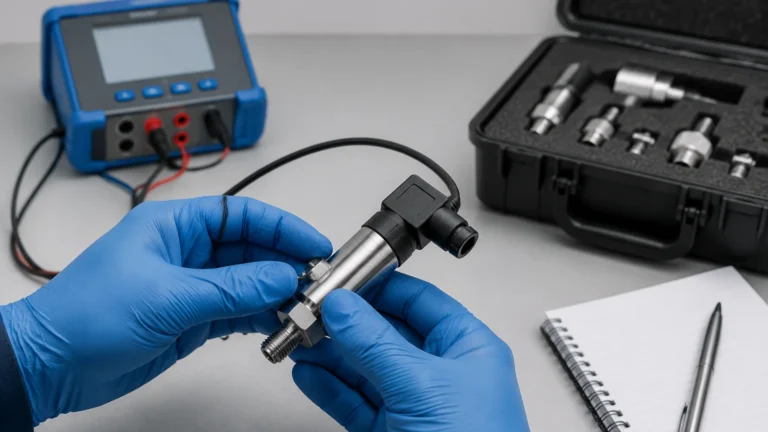
* Probe Design: The device typically utilizes a modular probe system, allowing users to fit probes of various lengths (ranging from 100 mm to 2000 mm) depending on the tank depth. The probes are generally made of high-grade stainless steel (316L/1.4404).
* Process Connection: It features a standard G 3/4 A male thread, facilitating easy integration into existing vessel ports.
* User Interface: The sensor head includes a 4-digit alphanumeric display that provides real-time level data and diagnostic information, along with integrated LEDs for switching status.
* Output Signals: The unit provides both analog signals (4…20 mA or 0…10 V) and switching outputs. Furthermore, it is fully IO-Link enabled, allowing for remote parameterization and advanced data diagnostics.
Performance Metrics
| Parameter | Specification (Typical) |
| :— | :— |
| Measurement Accuracy | ± 7 mm |
| Repeatability | ± 5 mm |
| Max. Tank Pressure | 16 bar (232 psi) |
| Medium Temperature | 0°C to 80°C (32°F to 176°F) |
| Dielectric Constant (εr) | ≥ 2 (with coaxial pipe) / ≥ 20 (single rod) |
Selection Criteria: When to Choose the ifm LR2050
Selecting the right level instrument requires a comparison of the LR2050 against other technologies, such as those found on the Main Page of industrial level measurement providers. The ifm LR2050 is particularly effective in specific scenarios but may require accessories for others.
Media Dielectric Constant
The dielectric constant of the liquid is the most critical factor in GWR selection. Water-based liquids have high dielectric constants (εr ≈ 80) and provide strong reflections. Oils and hydrocarbons have low dielectric constants (εr ≈ 2 to 5). For low εr fluids, the ifm LR2050 often requires a coaxial pipe accessory to concentrate the electromagnetic field and ensure a reliable signal return.
Tank Geometry and Obstructions
Because the radar pulse is guided along a probe, the LR2050 is less affected by internal tank obstructions (like agitators or baffles) than non-contact radar, provided the probe does not physically touch these objects. However, if the tank is plastic or the probe is installed very close to a metallic wall, the signal may be distorted.
Comparison Table: GWR vs. Other Technologies
| Feature | GWR (ifm LR2050) | Non-Contact Radar | Ultrasonic |
| :— | :— | :— | :— |
| Contact Type | Invasive (Probe in media) | Non-contact | Non-contact |
| Foam Resistance | Moderate to High | High | Low (Signal absorption) |
| Vapor/Dust Impact | Negligible | Negligible | High (Speed of sound changes) |
| Installation Ease | Moderate (Probe sizing) | High | High |
| Ideal Application | Small-medium tanks, oils | Large silos, corrosive acids | Open channels, water sumps |
Installation and Configuration Guidelines
Proper installation is paramount to the accuracy of the ifm LR2050. Engineering teams should adhere to the following considerations during the design and commissioning phases.
Mechanical Mounting
1. Dead Zones: All GWR sensors have an upper and lower "dead zone" (or blocking distance) where measurement is not possible or accurate. For the LR2050, the upper dead zone is typically around 40 mm, and the lower dead zone is approximately 10 mm. Engineers must ensure the probe length accounts for these zones to avoid "blind spots" at the top or bottom of the tank.
2. Wall Clearance: If using a single-rod probe, the distance to the tank wall or any internal metallic structure should be at least 50 mm to prevent signal interference. If this clearance cannot be maintained, a coaxial pipe must be used.
3. Probe Shortening: One of the advantages of the LR2050 system is that the stainless steel probes can be cut to length by the user. However, after cutting, the new length must be programmed into the sensor via the display menu or IO-Link to recalibrate the time-of-flight calculation.
Electrical and Digital Integration
The LR2050 supports IO-Link (version 1.1), which is a point-to-point digital communication protocol. This allows for:
* Remote Parameterization: Setting switching points and scaling the analog output from a PLC or PC.
* Diagnostic Data: Monitoring signal quality and internal device temperature to predict potential failures before they occur.
* Loss of Signal Handling: Configuring how the sensor reacts if the reflection is lost (e.g., holding the last valid value or outputting an error current).

Operational Limitations and Application Constraints
While the ifm LR2050 is a versatile instrument, it is not a universal solution. Engineers must be aware of its boundary conditions.
1. Heavy Coating and Build-up: Although GWR is more resistant to coating than capacitive sensors, extreme build-up of viscous or conductive media (like thick resins or metallic slurries) on the probe can cause signal attenuation or "ghost" reflections. In such cases, regular cleaning or a non-contact radar solution may be preferable.
2. Interface Measurement: While some high-end GWR sensors can measure the interface between two liquids (e.g., oil and water), the LR2050 is primarily designed for the total level of a single medium or the top surface of a liquid stack.
3. Temperature and Pressure Limits: With a maximum temperature rating of 80°C and a pressure limit of 16 bar, the LR2050 is not suitable for high-pressure steam boilers or high-temperature chemical reactors. For these applications, specialized heavy-duty level transmitters are required.
4. Turbulence: While the probe helps stabilize the signal, extreme turbulence or lateral forces can bend or damage long probes. In highly agitated tanks, a coaxial pipe provides both signal stability and mechanical protection.
Maintenance and Troubleshooting
The ifm LR2050 is designed for low maintenance, as it has no moving parts. However, certain issues may arise in demanding environments.
* Error Code "FULL": This often occurs if the liquid reaches the upper dead zone or if there is heavy moisture/bridging at the process connection. Ensure the probe is clean and the tank is not overfilled.
* Erratic Readings: Usually caused by electromagnetic interference or the probe touching a metallic object. Verify the 50 mm clearance or check the grounding of the tank.
* Signal Loss: If the media dielectric constant is too low for the current probe configuration, the sensor may lose the reflection. Switching to a coaxial probe or increasing the sensitivity (gain) via IO-Link can often resolve this.
Frequently Asked Questions (FAQ)
Q: Can the ifm LR2050 be used in plastic tanks?
A: Yes, but a single rod probe requires a metal launch plate (usually a stainless steel flange or a large washer) at the process connection to provide a reference ground for the radar pulse. Alternatively, a coaxial probe can be used, as it provides its own internal ground reference.
Q: Is the sensor compatible with aggressive chemicals?
A: The wetted parts are 316L stainless steel and PEEK. You must verify if these materials are compatible with your specific chemical. For highly corrosive acids that attack stainless steel, a non-contact radar with a PTFE-encapsulated antenna may be a better choice.
Q: How does foam affect the LR2050?
A: GWR sensors generally perform well in foamy conditions. The radar pulse will usually pass through light, airy foam and reflect off the true liquid surface. However, very dense, metallic, or wet foam may be detected as the liquid level or may attenuate the signal.
Q: Can I use the LR2050 for solids or powders?
A: The LR2050 is optimized for liquids. While GWR technology can be used for solids, the mechanical stresses and different dielectric properties of powders usually require sensors specifically designed for bulk solids, which often feature reinforced cable probes rather than rigid rods.
Conclusion
The ifm LR2050 represents a reliable, digitally-ready solution for liquid level measurement in standard industrial applications. Its use of Guided Wave Radar technology ensures that measurements remain accurate despite changes in the physical properties of the headspace. By understanding the dielectric requirements and adhering to mechanical installation clearances, engineers can implement the LR2050 to achieve high-precision monitoring. For applications exceeding the temperature or pressure limits of this device, or for non-contact requirements, exploring a broader range of industrial level meters is recommended to ensure the safety and longevity of the process installation.