Liquid Level Control Relays
Liquid Level Control Relays
In industrial automation, managing the volume of fluids within tanks, reservoirs, and sumps requires more than just a sensor; it requires a logic controller capable of translating physical levels into actionable electrical outputs. Liquid level control relays serve as the critical interface in these systems. These electronic devices monitor the presence or absence of liquid and trigger pumps, valves, or alarms to maintain levels within a specified range.
As a core component of process control, these relays are essential for preventing dry-run damage to pumps, avoiding tank overflows, and ensuring consistent supply in water treatment, chemical processing, and industrial manufacturing environments. This guide explores the engineering principles, selection criteria, and installation best practices for liquid level control relays.
Understanding Measurement Principles
Before selecting a control system, it is necessary to understand the underlying measurement principles that liquid level control relays utilize. These devices generally operate based on one of two primary methods: conductivity sensing or signal processing from external level transmitters.
Conductive Level Sensing
Conductive liquid level control relays are designed for use with conductive liquids, such as water, wastewater, acids, and alkalis. The system typically consists of a relay module and a set of electrodes (probes) submerged in the tank.
The relay applies a low-voltage AC signal (usually less than 24V to prevent electrolysis) to the electrodes. When the liquid rises and touches the "High" probe, a circuit is completed through the liquid back to a reference probe or the tank wall (if metal). The relay detects this change in resistance and switches its internal contacts. Conversely, when the level falls below the "Low" probe, the circuit is broken, and the relay reverts to its original state. This dual-probe setup creates a "hysteresis" or deadband, preventing the pump from rapidly cycling on and off due to surface ripples.
Integration with Level Transmitters
In more complex applications where continuous monitoring is required, liquid level control relays function as setpoint controllers. Instead of simple probes, they receive a standardized analog signal (typically 4-20mA or 0-10V) from devices like hydrostatic level transmitters, ultrasonic sensors, or radar level meters.
The relay is programmed with specific current values that correspond to physical height limits. For example, a relay might be set to activate a discharge pump when the input signal reaches 16mA (75% full) and deactivate it at 8mA (25% full). This method allows for precise digital adjustment of setpoints without moving physical sensors within the tank.
Key Types of Liquid Level Control Relays
Industrial relays are categorized by their mounting style and the logic they provide. Choosing the correct type depends on the complexity of the control loop.
1. Single-Level Relays: Used for high-level or low-level alarms. They have one trigger point and are primarily used for safety interlocks.
2. Differential Level Relays (Filling/Emptying): These are the most common in B2B applications. They manage two points (Start and Stop) to control a pump. They feature a toggle switch or wiring configuration to choose between "Charging" (filling a tank) and "Discharging" (emptying a sump).
3. Multi-Channel Relays: Capable of monitoring multiple tanks or multiple levels within a single large vessel, often used in complex chemical blending processes.
For engineers looking to integrate these components into a broader automation architecture, it is helpful to Review product options and application support on the Welk Main Page to ensure compatibility between sensors and control logic.
Selection Criteria and Practical Comparison
Selecting the right liquid level control relays requires an evaluation of the liquid's properties and the environmental conditions of the installation site. The following table provides a comparison of selection factors based on common industrial scenarios.
Selection Table: Relay and Sensor Compatibility
| Feature | Conductive Relays | Float-Switch Relays | Analog Signal Relays |
| :— | :— | :— | :— |
| Recommended Media | Water, wastewater, acids, beer | Oils, fuels, pure water | Slurries, corrosive chemicals, solids |
| Conductivity Required | Yes (>5 µS/cm) | No | No |
| Max Temperature | Limited by probe (up to 200°C) | Up to 120°C | Up to 450°C (with Radar) |
| Maintenance Level | Low (no moving parts) | Medium (mechanical wear) | Low to Medium |
| Adjustment Type | Potentiometer sensitivity | Physical float placement | Digital programming |
| Best Use Case | Boiler feed water, sumps | Fuel storage tanks | Large-scale chemical silos |
Installation and Wiring Considerations
Proper installation is paramount to the reliability of liquid level control relays. Electrical interference and improper probe placement are the leading causes of system failure.
Mounting and Environment
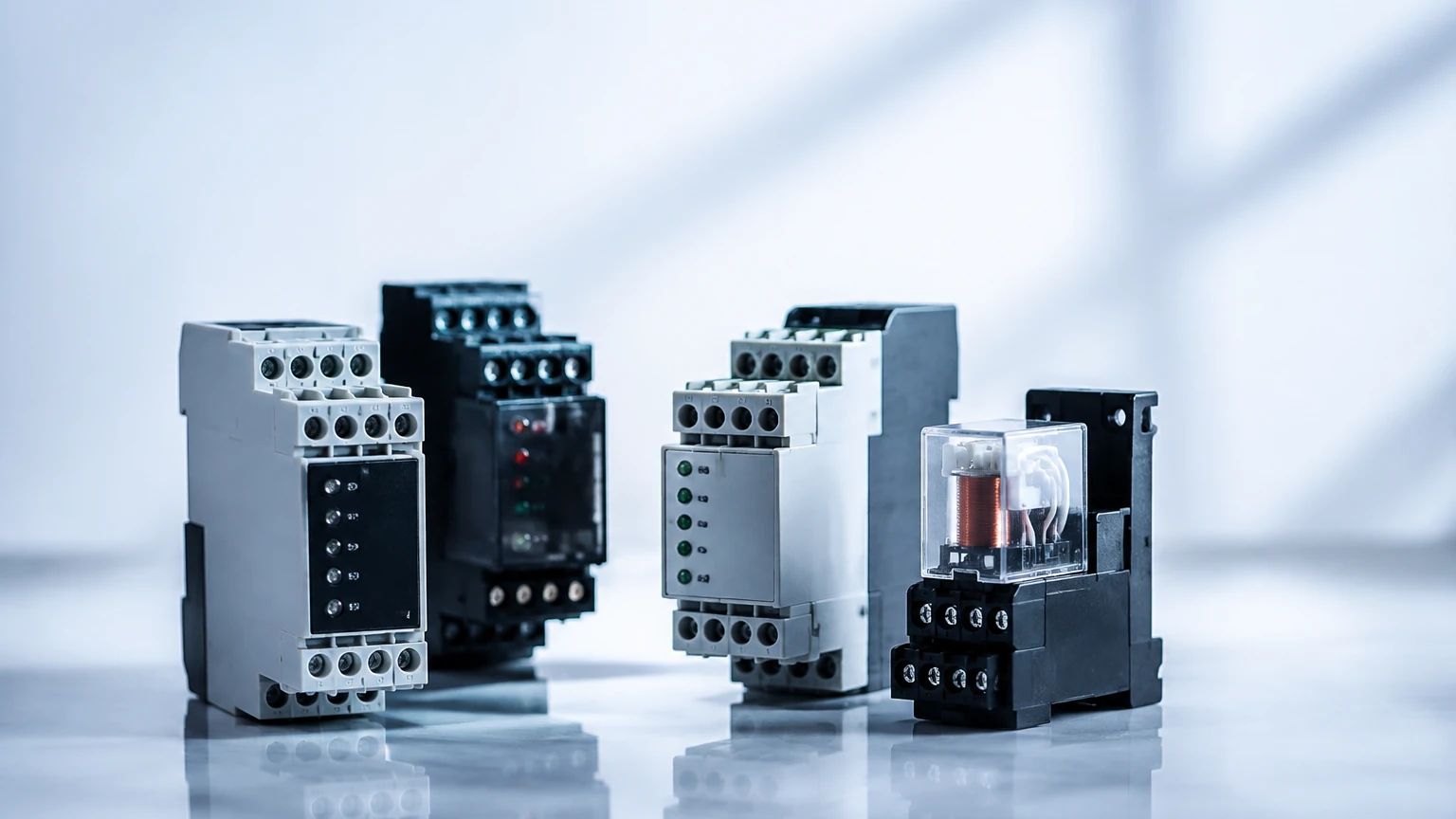
Relays should be mounted on standard 35mm DIN rails within a protected electrical enclosure. If the environment is prone to high humidity or corrosive vapors, the enclosure must meet NEMA 4X or IP66 standards. Ensure that the ambient temperature around the relay remains within the manufacturer's specified range, typically -20°C to +60°C.
Probe and Cable Installation
* Electrode Spacing: For conductive probes, ensure the electrodes are spaced far enough apart (at least 20mm) to prevent debris from bridging the gap and causing a false trigger.
* Cable Shielding: When using analog signal relays (4-20mA), use twisted-pair shielded cables to prevent Electromagnetic Interference (EMI) from high-power motor cables. The shield should be grounded at the controller end only.
* Reference Grounding: In non-metallic tanks (plastic or fiberglass), a reference probe must be installed that reaches deeper than the "Low" probe to provide a return path for the conductive circuit.
Sensitivity Adjustment
Most conductive liquid level control relays feature a sensitivity adjustment potentiometer. This is used to calibrate the relay to the specific conductivity of the liquid. For example, distilled water has very low conductivity and requires high sensitivity, whereas sewage has high conductivity and requires lower sensitivity to prevent false tripping from foam or moisture on the probe head.
Common Risks and Operational Limitations
While liquid level control relays are robust, they are not universal solutions. Engineers must account for the following limitations:
* Foaming: In applications like wastewater treatment or food processing, surface foam can be conductive. A conductive relay may detect the foam as the actual liquid level, leading to premature pump deactivation. In these cases, ultrasonic or radar sensors paired with a signal relay are preferred.
* Turbulence: Rapidly moving liquid or splashing near the probes can cause "chattering" of the relay contacts. To mitigate this, select relays with a built-in time delay (usually adjustable from 0.5 to 10 seconds) to ignore momentary level fluctuations.
* Coating and Build-up: Non-conductive build-up (like oils or fats) on conductive probes can insulate them, preventing the relay from sensing the liquid. Regular cleaning or the use of non-contact sensors is required for such media.
* Electrolytic Corrosion: Using a DC voltage for conductive sensing will cause the probes to erode over time. Always ensure the relay utilizes an AC signal for the sensing circuit to maintain probe longevity.
Frequently Asked Questions (FAQs)
Q: Can I use a conductive level relay for oil or diesel?
A: No. Oils and hydrocarbons are non-conductive. For these liquids, you should use a float-based switch or a hydrostatic pressure transmitter connected to an analog control relay.
Q: What is the maximum distance between the relay and the probes?
A: This depends on the cable capacitance and the relay's sensitivity. Generally, for conductive probes, the distance can be up to 100 meters using standard copper wire. For distances exceeding this, shielded cable is mandatory to prevent false triggering from induced voltage.
Q: How do I choose between "Filling" and "Emptying" modes?
A: Most industrial relays have a terminal jumper or a front-facing switch. In "Filling" mode, the relay energizes when the level is low (to start a supply pump). In "Emptying" mode, the relay energizes when the level is high (to start a discharge pump).
Q: Is it possible to control a 3-phase pump directly with the relay?
A: No. Liquid level control relays are pilot-duty devices. Their internal contacts are typically rated for 5A to 10A at 250VAC. They should be used to switch the coil of a larger motor contactor which then handles the 3-phase power to the pump.
Conclusion
Liquid level control relays are the backbone of automated fluid management. By understanding the specific conductivity of the media, the required control logic (filling vs. emptying), and the environmental constraints of the installation, engineers can design systems that are both reliable and cost-effective. Whether utilizing simple conductive probes for water sumps or integrating advanced radar data via analog relays for chemical processing, selecting high-quality components is the first step toward operational efficiency. For detailed technical specifications and to explore a wide range of industrial measurement hardware, visit the Welk Main Page to find the right solution for your specific project requirements.