Rheonik Coriolis Mass Flow Meters
Rheonik Coriolis Mass Flow Meters
In the landscape of industrial process control, the precision of mass flow measurement is often the determining factor in product quality, safety, and operational efficiency. Rheonik Coriolis mass flow meters have established themselves as a specialized solution within this field, particularly for applications involving extreme pressures, low flow rates, and complex fluids. This guide examines the engineering principles, selection criteria, and installation requirements for these instruments, providing a reference for engineers integrating flow and level measurement systems.
Understanding the Coriolis Measurement Principle
Before selecting a specific meter, it is essential to understand the physics governing Coriolis technology. Unlike volumetric flow meters (such as turbine or vortex meters), a Coriolis meter measures mass directly by exploiting the inertia of the fluid.
The Coriolis Force
At the heart of the instrument are one or more measuring tubes that are vibrated at their resonant frequency by an electromagnetic drive coil. When a fluid (liquid or gas) flows through these vibrating tubes, it is subjected to a Coriolis acceleration. This acceleration induces a minute twisting or phase shift in the tube's vibration.
Sensors located at the inlet and outlet of the tube pick up these oscillations. When there is no flow, the two ends of the tube vibrate in phase. As mass flows through, the inlet side of the tube resists the vibration while the outlet side is accelerated by it, resulting in a phase shift. This shift is directly proportional to the mass flow rate.
Density and Temperature Measurement
In addition to mass flow, Rheonik Coriolis mass flow meters simultaneously measure fluid density and temperature. Density is determined by the resonant frequency of the tubes; a denser fluid increases the mass of the vibrating system, lowering the frequency. Temperature is measured via an internal RTD (Resistance Temperature Detector) to compensate for changes in tube elasticity. This multi-variable capability allows for the calculation of volume flow and concentration in real-time.
Key Features of Rheonik Coriolis Mass Flow Meters
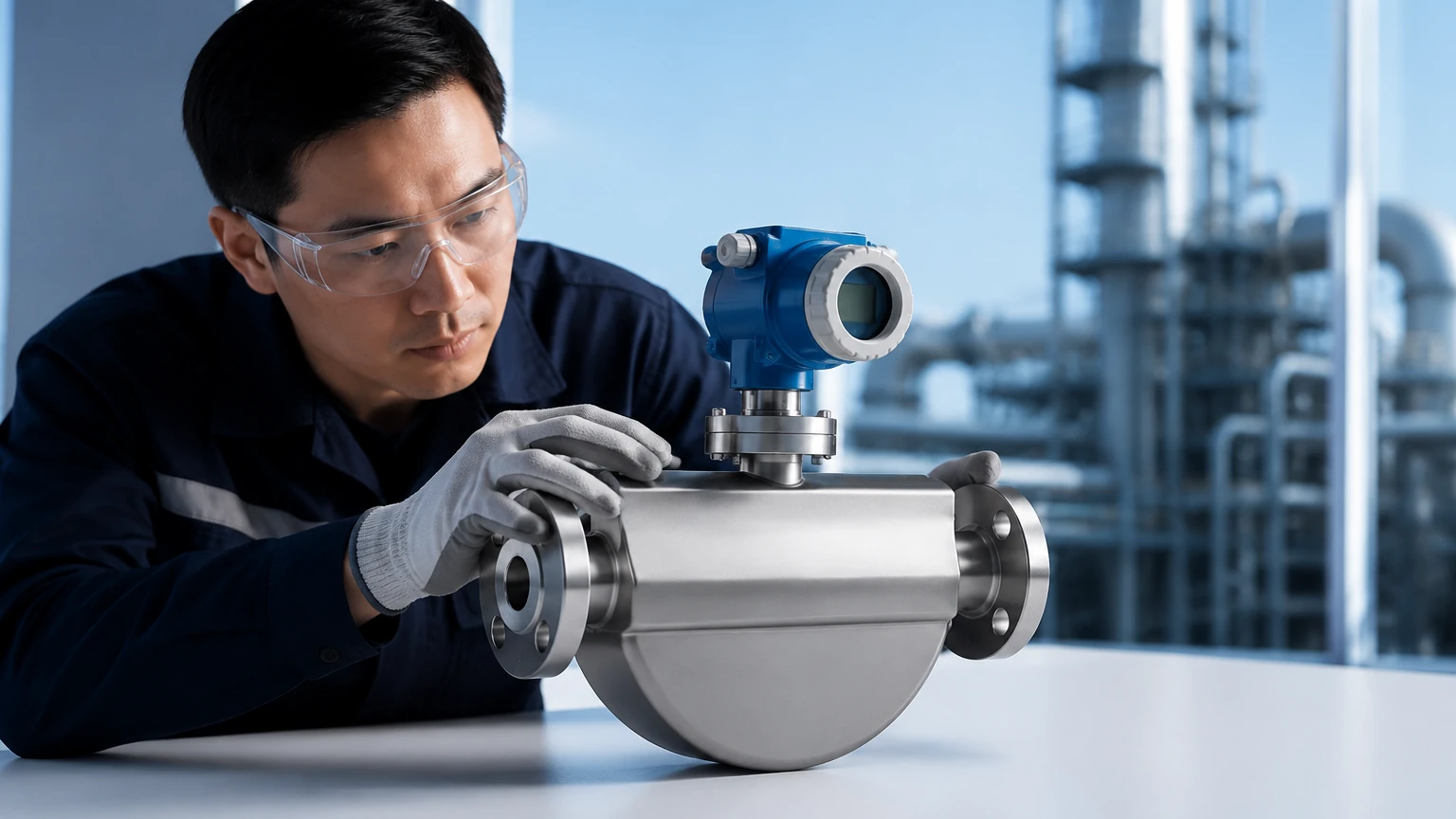
Rheonik is distinguished in the market by its unique "Omega" shape tube design. While many manufacturers use U-shaped or straight tubes, the Omega geometry offers specific mechanical advantages for demanding industrial environments.
The Omega Tube Advantage
The Omega design features a large loop that provides high sensitivity to the Coriolis force while maintaining a relatively thick wall structure. This allows the meters to handle extremely high pressures—exceeding 1,000 bar (14,500 psi) in some models—without sacrificing accuracy. The torsion-based oscillation of the Omega tube is less susceptible to external pipe vibration compared to bending-mode tubes, making it a robust choice for heavy industrial sites.
Material Versatility
To accommodate corrosive or abrasive media, these meters are available in a wide range of materials. While 316L stainless steel is the standard, options include:
* Hastelloy C22: For aggressive acids and chlorides.
* Duplex Steel: For high-pressure offshore applications.
* Tantalum: For extreme chemical resistance.
* Monel: For hydrofluoric acid and oxygen service.
Selection Criteria for Industrial Applications
Choosing the correct Rheonik meter requires a detailed analysis of the process parameters. Engineers should use the following table as a baseline for evaluating different series within the product line.
Selection Table: Typical Rheonik RHM Series Specifications
| Series | Typical Flow Range (kg/min) | Max Pressure (bar/psi) | Common Applications |
| :— | :— | :— | :— |
| RHM 015 | 0.004 – 0.6 (0.009 – 1.3 lb/min) | 1,000+ (14,500+) | Chemical injection, high-pressure R&D |
| RHM 04 | 0.1 – 10 (0.22 – 22 lb/min) | 600 (8,700) | Pilot plants, additive dosing |
| RHM 20 | 5 – 200 (11 – 440 lb/min) | 400 (5,800) | General process, truck loading |
| RHM 60 | 50 – 1,500 (110 – 3,300 lb/min) | 300 (4,350) | Bulk chemical transfer, oil & gas |
| RHM 160 | 100 – 14,000 (220 – 30,800 lb/min) | 150 (2,175) | Large scale distribution, marine bunkering |
Critical Evaluation Factors
1. Flow Turn-down: Consider the minimum and maximum flow rates. Coriolis meters maintain high accuracy over a wide range (often 100:1), but accuracy degrades at the very bottom of the scale.
2. Pressure Drop: Because the fluid must travel through the curved tubes, there is an inherent pressure drop. This must be calculated to ensure the process pump can maintain the required flow rate.
3. Fluid State: While Coriolis meters are excellent for liquids, gas measurement requires higher velocities and pressures to ensure sufficient mass is present to generate a measurable phase shift.
Installation Best Practices and Considerations
Proper installation is paramount to achieving the rated accuracy of ±0.05% to ±0.1% for liquids. Even the most advanced Rheonik Coriolis mass flow meters can underperform if subjected to mechanical stress or improper fluid conditions.
Mechanical Mounting and Support
The meter should be supported by the adjacent piping, and the piping itself must be anchored to a rigid structure. This prevents external vibrations from interfering with the tube's resonant frequency. It is vital to avoid installing the meter at the highest point of a piping system, as air or gas bubbles can trap in the tubes, causing "slug flow" and erratic readings.
Orientation
* For Liquids: The meter is ideally installed in a vertical pipe with the flow moving upward. This ensures the tubes remain completely full and any air bubbles naturally migrate out.
* For Gases: A vertical installation with downward flow is preferred to prevent condensate from pooling in the tubes.
* Horizontal Mounting: If horizontal mounting is necessary, the tubes should point downward for liquid service (to avoid air pockets) and upward for gas service (to avoid liquid buildup).
Zero Calibration
Once installed and under process pressure/temperature, a "zero-point calibration" must be performed. This involves stopping the flow completely while keeping the meter full of fluid. This step accounts for the specific mechanical stresses of the installation environment.
Limitations and Operational Boundaries
While highly versatile, Coriolis technology is not a universal solution for every application. Understanding its boundaries helps prevent costly engineering errors.
1. Entrained Gas: Small amounts of gas (bubbles) in a liquid stream can dampen the tube vibration, leading to measurement errors or a complete stall of the drive circuit. Rheonik meters use advanced digital signal processing to mitigate this, but "three-phase" flow (liquid, gas, and solids) remains a challenge.
2. Initial Cost: The capital expenditure for a Coriolis meter is significantly higher than for magnetic, ultrasonic, or differential pressure meters. The investment is typically justified by the reduction in maintenance and the high accuracy of mass-based billing.
3. Size Constraints: As pipe diameters increase (above 12 inches or 300 mm), Coriolis meters become extremely heavy and expensive, often making other technologies more practical for very large-scale water or utility lines.
Integration with Level Measurement Systems
In many industrial processes, flow measurement and level measurement are complementary. For example, in a chemical blending tank, a Coriolis meter may control the mass of the additives being injected, while a radar level meter or ultrasonic sensor monitors the total volume in the vessel to prevent overfills and manage inventory.
Welk, as a professional manufacturer of industrial level measurement instruments, provides the secondary layer of data necessary for comprehensive process automation. While flow meters track the "delta" (what is moving), level transmitters track the "state" (what is stored). For engineers looking to balance these two critical data points, reviewing the Main Page for radar and hydrostatic level solutions is a recommended next step in system design.
Frequently Asked Questions (FAQs)
Q: Do Rheonik Coriolis mass flow meters require straight pipe runs?
A: Unlike many other flow technologies (like turbine or vortex), Coriolis meters do not require long straight runs of pipe before or after the meter. They are relatively immune to flow profile disturbances, such as swirls or turbulence caused by elbows or valves.
Q: Can these meters measure extremely viscous fluids?
A: Yes. Because the measurement is based on mass and inertia rather than fluid velocity or Reynolds number, Coriolis meters excel at measuring high-viscosity fluids like resins, polymers, and heavy oils, provided the pump can overcome the pressure drop.
Q: How often should the meter be recalibrated?
A: Because there are no moving parts to wear out, the physical calibration of the meter is very stable. Most industrial users perform a zero-check annually and a full wet calibration every 2 to 5 years, depending on the criticality of the application and local regulations.
Q: Is the Omega tube design safe for high-vibration environments?
A: Yes. The Rheonik Omega design is inherently balanced. The drive and pick-up system is designed to ignore frequencies outside of the narrow resonant band of the tubes, making it one of the most vibration-resistant Coriolis designs available.
By carefully considering the fluid properties, pressure requirements, and installation geometry, Rheonik Coriolis mass flow meters provide a reliable and high-precision solution for modern process industries. When paired with robust level measurement technologies, they form the backbone of accurate industrial mass balance and inventory control.