What Is Coriolis Flow Meter
What Is Coriolis Flow Meter
In the landscape of industrial process control, precision is the primary driver of efficiency and safety. Among the various technologies used to quantify fluid movement, the Coriolis flow meter stands out as one of the most accurate and versatile instruments available. Often referred to as a "mass flow meter," it provides a direct measurement of mass flow, density, and temperature, making it a critical component in high-value custody transfer, chemical blending, and complex industrial automation.
Understanding what is coriolis flow meter technology requires looking beyond simple velocity measurement. Unlike traditional volumetric meters, which can be affected by changes in temperature, pressure, and fluid viscosity, a Coriolis meter measures the actual mass of the fluid passing through the system. This distinction is vital for industries where the chemical or energy content of a substance is tied to its mass rather than its volume.
The Measurement Principle: The Coriolis Effect
To understand how these meters function, one must first understand the underlying physics known as the Coriolis effect. This effect describes the inertial force acting on an object that is in motion within a frame of reference that is rotating.
The Vibrating Tube Mechanism
In a Coriolis flow meter, the fluid passes through one or two measuring tubes. These tubes are intentionally vibrated at their resonant frequency by an electromagnetic drive coil. When there is no flow, the tubes vibrate in a uniform, symmetrical manner. Sensors (pick-offs) located at the inlet and outlet of the tubes record this vibration as a sine wave.
Phase Shift and Mass Flow
When fluid begins to flow through the vibrating tubes, the Coriolis force is generated. As the fluid moves toward the center of the vibration (the bend of the tube), it resists being pushed sideways, exerting a force against the tube. As it moves away from the center, it exerts a force in the opposite direction.
This causes the tubes to twist slightly. The inlet side of the tube and the outlet side no longer reach their peak vibration at the same time. This time delay is known as a "phase shift." The magnitude of this phase shift is directly proportional to the mass flow rate of the fluid. Because the meter measures the physical twist of the tube, it is inherently measuring mass, not volume.
Density and Temperature Measurement
Beyond mass flow, these instruments are multi-variable.
1. Density: The resonant frequency at which the tubes vibrate changes depending on the mass of the fluid inside them. A heavier (denser) fluid will cause the tubes to vibrate at a lower frequency. By measuring this frequency, the meter calculates the fluid's density in real-time.
2. Temperature: Since the elasticity of the measuring tubes changes with temperature, a built-in RTD (Resistance Temperature Detector) monitors the tube temperature to compensate the flow and density calculations, while also providing the process temperature as an output.
Why Mass Flow Measurement is Superior
In many B2B industrial applications, measuring volume is insufficient. For example, 1,000 liters (approx. 264 gallons) of fuel at 10°C (50°F) contains more energy and more mass than 1,000 liters at 40°C (104°F) because the fuel expands as it warms.
By focusing on mass, Coriolis meters eliminate the need for complex compensation calculations involving external pressure and temperature transmitters. This makes them the preferred choice for:
* Custody Transfer: Ensuring the exact mass of product bought or sold is recorded.
* Chemical Reactions: Maintaining precise stoichiometric ratios in reactors.
* Compressed Gases: Measuring gases where volume is highly dependent on pressure.
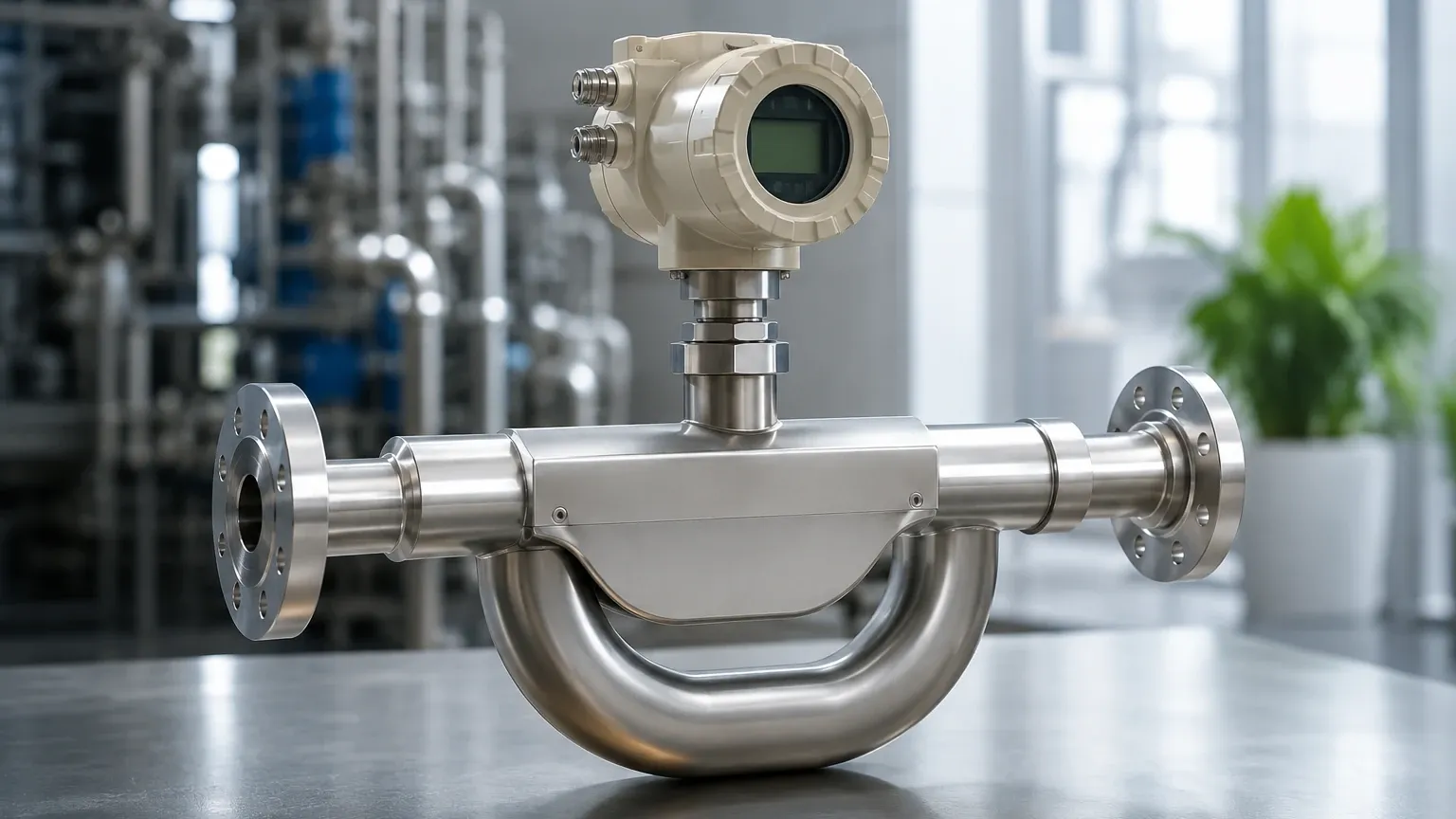
Design Variations: U-Tube vs. Straight Tube
Coriolis flow meters are typically designed in two primary configurations, each suited for specific process requirements.
| Feature | U-Shaped Tube | Straight Tube |
| :— | :— | :— |
| Sensitivity | High; the geometry amplifies the Coriolis force. | Lower; requires more sophisticated electronics to detect twist. |
| Pressure Drop | Generally higher due to the curved path. | Lower; ideal for gravity-fed or low-pressure systems. |
| Cleanability | Harder to drain; may retain fluid in the bend. | Excellent; "self-draining" and easier to clean (CIP/SIP). |
| Installation Space | Requires more vertical or horizontal clearance. | Compact; fits easily into existing straight piping runs. |
| Solids Handling | Risk of erosion or buildup in the bend. | Better performance with slurries or suspended solids. |
Technical Evaluation and Selection Criteria
When evaluating a Coriolis flow meter for a specific application, engineers must consider several technical parameters to ensure long-term reliability and accuracy.
1. Accuracy and Repeatability: Most high-end Coriolis meters offer mass flow accuracy of ±0.1% or even ±0.05%. This is significantly higher than most other flow technologies.
2. Turndown Ratio: This refers to the range over which the meter can measure accurately. Coriolis meters often feature a turndown ratio of 20:1 or 100:1, allowing them to handle fluctuating flow rates without losing precision.
3. Material Compatibility: The measuring tubes must be compatible with the process fluid. Common materials include 316L Stainless Steel, Hastelloy C22, and Tantalum for highly corrosive acids.
4. Pressure Rating: The wall thickness of the vibrating tubes dictates the maximum operating pressure. Higher pressure ratings often require thicker tubes, which may slightly reduce sensitivity.
Practical Selection Table for Industrial Applications
| Application | Recommended Tube Material | Key Requirement | Preferred Design |
| :— | :— | :— | :— |
| Food & Beverage | 316L Stainless Steel | Hygienic (CIP/SIP) | Straight Tube |
| Oil & Gas (Loading) | Carbon Steel / SS | High Accuracy | U-Tube |
| Corrosive Chemicals | Hastelloy / Tantalum | Chemical Resistance | U-Tube |
| High-Viscosity Oils | 316L Stainless Steel | Low Pressure Drop | Straight Tube |
| Cryogenic Fluids | Specialized Alloys | Thermal Stability | U-Tube |
Installation Considerations and Best Practices
Proper installation is paramount for Coriolis meters because they rely on detecting minute vibrations. External factors can easily introduce "noise" into the measurement.
Vibration Decoupling
The meter should be isolated from plant vibrations caused by pumps, motors, or vibrating machinery. Using flexible connectors or rigid pipe supports on both the inlet and outlet sides of the meter is recommended to ensure the only vibration the sensors detect is the intended resonant frequency of the tubes.
Orientation
* Liquids: The meter should ideally be installed in a "U-down" position (for U-tube models) or vertically with flow moving upward. This ensures the tubes remain full and prevents air bubbles from being trapped.
* Gases: The meter should be installed in a "U-up" position or vertically with flow moving downward to allow any condensed liquids to drain out of the tubes.
Avoiding Entrained Gas
One of the primary challenges for Coriolis meters is "slug flow" or entrained gas in a liquid stream. Small bubbles can dampen the vibration of the tubes, leading to measurement errors or a "stalled" meter. In applications where gas entrainment is likely, air eliminators should be installed upstream.
Limitations and Common Risks
While highly capable, Coriolis meters are not a universal solution for every scenario:
* Initial Cost: They are generally more expensive than magnetic or ultrasonic meters. However, the Total Cost of Ownership (TCO) is often lower due to reduced maintenance and high accuracy.
* Size Constraints: As pipe diameters increase (above 250mm or 10 inches), Coriolis meters become extremely large, heavy, and expensive.
* Pressure Drop: In U-tube designs, the change in flow direction can cause a significant pressure drop, which must be accounted for in pump sizing.
Integration with Level Measurement Systems
In a comprehensive process automation strategy, flow measurement and level measurement are complementary. While a Coriolis meter tells you how much mass is entering or leaving a vessel, level measurement instruments provide the necessary redundancy and inventory validation.
For instance, in a blending tank, a Coriolis meter ensures the precise mass of each ingredient is added. Simultaneously, hydrostatic or radar level transmitters provide a continuous check on the total volume in the tank, ensuring safety against overfills and providing a secondary data point for mass balance calculations. For engineers looking to optimize their entire process loop, exploring the Main Page of specialized measurement providers like Welk can provide insights into integrating these technologies. Reliable level switches and transmitters act as the final safeguard in systems where flow meters manage the primary process throughput.
Frequently Asked Questions (FAQs)
Q: Can a Coriolis flow meter measure steam?
A: While theoretically possible, it is rarely practical. The low density of steam requires very high velocities to generate a measurable Coriolis force, leading to extreme pressure drops. Vortex meters are generally preferred for steam applications.
Q: How often does a Coriolis meter need calibration?
A: Because there are no moving parts to wear out (the tubes only vibrate slightly), Coriolis meters are incredibly stable. Many industries perform a "zero check" periodically, but full recalibration may only be required every 2 to 5 years depending on the criticality of the process and local regulations.
Q: Does fluid viscosity affect the measurement?
A: No. One of the greatest strengths of the Coriolis principle is that it is independent of viscosity. It can measure everything from water and thin solvents to thick resins and peanut butter with the same level of accuracy.
Q: What is the "Zero Offset"?
A: This is the small signal the meter might produce when there is zero flow, often caused by installation stresses or ambient temperature shifts. Performing a "zeroing" procedure under actual process conditions (full pipe, zero flow) is a standard commissioning step.
Conclusion
Determining what is coriolis flow meter technology's role in your facility depends on your requirements for accuracy and the nature of your process fluids. By providing direct mass, density, and temperature data in a single device, these meters offer unparalleled insight into process dynamics. When combined with robust level measurement solutions, they form the backbone of modern, efficient industrial automation. By adhering to strict installation guidelines and selecting the appropriate tube geometry, B2B operators can ensure precise control over their most valuable liquid and gas assets.