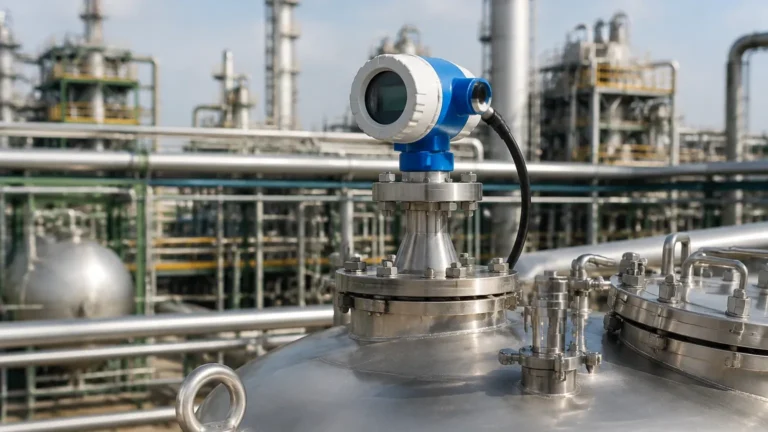
Radar Level Transmitter Fmcw
Radar Level Transmitter FMCW: A Technical Guide to Frequency Modulated Continuous Wave Measurement
In the field of industrial process automation, the demand for high-precision, non-contact level measurement has led to the widespread adoption of radar technology. Among the various methods available, the radar level transmitter FMCW (Frequency Modulated Continuous Wave) has emerged as a superior solution for complex applications. Unlike traditional pulse radar, FMCW technology provides enhanced resolution and reliability, making it a staple in industries ranging from chemical processing to wastewater treatment.
As a professional manufacturer of industrial instrumentation, Welk provides a range of Radar Level Meters designed to meet these rigorous standards. This guide examines the technical principles of FMCW radar, its advantages over alternative technologies, and the critical factors engineers must consider during selection and installation.
1. Measurement Principles: How FMCW Radar Works
To understand the performance of a radar level transmitter fmcw, one must first distinguish it from the older "Time of Flight" (ToF) pulse radar.
The FMCW Mechanism
In FMCW radar, the transmitter emits a continuous high-frequency signal. However, unlike a simple continuous wave, the frequency of this signal is modulated over time—typically in a linear "sweep" or "chirp." The signal travels to the surface of the medium, reflects, and returns to the sensor.
Because the transmitter is constantly changing its frequency, by the time the reflected signal returns, the transmitter is already emitting a different frequency. The electronic components of the radar level meter then mix the received signal with a portion of the currently transmitted signal. This creates a "beat frequency" ($Δf$) that is directly proportional to the distance the signal traveled.
Why Frequency Modulation Matters
By measuring the frequency difference rather than attempting to time a nanosecond-speed pulse, FMCW systems achieve much higher signal-to-noise ratios. This allows for:
* Higher Precision: Accuracy can often reach ±1 mm or ±2 mm.
* Better Resolution: The ability to distinguish between the actual product level and nearby obstructions like agitator blades or tank internal structures.
* Greater Sensitivity: Improved performance on low-dielectric constant (εr) materials, such as oils and plastics.
2. Technical Comparison: FMCW vs. Pulse Radar
Engineers often choose between FMCW and Pulse radar based on the specific requirements of the vessel and the medium.
| Feature | Pulse Radar | FMCW Radar |
| :— | :— | :— |
| Signal Type | Short bursts/pulses | Continuous modulated wave |
| Measurement Basis | Time of flight | Frequency difference (Beat frequency) |
| Accuracy | Standard (±5mm to ±10mm) | High (±1mm to ±3mm) |
| Signal-to-Noise | Moderate | High |
| Power Consumption | Very Low (Loop-powered) | Moderate to High (Modern units are loop-powered) |
| Application Range | Simple liquid storage | Complex tanks, solids, and low-dielectric media |
While pulse radar remains cost-effective for simple water tank applications, the radar level transmitter fmcw is the preferred choice for process vessels where steam, turbulence, or internal obstructions are present.
3. Selecting the Right Frequency: 26GHz vs. 80GHz
The operating frequency of a radar level transmitter fmcw significantly impacts its performance. Most industrial FMCW radars operate in either the K-band (approx. 26GHz) or the W-band (approx. 80GHz).
26GHz Radar Level Meters
These are versatile instruments suitable for a wide range of liquids. Their larger wavelength allows them to penetrate moderate amounts of foam or dust better than higher-frequency units. However, they typically have a wider beam angle, which requires a larger "clear path" within the tank to avoid false echoes from walls or pipes.
80GHz Radar Level Meters
The move toward 80GHz technology has revolutionized the industry. The higher frequency allows for a much narrower beam angle (as small as 3°).
* Small Nozzles: Can be installed on narrow nozzles without signal interference.
* Internal Obstructions: The narrow beam can easily bypass agitators, heating coils, and ladders.
* High Resolution: Superior performance in measuring solids where the surface may be uneven or sloped.
4. Engineering Selection Criteria
When specifying a radar level transmitter fmcw, several environmental and process variables must be confirmed to ensure reliable operation.
Dielectric Constant (εr)
The dielectric constant of the medium determines how much energy is reflected back to the sensor.
* High εr (>10): Water-based liquids provide strong reflections and are easy to measure.
* Low εr (1.4 to 4): Hydrocarbons, solvents, and dry solids reflect very little energy. In these cases, a high-sensitivity FMCW transmitter with a large antenna or a focused 80GHz beam is required.
Process Temperature and Pressure
Standard radar sensors are often rated up to 80°C or 130°C. For high-temperature applications (e.g., molten salts or high-pressure steam), specialized horn antennas with ceramic or PTFE seals are necessary to protect the electronics while maintaining signal integrity.
Vessel Geometry and Internals
Before purchasing, an international buyer should provide a tank drawing. The presence of an agitator, for instance, might necessitate an FMCW unit with "false echo suppression" software, which allows the device to learn and ignore static reflections from the blades.
5. Installation Considerations and Constraints
Even the most advanced radar level transmitter fmcw will fail if installed incorrectly. Follow these engineering guidelines to ensure optimal signal quality:
1. Avoid the Center: Never install the radar in the exact center of a domed tank. This can cause multiple reflections to converge and overwhelm the sensor.
2. Nozzle Height: The antenna should ideally extend slightly past the bottom of the mounting nozzle. If the nozzle is too long or narrow, it can create "ringing" or noise that masks the signal from the product surface.
3. Dead Zone (Blocking Distance): Every radar has a minimum distance it cannot measure (typically 50mm to 200mm from the antenna tip). Ensure the maximum fill level of the tank does not enter this zone.
4. Beam Path: Ensure the 3dB beam path is clear of obstructions. For a 10-meter tall tank with an 8° beam angle, the beam diameter at the bottom is approximately 1.4 meters.
5. Orientation: For solids measurement, an aiming flange (swivel mount) is often required to point the radar at the material's angle of repose.
6. Practical Selection Table for Industrial Applications
| Application Type | Recommended Technology | Key Reason |
| :— | :— | :— |
| Acid/Alkali Storage | 80GHz FMCW (PTFE Lens) | Chemical resistance and narrow beam for small plastic tanks. |
| Bitumen/Asphalt | 26GHz FMCW (Horn Antenna) | Handles high temperatures and potential antenna coating. |
| Cement Silos | 80GHz FMCW (High Power) | Penetrates dust and measures sloped surfaces accurately. |
| Oil/Water Separator | FMCW with High Sensitivity | Precisely detects the interface or low-dielectric oil top layer. |
| Wastewater Sump | 26GHz FMCW or Ultrasonic | Cost-effective for non-turbulent, high-dielectric liquids. |
7. Limitations and Risks
While FMCW radar is highly robust, it is not a universal solution for every scenario. Engineers should be aware of the following risks:
* Heavy Foam: Extremely thick, dense foam (like shaving cream) can absorb the radar signal entirely, leading to a "loss of echo." In such cases, a guided wave radar or a mechanical float may be more appropriate.
* Vacuum Conditions: While radar works in a vacuum, the sealing materials of the transmitter must be rated for vacuum service to prevent air ingress or sensor damage.
* Condensation: Heavy droplets on the antenna lens can attenuate the signal. Selecting a device with a curved PTFE lens (dripping-lens design) helps shed condensation and maintain signal strength.
8. Frequently Asked Questions (FAQs)
Q: Can a radar level transmitter fmcw measure through a plastic tank wall?
A: Yes, if the tank is made of a non-conductive material like PE, PP, or GRP and is not reinforced with metal mesh, the radar can measure the level from the outside, provided the dielectric constant of the liquid inside is high enough.
Q: Does the frequency of the radar affect safety ratings?
A: No, the frequency (26GHz vs 80GHz) does not dictate the ATEX or SIL rating. Safety ratings are determined by the enclosure design and the electronic circuit's functional safety architecture.
Q: How often does an FMCW radar need calibration?
A: Because there are no moving parts and the measurement is based on frequency, FMCW radars are extremely stable. In most non-custody transfer applications, a verification check every 12 to 24 months is sufficient.
Q: What information should I provide to a manufacturer like Welk for a quote?
A: You should provide the medium name, dielectric constant (if known), operating temperature/pressure, tank height, nozzle dimensions, and whether there is an agitator or steam present.
Conclusion
The radar level transmitter fmcw represents the pinnacle of non-contact level measurement technology. By utilizing frequency modulation, these devices offer the precision and reliability required for modern industrial processes. Whether you are managing volatile chemicals or bulk solids, understanding the nuances of beam angles, frequencies, and dielectric properties is essential for a successful installation.
For more detailed specifications and to explore our full range of instrumentation, visit our Radar Level Meters product page. Selecting the right tool for the job ensures not only process efficiency but also the long-term safety and reliability of your industrial operations.