Pressure Level Transmitter
Pressure Level Transmitter
In the landscape of industrial process control, the pressure level transmitter remains one of the most versatile and widely adopted instruments for determining the liquid level in tanks, wells, and pressurized vessels. By leveraging the physical relationship between the height of a liquid column and the pressure it exerts at a specific depth, these devices provide reliable data essential for inventory management, safety monitoring, and automated process control.
As a professional manufacturer, Welk specializes in providing high-precision level measurement solutions. Understanding the underlying physics and the engineering nuances of the pressure level transmitter is the first step toward selecting the correct instrument for a specific application. This guide details the measurement principles, selection criteria, and installation best practices for engineers and plant managers.
Measurement Principles of Pressure Level Transmitters
The operation of a pressure level transmitter is based on the hydrostatic pressure principle. Hydrostatic pressure is the pressure exerted by a fluid at equilibrium at any given point within the fluid, due to the force of gravity.
The Hydrostatic Equation
The relationship is defined by the following formula:
P = ρ · g · h
Where:
* P is the hydrostatic pressure (measured in Pascals or bar).
* ρ (rho) is the density of the liquid (kg/m³).
* g is the acceleration due to gravity (approximately 9.81 m/s²).
* h is the height of the liquid column above the measurement point (meters).
In most industrial applications, gravity remains constant. If the density (ρ) of the liquid is known and remains stable, the pressure measured by the transmitter is directly proportional to the liquid level (h). The pressure level transmitter converts this mechanical pressure into an electrical signal, typically a 4-20mA analog output or a digital signal via HART or RS485 protocols.
Atmospheric Compensation
For tanks open to the atmosphere, the transmitter must account for ambient atmospheric pressure. If the sensor only measured absolute pressure, fluctuations in weather or altitude would cause errors in the level reading. To prevent this, a pressure level transmitter usually features a vent tube or a reference port that allows the sensor to measure "gauge pressure"—subtracting the atmospheric pressure from the total pressure to isolate the pressure generated solely by the liquid height.
Types of Pressure Level Transmitters
Depending on the mounting requirements and the nature of the storage vessel, different configurations of transmitters are utilized.
1. Submersible Level Transmitters
Often referred to as "throw-in" sensors, these are designed to be lowered directly into the liquid. They consist of a sensing element housed in a waterproof stainless steel casing, connected to a specialized cable that contains a vent tube for atmospheric compensation. These are ideal for deep wells, reservoirs, and wastewater sumps.
2. External (Side-Mounted) Transmitters
These are mounted to the outside of a tank via a threaded or flanged connection near the bottom of the vessel. The diaphragm of the transmitter is in direct contact with the process fluid. These are common in chemical processing and food and beverage industries where the tank structure allows for side penetration.
3. Differential Pressure (DP) Transmitters
In closed or pressurized tanks, the space above the liquid is often occupied by pressurized gas or steam. In this scenario, a standard gauge pressure transmitter would provide an incorrect reading because it cannot distinguish between the pressure of the liquid and the pressure of the gas. A DP transmitter measures the difference between the pressure at the bottom of the tank (High side) and the pressure at the top of the tank (Low side), effectively canceling out the gas pressure to provide an accurate liquid level.
Selection Criteria for Industrial Applications
Choosing the right pressure level transmitter requires a thorough analysis of the process environment. Engineers should consult the Main Page of technical documentation to ensure compatibility with specific chemical and physical parameters.
Media Compatibility
The wetted parts of the transmitter, particularly the diaphragm, must be resistant to the process fluid. While 316L stainless steel is standard, highly corrosive media may require specialized materials such as Hastelloy C, Monel, or Tantalum. For food and pharmaceutical applications, a flush diaphragm design is necessary to prevent bacterial growth and allow for Clean-in-Place (CIP) procedures.
Temperature and Pressure Range
Standard transmitters typically operate within a range of -20°C to +80°C. High-temperature applications (such as steam boilers) require cooling elements or remote capillary seals to protect the sensitive electronics from heat damage. Additionally, the transmitter must be rated for the maximum expected pressure of the system to prevent diaphragm rupture.
Accuracy and Stability
Industrial-grade transmitters usually offer accuracy levels ranging from 0.1% to 0.5% of the full scale. For critical custody transfer or high-value chemical dosing, higher precision models are required. Long-term stability is also a factor, as it determines how often the device will need recalibration.
Practical Selection Table
| Application Type | Recommended Transmitter | Mounting Style | Key Advantage |
| :— | :— | :— | :— |
| Deep Wells / Boreholes | Submersible | Suspended by cable | Easy installation in deep, narrow spaces. |
| Open Chemical Tanks | External / Flanged | Side-mounted | Easy access for maintenance and cleaning. |
| Pressurized Vessels | Differential Pressure | Dual-port connection | Accurate level regardless of headspace pressure. |
| Viscous / Slurry Media | Flush Diaphragm | Threaded or Flanged | Prevents clogging and material buildup. |
| Potable Water | Submersible (Food Grade) | Suspended | Certified materials prevent contamination. |
Installation Considerations
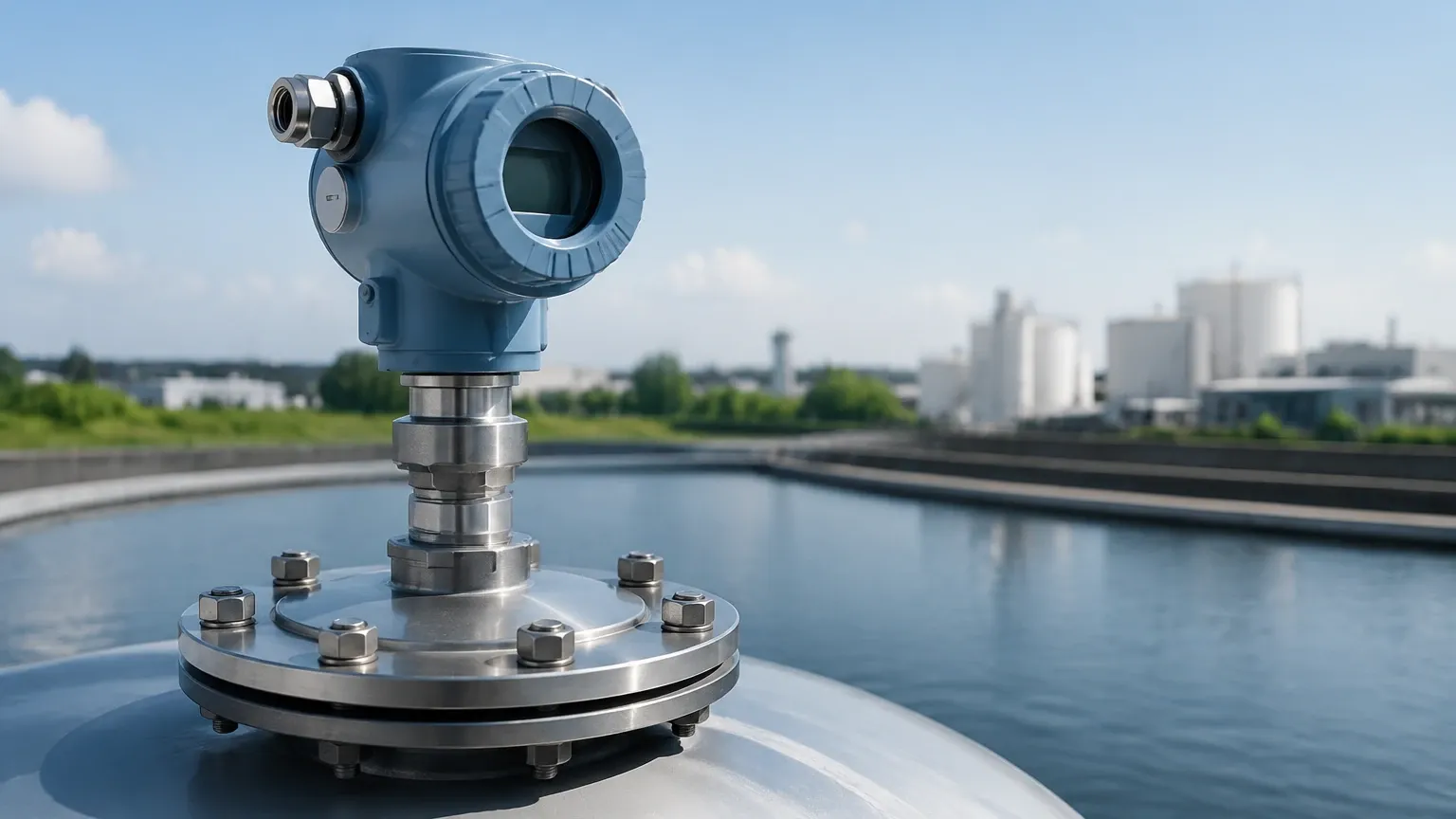
Proper installation is critical to the longevity and accuracy of a pressure level transmitter. Even the most advanced sensor will fail if environmental factors are ignored.
1. Avoid Turbulence: In tanks with agitators or high-velocity inlets, the transmitter should not be placed directly in the path of the flow. Turbulence can cause pressure spikes and mechanical wear. The use of a "stilling well" (a perforated pipe that shields the sensor) is recommended in these environments.
2. Positioning: For side-mounted units, ensure the transmitter is installed at the lowest point of the required measurement range. Any liquid below the transmitter level will be "dead volume" and cannot be measured.
3. Cable Protection: For submersible models, the cable should be secured to prevent it from swinging. The vent tube within the cable must remain unobstructed and protected from moisture ingress. Using a desiccant filter at the end of the vent tube is a common best practice.
4. Diaphragm Protection: The sensing diaphragm is extremely thin. During installation, avoid touching the diaphragm with fingers or tools, as even a slight deformation can result in significant measurement errors.
Limitations and Risks
While highly effective, the pressure level transmitter has specific limitations that engineers must account for during the design phase:
* Density Sensitivity: Since the measurement relies on the formula $P = ρgh$, any change in the liquid's density will change the level reading. If a tank is used for different fluids with varying densities, the transmitter must be recalibrated, or a density-compensation algorithm must be used in the control system.
* Sediment Buildup: In wastewater or mining applications, silt and sediment can accumulate at the bottom of the tank, covering the transmitter's diaphragm. This can lead to "drift" or a complete loss of signal. Regular cleaning schedules or the use of flush diaphragms can mitigate this risk.
* Gas Pockets: In DP applications, if the impulse lines (the tubes connecting the tank to the transmitter) become trapped with gas (in liquid lines) or liquid (in gas lines), the reading will be inaccurate. Proper sloping of impulse lines is required to allow trapped fluids or gases to escape back into the tank.
Frequently Asked Questions (FAQs)
Q: Can a pressure level transmitter be used to measure the level of solids?
No. Hydrostatic pressure principles only apply to fluids that exert pressure equally in all directions. For solids, powders, or granulates, technologies like radar or ultrasonic level meters are required.
Q: How often should a pressure level transmitter be calibrated?
In stable environments, annual calibration is typically sufficient. However, in high-precision or harsh chemical environments, semi-annual checks are recommended to account for potential sensor drift.
Q: What is the difference between a pressure sensor and a pressure transmitter?
A pressure sensor is the basic element that converts pressure into a low-level electrical signal (like millivolts). A pressure transmitter includes signal conditioning electronics to convert that raw signal into a standardized industrial output, such as 4-20mA, which can travel long distances without signal loss.
Q: How do I handle foaming liquids?
One of the primary advantages of a pressure level transmitter over ultrasonic or radar technology is that it is unaffected by foam. Because the pressure is determined by the mass of the liquid above the sensor, the light, airy foam on the surface does not add significant pressure and is effectively ignored by the sensor.
Conclusion
The pressure level transmitter remains a cornerstone of industrial instrumentation due to its simplicity, reliability, and cost-effectiveness. By understanding the hydrostatic principle and carefully matching the transmitter materials and mounting styles to the application, operators can achieve precise level control in even the most demanding environments. For those seeking to integrate these solutions into their automation systems, Welk provides a range of robust instruments tailored for water treatment, chemical processing, and oil and gas sectors. For more detailed product specifications and engineering support, please visit our Main Page to explore our full catalog of level measurement technologies.