Füllstandssensor
Füllstandssensor
In the realm of industrial automation and process control, the accurate measurement of liquids and solids within containers is fundamental to operational efficiency, safety, and inventory management. A füllstandssensor (level sensor) is a critical instrument designed to detect the level of substances that flow, including liquids, slurries, granular materials, and powders. These sensors provide the data necessary for automated systems to prevent overflows, manage dry-run protection for pumps, and ensure precise dosing in chemical processes.
Choosing the correct füllstandssensor requires a deep understanding of the physical properties of the medium, the environmental conditions of the storage vessel, and the specific requirements of the application. As a professional manufacturer, Welk provides a comprehensive range of instruments, from radar and ultrasonic sensors to hydrostatic transmitters and magnetic gauges, tailored for industries such as water treatment, chemical processing, and oil and gas.
Core Measurement Principles
Before selecting a füllstandssensor, it is essential to understand the underlying physics that govern different measurement technologies. These can be broadly categorized into non-contact and contact measurement methods.
Non-Contact Measurement
Non-contact sensors are preferred in applications where the medium is corrosive, abrasive, or extremely hot, as they do not physically touch the material being measured.
1. Radar (Radio Detection and Ranging): Radar sensors emit high-frequency electromagnetic waves (typically in the GHz range). These waves travel to the surface of the medium, reflect, and return to the sensor. The sensor calculates the distance based on the time-of-flight or frequency shift. Radar is highly versatile because electromagnetic waves are not affected by air temperature, pressure, or vacuum.
2. Ultrasonic: These sensors emit high-frequency sound pulses. The time taken for the echo to return from the surface is used to calculate the distance. While cost-effective, ultrasonic waves are mechanical and can be influenced by air temperature, heavy foam, or high-pressure vapors.
Contact Measurement
Contact sensors are often more economical or provide mechanical reliability in specific pressurized environments.
1. Hydrostatic Pressure: This principle relies on the fact that the pressure at the bottom of a liquid column is directly proportional to the height of the liquid. By measuring the pressure relative to the atmospheric pressure (or vessel pressure), the sensor determines the level.
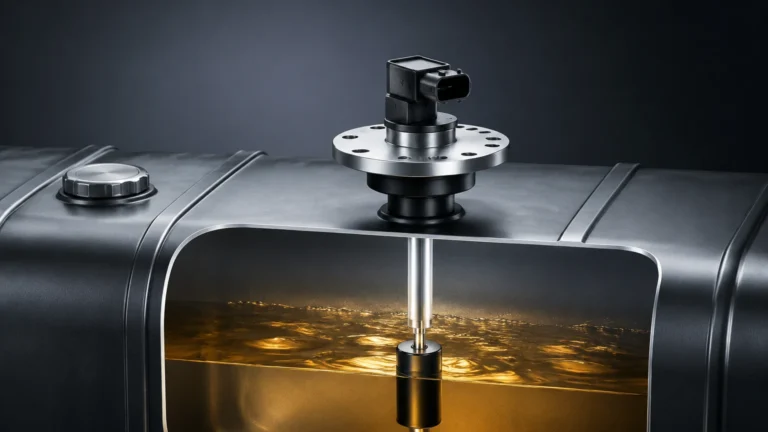
2. Magnetic Buoyancy: Utilizing a float with an internal magnet, these sensors move along a guide tube or alongside a visual indicator. The magnetic field interacts with reed switches or a magnetic display to indicate the level.
3. Point Level Switches: Unlike continuous sensors, switches detect when a material reaches a specific height. Technologies include tuning forks (vibrating level switches), capacitive probes, and float switches.
Technical Deep Dive: Radar Level Meters
Radar technology has become the gold standard for many industrial applications due to its precision and reliability. Modern radar füllstandssensor units generally operate on one of two principles: Pulse Radar or Frequency Modulated Continuous Wave (FMCW).
Pulse Radar vs. FMCW
Pulse radar sends short microwave pulses and measures the time-of-flight. FMCW radar, however, emits a continuous signal with a constantly changing frequency. The difference in frequency between the emitted and received signal is proportional to the distance. FMCW is generally more accurate and provides a better signal-to-noise ratio, making it ideal for complex tanks with internal obstructions.
Frequency Considerations
* 26 GHz Radar: Suitable for most liquid applications and large-grain solids. It offers a good balance between beam angle and signal strength.
* 80 GHz Radar: Features a much narrower beam angle and higher resolution. This allows the sensor to be installed in small nozzles or tanks with many internal structures (agitators, pipes) without interference. It is also superior for measuring low-dielectric media like oils.
Ultrasonic Level Sensors: Practical Utility
Ultrasonic sensors are widely used in water treatment and open-channel flow measurement. Because they rely on the speed of sound, which varies with temperature, high-quality ultrasonic füllstandssensor units include integrated temperature compensation.
Limitations: They are not recommended for vacuum applications, as sound cannot travel through a vacuum. Additionally, heavy dust or thick foam can absorb the acoustic signal, leading to signal loss. For such environments, radar is typically the preferred alternative.
Hydrostatic Level Transmitters
For deep wells, open reservoirs, and vented tanks, hydrostatic measurement is a robust choice. The sensor is typically submerged at the bottom of the tank. The formula used is:
*P = ρ * g * h*
Where *P* is pressure, *ρ* (rho) is the density of the liquid, *g* is gravity, and *h* is the height of the liquid.
It is vital to note that if the liquid density changes significantly due to temperature fluctuations, the accuracy of a hydrostatic füllstandssensor will be affected unless density compensation is applied. For pressurized tanks, a differential pressure transmitter is required to subtract the top gas pressure from the total bottom pressure.
Selection Criteria for Industrial Level Measurement
Selecting the right instrument involves more than just picking a technology. Engineers must evaluate the following parameters:
| Feature | Radar | Ultrasonic | Hydrostatic | Magnetic Gauge |
| :— | :— | :— | :— | :— |
| Medium | Liquids, Solids, Corrosives | Liquids, Slurries | Liquids | Clean Liquids |
| Accuracy | High (±2mm to ±5mm) | Moderate (±0.25% FS) | High (±0.1% to ±0.5%) | Moderate |
| Pressure Range | Vacuum to 40 MPa | Atmospheric | Submersible/Pressurized | Up to 16 MPa |
| Temp. Range | -40°C to +250°C+ | -40°C to +70°C | -20°C to +80°C | -40°C to +400°C |
| Cost | Higher | Moderate | Low to Moderate | Moderate |
| Contact | Non-contact | Non-contact | Contact | Contact |
For a complete overview of available hardware and technical specifications, you may visit the Main Page of our product catalog.

Installation Considerations and Best Practices
Proper installation is as important as selecting the right technology. Even the most advanced füllstandssensor will fail if installed incorrectly.
1. Dead Zones (Blocking Distance)
Every non-contact sensor (radar and ultrasonic) has a "dead zone" directly beneath the sensor face where measurements cannot be taken. Ensure the maximum expected level does not enter this zone. For example, if a sensor has a 0.3m dead zone, the mounting nozzle should be positioned so the liquid never reaches within 0.3m of the sensor face.
2. Nozzle Positioning
Avoid mounting sensors in the center of a tank, especially in cylindrical tanks with domed tops, as this can create multiple echoes (parabolic effect). The ideal position is usually 1/6th of the tank diameter away from the wall. However, do not mount the sensor too close to the wall, as the beam may reflect off the wall surface or buildup.
3. Avoiding Obstructions
Internal pipes, ladders, and agitators can create false reflections. While modern software allows for "false echo suppression" (mapping out the tank when empty), it is best to provide a clear line of sight to the medium surface.
4. Turbulence and Foam
In tanks with heavy agitation or foaming, a stilling well or bypass pipe can be used. This provides a calm surface for the füllstandssensor to measure, ensuring a stable and accurate reading.
Common Risks and Limitations
* Dielectric Constant (DC): Radar sensors depend on the reflectivity of the medium. Materials with a low DC (like liquefied gases or pure oils) reflect less energy. Specialized high-sensitivity radar or guided wave radar (GWR) may be required for these substances.
* Vapor and Condensation: While radar is generally immune to vapor, heavy condensation on the sensor face can attenuate the signal. Sensors with PTFE-encapsulated antennas or air-purge systems are designed to mitigate this risk.
* Build-up: In applications involving sticky resins or wastewater, material can build up on the sensor. Non-contact sensors are less prone to failure here, but thick coatings on an ultrasonic transducer can still impede performance.
Industry Applications
Water and Wastewater Treatment
In this sector, ultrasonic and hydrostatic sensors are dominant. They are used for monitoring basin levels, chemical storage tanks (for alum or chlorine), and open channel flow in flumes. The reliability of the füllstandssensor ensures that treatment plants operate within environmental regulations and prevent untreated discharge.
Chemical and Pharmaceutical
Precision and material compatibility are paramount here. Radar sensors with high-grade stainless steel or plastic-coated antennas are used to measure aggressive acids and bases. The non-contact nature ensures no contamination of the process medium.
Oil and Gas
Magnetic level gauges and high-pressure radar meters are standard. These instruments must be explosion-proof (ATEX/IECEx certified) and capable of handling high temperatures and pressures found in refining and storage terminals.
Frequently Asked Questions (FAQ)
Q: Can an ultrasonic sensor measure the level of solids?
A: Yes, but with limitations. Solids like grain or sand do not have a flat surface; they form cones. This scatters the sound waves. Higher-power sensors or radar are typically more reliable for solids.
Q: What is the benefit of a 2-wire vs. 4-wire füllstandssensor?
A: 2-wire sensors are powered by the 4-20mA current loop, simplifying wiring and reducing costs. 4-wire sensors have separate power and signal lines, allowing for higher power consumption, which is often necessary for heated sensors or long-range radar.
Q: How often should a füllstandssensor be calibrated?
A: This depends on the industry and the criticality of the measurement. In regulated industries like pharmaceuticals, annual calibration is common. For general water monitoring, a functional check every 12 to 24 months may suffice.
Conclusion
The selection of a füllstandssensor is a technical decision that impacts the safety and profitability of an industrial operation. By understanding the measurement principles—whether it be the electromagnetic precision of radar, the cost-effectiveness of ultrasonic, or the mechanical simplicity of hydrostatic transmitters—engineers can implement solutions that provide long-term reliability.
Before finalizing a project, it is recommended to confirm the medium's density, dielectric constant, and the physical dimensions of the vessel. For detailed technical support and to explore our full range of industrial measurement instruments, please refer to our Main Page for comprehensive product specifications and application guides.