Gas Analysis Equipment for Factories
Gas Analysis Equipment for Factories
In modern industrial environments, the monitoring of atmospheric composition is as critical as the measurement of liquid levels or pressure. Gas analysis equipment for factories serves three primary functions: ensuring personnel safety by detecting toxic or combustible leaks, maintaining process efficiency through combustion analysis, and ensuring environmental compliance by monitoring stack emissions.
For facilities utilizing advanced automation, such as those employing Welk level measurement instruments, integrating gas analysis into the broader process control framework is essential. Whether monitoring the headspace of a chemical storage tank or detecting fugitive emissions in a pressurized pump room, understanding the underlying sensor technologies and selection criteria is the first step toward a robust safety profile.
Fundamental Principles of Gas Detection Technologies
Before selecting gas analysis equipment for factories, engineering teams must understand the physical and chemical principles that govern gas detection. No single sensor type is universal; each technology has specific strengths and inherent limitations.
Electrochemical Sensors
Electrochemical sensors are the most common choice for detecting toxic gases like carbon monoxide (CO), hydrogen sulfide (H2S), and chlorine (Cl2). These sensors work by allowing the target gas to diffuse through a porous membrane to an electrode, where a chemical reaction (oxidation or reduction) occurs. This reaction generates an electrical current proportional to the gas concentration.
* Advantages: High sensitivity, excellent repeatability, and low power consumption.
* Limitations: Limited lifespan (typically 2–3 years) as the electrolyte is eventually consumed, and susceptibility to cross-sensitivity from non-target gases.
Non-Dispersive Infrared (NDIR)
NDIR sensors are optical sensors used primarily for detecting hydrocarbons (like methane) and carbon dioxide (CO2). They operate on the principle that many gases absorb infrared light at specific wavelengths. A beam of IR light is passed through a gas sample; the amount of light absorbed at the target wavelength indicates the concentration of the gas.
* Advantages: Long operational life, no risk of sensor "poisoning," and high stability in oxygen-deficient environments.
* Limitations: High humidity can interfere with readings if not properly filtered, and they cannot detect gases that do not absorb IR light, such as hydrogen (H2).
Catalytic Bead (Pellistor)
Used almost exclusively for combustible gases, catalytic bead sensors consist of two coils of wire (beads). One bead is treated with a catalyst that promotes oxidation, while the other is a reference bead. When combustible gas is present, it burns on the catalytic bead, increasing its temperature and resistance relative to the reference bead.
* Advantages: Robust, inexpensive, and capable of detecting a wide range of flammable gases.
* Limitations: Requires oxygen to function and can be permanently damaged (poisoned) by exposure to silicones, lead, or sulfur compounds.
Photoionization Detection (PID)
PID sensors use high-energy ultraviolet (UV) light to ionize gas molecules. The resulting ions produce a current that is measured. This technology is the gold standard for detecting Volatile Organic Compounds (VOCs) at very low concentrations (parts per billion or low parts per million).
Selecting Gas Analysis Equipment for Industrial Environments
Choosing the right equipment requires a detailed analysis of the factory's specific hazards. The following table provides a comparison of common technologies used in factory settings to assist in the initial selection process.
| Technology | Typical Target Gases | Measurement Range | Common Applications |
| :— | :— | :— | :— |
| Electrochemical | O2, CO, H2S, SO2, NO2 | 0–100/500 ppm | Personnel safety, confined space entry |
| NDIR | CH4, CO2, Hydrocarbons | 0–100% LEL or Vol | Biogas monitoring, leak detection |
| Catalytic Bead | All Combustibles (H2, CH4) | 0–100% LEL | Boiler rooms, gas storage areas |
| PID | Benzene, Toluene, VOCs | 0–2,000 ppm | Chemical processing, solvent storage |
| TDLAS | NH3, HCl, H2O, CH4 | Trace to % Vol | Stack monitoring, high-purity gas analysis |
When evaluating these options, factory managers should prioritize sensors with a fast T90 response time—the time it takes for the sensor to reach 90% of its final stable reading. In emergency leak scenarios, every second is critical.
Synergies Between Level Measurement and Gas Analysis
In many factory applications, gas analysis and level measurement are two sides of the same coin. For example, in the chemical and oil and gas industries, storage tanks are often equipped with both a level transmitter and a gas analyzer.
While a Welk radar level meter or ultrasonic sensor tracks the volume of the liquid, a gas analyzer monitors the "headspace" (the area between the liquid surface and the tank roof). Monitoring the headspace is vital for:
1. Blanketing Control: Ensuring that an inert gas (like Nitrogen) is maintaining a non-explosive atmosphere.
2. Vapor Recovery: Measuring the concentration of VOCs to optimize the efficiency of vapor recovery units.
3. Leak Detection: Detecting if product vapors are escaping through seals or pressure relief valves.
For comprehensive process control solutions, engineers often Review product options and application support on the Welk Main Page to ensure that level measurement data and gas concentration data are integrated into a single PLC or SCADA system.
Installation Strategies and Strategic Placement
The effectiveness of gas analysis equipment for factories depends heavily on where the sensors are installed. Unlike level meters, which are fixed to a specific vessel, gas sensors must be placed where gas is most likely to accumulate or where it poses the greatest risk to personnel.
Gas Density and Mounting Height
One of the most common mistakes in factory installations is ignoring the relative density of the target gas compared to air (air = 1.0).
* Heavier-than-air gases: Gases like Propane (1.5) or Hydrogen Sulfide (1.19) will sink. Sensors should be mounted 0.3 meters to 0.5 meters (approx. 1 to 1.5 feet) above the floor.
* Lighter-than-air gases: Gases like Hydrogen (0.07) or Methane (0.55) will rise. Sensors should be mounted near the ceiling or above potential leak points.
* Neutral density gases: Gases like Carbon Monoxide (0.97) have a density similar to air. Sensors should be mounted in the "breathing zone," typically 1.5 to 1.8 meters (5 to 6 feet) from the floor.
Environmental Considerations
Factories are harsh environments. Sensors must be protected from high-pressure washdowns, excessive vibration, and extreme temperatures. For outdoor installations or areas with high airflow, weather guards and wind deflectors are necessary to prevent "false clears" where wind dilutes the gas sample before it reaches the sensor.
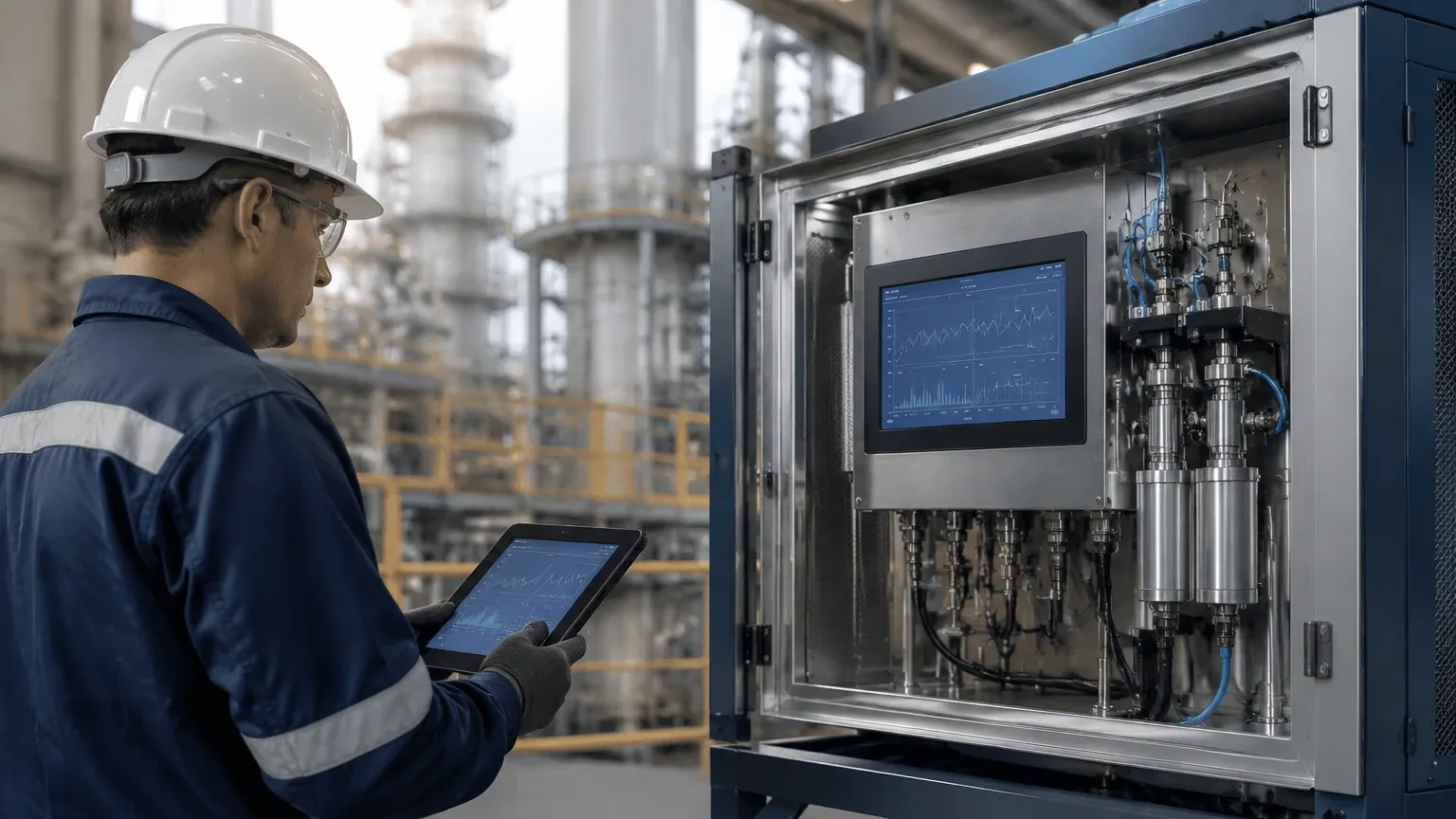
Maintenance, Calibration, and Operational Limitations
All gas analysis equipment for factories requires regular maintenance to remain accurate. Unlike a hydrostatic level transmitter that might operate for years with minimal drift, gas sensors are subject to "sensor fatigue" and environmental degradation.
Calibration and Bump Testing
* Bump Testing: A brief exposure to the target gas to verify that the sensor responds and the alarms activate. This should be done frequently (often daily or weekly in high-risk areas).
* Calibration: A full adjustment of the sensor using a certified span gas of a known concentration. Most industrial guidelines recommend calibration every 3 to 6 months.
Limitations and Risks
1. Sensor Poisoning: As mentioned, catalytic bead sensors can be silenced by silicones found in many lubricants and sealants. A poisoned sensor will show a reading of zero even in the presence of an explosive gas concentration.
2. Oxygen Dependency: Electrochemical and catalytic sensors require a minimum level of oxygen (typically >10%) to function. If a tank is nitrogen-blanketed, these sensors will fail to provide accurate readings.
3. Cross-Sensitivity: An H2S sensor may react to the presence of Hydrogen. Engineers must consult the manufacturer’s cross-sensitivity charts during the design phase to avoid false alarms.
Frequently Asked Questions (FAQ)
Q: Can I use one gas detector for all types of gases?
No. Most sensors are designed for a specific gas or a specific class of gases (like combustibles). While some multi-gas portables exist, fixed factory systems require specific sensors for each target hazard.
Q: What is the difference between a "fixed" and "portable" gas analyzer?
Fixed systems are permanently mounted and wired into the factory's power and alarm grid, providing 24/7 continuous monitoring. Portable units are worn by workers to provide localized protection as they move through different areas of the plant.
Q: How do I know when a sensor needs replacing?
Most modern gas analysis equipment for factories features "End of Life" indicators. Additionally, during calibration, if the sensor can no longer be adjusted to match the span gas concentration (low sensitivity), it must be replaced.
Q: Are wireless gas detectors reliable for factory use?
Wireless technology has improved significantly. However, in heavy industrial environments with significant metal shielding and EMI (electromagnetic interference), a site survey is required to ensure signal integrity. Many factories prefer wired 4-20mA or Modbus connections for critical safety loops.
Conclusion
Implementing gas analysis equipment for factories is a multi-faceted engineering challenge that requires a deep understanding of gas chemistry, environmental factors, and integration with existing automation. By combining precise gas detection with reliable level measurement technologies from manufacturers like Welk, factory operators can create a comprehensive safety and process monitoring ecosystem.
For technical specifications on level measurement instruments that complement your gas detection strategy, visit the Welk Main Page to explore our range of radar, ultrasonic, and hydrostatic solutions. Ensuring that your level data and gas analysis data work in tandem is the most effective way to protect your assets, your personnel, and the environment.