Pressure Gauge with Transmitter
Pressure Gauge with Transmitter
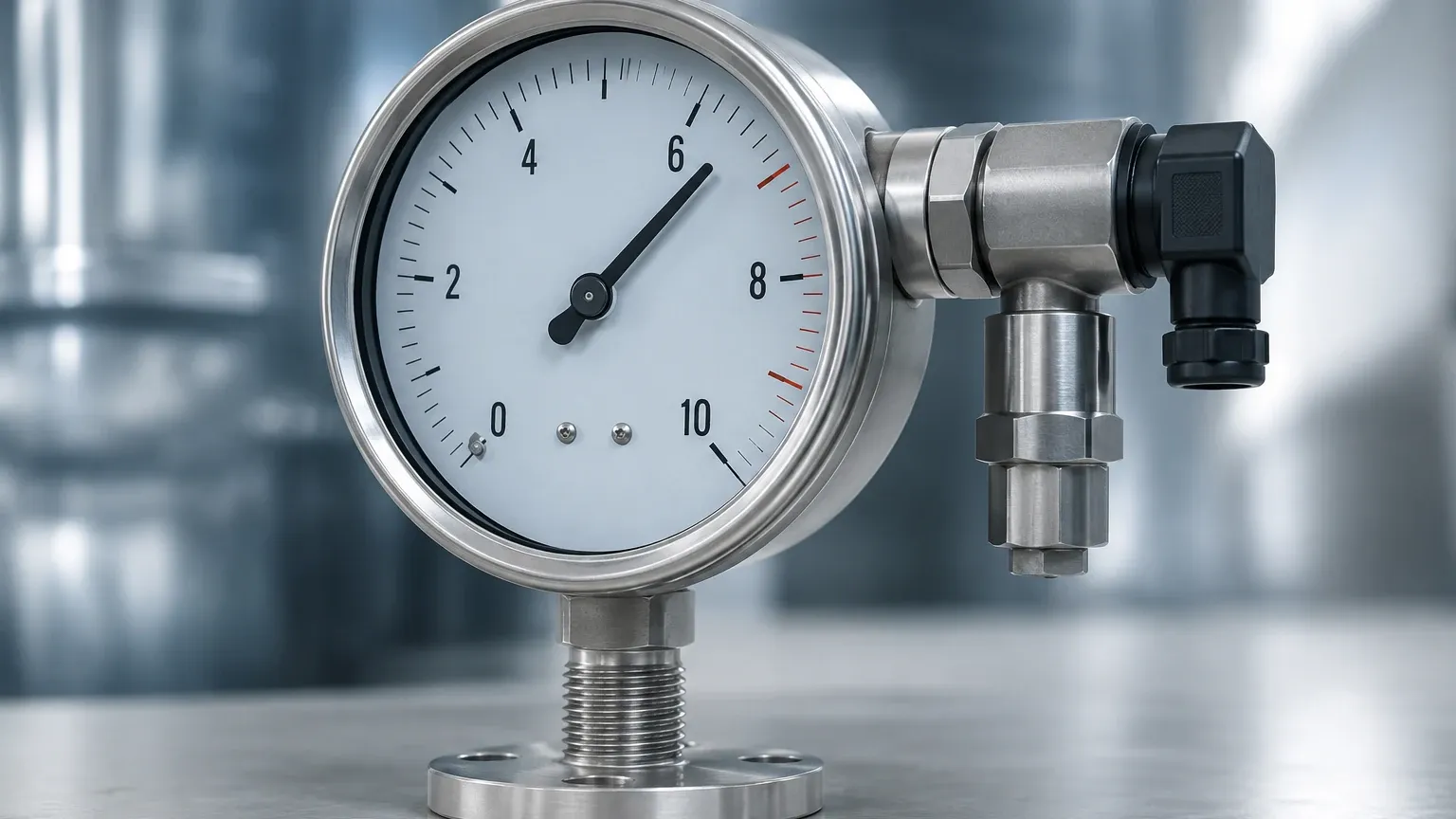
In the landscape of industrial process control, the ability to monitor pressure both locally and remotely is a fundamental requirement for safety and efficiency. A pressure gauge with transmitter is a hybrid instrument designed to bridge the gap between traditional mechanical observation and modern electronic data acquisition. While a standard mechanical gauge provides a visual reading for field operators and a standalone transmitter sends data to a control system, the integrated pressure gauge with transmitter performs both functions within a single process connection.
This dual-functionality is particularly critical in industries such as water treatment, chemical processing, and oil and gas, where redundant monitoring can prevent equipment failure and process downtime. By providing a local dial for immediate inspection and an electronic signal for remote PLC/DCS integration, these devices ensure that process variables remain within safe operating limits even if one monitoring method fails.
Measurement Principles and Technology
To select the correct instrument, it is essential to understand the underlying physics that allow a pressure gauge with transmitter to convert physical force into both mechanical movement and an electrical signal. Most industrial units utilize one of three primary sensing technologies.
1. Bourdon Tube Systems with Electronic Pickups
In this design, a curved, hollow tube (the Bourdon tube) tends to straighten when pressurized. This mechanical movement is linked to a pointer on a dial. To provide a transmitter output, a non-contact sensor—such as a Hall effect sensor or an optical encoder—is mounted within the gauge casing to track the position of the pointer or the internal linkage. This movement is then converted by an internal circuit board into a standardized electrical output, typically 4-20mA.
2. Diaphragm-Based Piezoresistive Sensors
For applications involving viscous or corrosive media, a diaphragm is often used. The process pressure deforms a metal or ceramic diaphragm. In a hybrid gauge, this deformation is used to drive a mechanical linkage for the dial, while simultaneously acting upon a piezoresistive element. The change in resistance across the element is proportional to the pressure, which the transmitter electronics then process into a digital or analog signal.
3. Hydrostatic Level Measurement Integration
In many liquid storage applications, a pressure gauge with transmitter is used to calculate the level of a fluid based on the weight of the liquid column above the sensor. This is known as hydrostatic level measurement. For engineers managing tank farms, using a gauge with a transmitter allows for a local "height" reading on the dial (calibrated in meters or feet) while transmitting the exact pressure data to a central controller for inventory management.
Key Evaluation Criteria for Selection
Choosing the right pressure gauge with transmitter requires a detailed analysis of the process environment and the required data precision. The following table provides a comparison of common configurations found in industrial applications.
Selection Comparison Table
| Feature | Bourdon Tube Hybrid | Diaphragm Seal Hybrid | Digital Gauge with Output |
| :— | :— | :— | :— |
| Primary Use | Clean gases and liquids | Corrosive, viscous, or hygienic media | High-precision laboratory or testing |
| Accuracy Class | 1.0% to 1.6% of Span | 0.5% to 1.0% of Span | 0.05% to 0.25% of Span |
| Pressure Ranges | 0.6 bar to 1,000 bar | 10 mbar to 40 bar | 0 to 2,500 bar |
| Signal Output | 4-20mA, 0-10V | 4-20mA, HART, RS485 | 4-20mA, Modbus, Wireless |
| Local Display | Analog Dial (Mechanical) | Analog Dial (Mechanical) | LCD/LED (Electronic) |
| Power Source | Loop-powered (24V DC) | Loop-powered (24V DC) | Battery or External Power |
When evaluating these options, engineers must also consider the wetted materials. While 316L stainless steel is the industry standard, specialized applications may require Monel, Hastelloy, or PTFE coatings to withstand aggressive chemical environments.
Installation Considerations
The longevity and accuracy of a pressure gauge with transmitter depend heavily on proper installation. Because these devices contain sensitive electronic components alongside mechanical linkages, they are more susceptible to environmental stressors than simple mechanical gauges.
1. Orientation and Mounting: Most gauges are calibrated for vertical installation. Mounting a gauge horizontally can cause a "zero shift" due to the weight of the internal components. If horizontal mounting is required, the unit must be re-zeroed after installation.
2. Impulse Piping and Siphons: For steam applications, a pigtail or U-type siphon must be installed to prevent high-temperature steam from entering the gauge internals. The siphon creates a water seal that protects both the mechanical Bourdon tube and the transmitter's electronic sensors.
3. Vibration Dampening: In environments with high mechanical vibration (such as near pumps or compressors), liquid-filled cases (usually glycerin or silicone oil) are recommended. The liquid dampens the movement of the pointer and protects the internal electronics from fatigue.
4. Pressure Snubbers: To protect against rapid pressure spikes or "water hammer," a snubber should be installed at the process connection. This restricts the flow rate into the gauge, smoothing out the pressure pulses.
Limitations and Common Risks
While the pressure gauge with transmitter is a versatile tool, it is not without limitations. Understanding these risks is vital for maintaining system integrity.
* Temperature Sensitivity: Both the mechanical accuracy and the electronic signal can drift if the ambient or process temperature exceeds the rated limits. For high-temperature processes, cooling elements or capillary lines should be used to isolate the instrument.
* Power Dependency for Remote Data: While the local dial will continue to function during a power outage, the transmitter output will fail. Systems relying solely on the electronic signal for safety shutdowns must account for this risk.
* Media Compatibility: If the process media crystallizes or contains solids, it can clog the pressure port. In these instances, a diaphragm seal with a flushing port is necessary to ensure the sensor remains in contact with the process fluid.
* Calibration Complexity: Calibrating a hybrid device requires two steps: verifying the mechanical dial accuracy and calibrating the 4-20mA output. Discrepancies between the two can occur if the internal linkage becomes worn or misaligned.
Frequently Asked Questions (FAQs)
Q: Can a pressure gauge with transmitter be used in hazardous areas?
A: Yes, but the unit must be specifically rated as intrinsically safe (Ex i) or explosion-proof (Ex d). These units will feature specialized enclosures and require the use of safety barriers in the electrical loop.
Q: What is the difference between a 2-wire and a 4-wire transmitter output?
A: A 2-wire transmitter uses the same two wires for both power supply and signal transmission (loop-powered), making it easier to install. A 4-wire transmitter uses two wires for power and two for the signal, which is often required for high-power devices or those with integrated heaters.
Q: How often should these instruments be calibrated?
A: For most industrial applications, an annual calibration is recommended. However, in critical safety applications or harsh environments, semi-annual checks may be necessary to ensure the mechanical and electronic readings remain synchronized.
Q: Can I replace a standard gauge with a hybrid gauge without changing my piping?
A: Generally, yes. Most hybrid gauges use standard NPT or G thread connections (e.g., 1/2" NPT). However, you must ensure there is adequate space for the larger housing and that electrical conduit can be routed to the location.
Technical Specifications and Support
Integrating a pressure gauge with transmitter into an existing automation framework requires precise technical data regarding signal protocols and pressure ranges. For professional assistance in selecting the appropriate instrumentation for water treatment, chemical processing, or industrial automation, it is recommended to consult with a specialist manufacturer.
To explore a comprehensive range of measurement solutions, including radar level meters and hydrostatic transmitters that complement pressure monitoring systems, you can Review product options and application support on the Welk official site. Accessing the Main Page provides detailed engineering specifications and customized OEM/ODM service information for global industrial projects.
Conclusion
The pressure gauge with transmitter represents a critical evolution in process instrumentation. By combining the reliability of mechanical measurement with the speed and connectivity of electronic transmission, it provides a robust solution for modern industrial demands. Whether used for simple pressure monitoring or complex hydrostatic level calculations, these devices offer the redundancy and clarity required to maintain safe and productive operations. Proper selection, based on media type, pressure range, and environmental conditions, remains the most important step in ensuring long-term instrument performance.