Stainless Steel Thermowell
Stainless Steel Thermowell
In industrial process control, the integrity of a temperature sensor is paramount to both safety and accuracy. A stainless steel thermowell serves as a critical pressure-tight receptacle that protects temperature sensors—such as RTDs, thermocouples, and thermistors—from the harsh conditions of the process media. By isolating the sensor from high pressures, corrosive chemicals, and high-velocity flows, the thermowell allows for sensor maintenance or replacement without depressurizing the system or draining the vessel.
For engineers and plant managers utilizing advanced instrumentation, understanding the mechanics and selection criteria of a stainless steel thermowell is essential. This guide explores the engineering principles, material considerations, and installation best practices necessary to ensure reliable measurement in demanding B2B environments.
Measurement Principles and Functionality
The primary function of a thermowell is to act as a heat exchanger. It must transfer thermal energy from the process fluid to the internal sensor as efficiently as possible while maintaining a robust physical barrier.
Heat Transfer and Thermal Lag
When a temperature change occurs in the process fluid, the heat must conduct through the wall of the stainless steel thermowell and across the internal air gap (or thermal paste) to reach the sensing element. This process inherently introduces "thermal lag," or a delay in response time. The rate of heat transfer is influenced by:
1. Thermal Conductivity: Stainless steel has a lower thermal conductivity compared to copper or brass, but its mechanical strength and corrosion resistance make it the industry standard.
2. Wall Thickness: Thicker walls increase pressure resistance but also increase thermal lag.
3. Surface Area: Tapered or stepped designs can optimize the surface-area-to-mass ratio to improve response times.
Mechanical Protection
Beyond heat transfer, the thermowell must withstand the static and dynamic forces of the process. In high-velocity pipelines, the fluid flow creates Karman vortices behind the thermowell. If the frequency of these vortices matches the natural frequency of the thermowell, resonance occurs, which can lead to catastrophic fatigue failure. This is why wake frequency calculations (per ASME PTC 19.3 TW) are a standard requirement in professional engineering specifications.
Material Selection: Why Stainless Steel?
Stainless steel is the preferred material for thermowells due to its versatility, cost-effectiveness, and resistance to oxidation. The choice of specific grade depends on the chemical composition of the process media and the operating temperature.
Common Stainless Steel Grades
* SS304/304L: The most common grade for general-purpose applications. It offers good corrosion resistance in water treatment and food processing but is susceptible to chloride stress corrosion cracking.
* SS316/316L: Contains molybdenum, which significantly enhances resistance to pitting and crevice corrosion in chloride-rich environments. It is the standard choice for chemical processing and oil and gas applications.
* SS310: A high-chromium, high-nickel alloy designed for high-temperature service (up to 1,100°C), often used in furnace and kiln applications.
Selection Table for Stainless Steel Thermowells
| Feature | SS304 | SS316 | SS316L | SS310 |
| :— | :— | :— | :— | :— |
| Max Temp (Continuous) | 800°C | 870°C | 450°C | 1,100°C |
| Corrosion Resistance | Moderate | High | High (Intergranular) | Moderate |
| Typical Industry | Water/HVAC | Chemical/O&G | Pharma/Welded | Power/Kilns |
| Weldability | Excellent | Good | Superior | Good |
Types of Thermowell Designs
Selecting the right physical configuration is as important as the material. The connection type and stem shape determine how the thermowell integrates into the piping system.
Stem Shapes
1. Straight: The diameter is uniform along the entire insertion length. These are easy to manufacture and provide consistent strength.
2. Stepped: The diameter is reduced at the tip (e.g., from 19 mm to 12.7 mm). This reduces the mass around the sensor, significantly improving response time.
3. Tapered: The diameter gradually decreases from the base to the tip. This design provides the highest strength-to-weight ratio and is ideal for high-velocity applications.
Connection Types
* Threaded: Screwed directly into a pipe tee or vessel NPT/BSPT fitting. Best for low-pressure, non-corrosive applications.
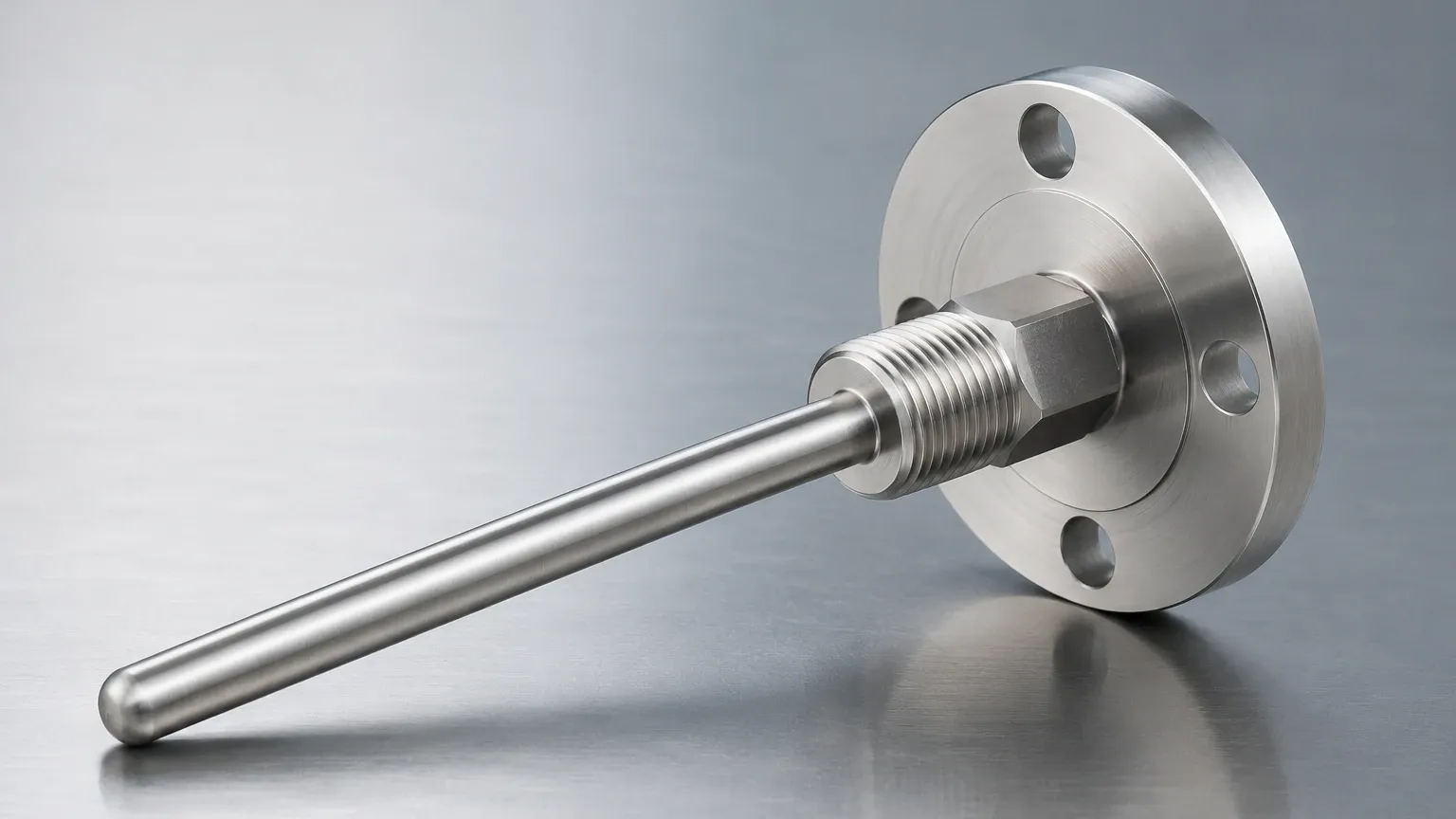
* Flanged: Bolted to a mating flange on the process equipment. This is the standard for high-pressure and high-safety environments, allowing for easier removal and inspection.
* Socket Weld: Welded permanently into place. This provides the strongest, most leak-proof connection but makes replacement difficult.
Installation Considerations
Correct installation is vital to ensure that the stainless steel thermowell provides an accurate representation of the process temperature.
Insertion Length (U-Length)
To minimize conduction error (heat escaping through the wall of the pipe), the thermowell must be inserted deep enough into the process stream. A general rule of thumb is:
* Liquids: Insertion length should be at least 8 to 10 times the thermowell tip diameter.
* Gases/Vapors: Insertion length should be 15 to 20 times the tip diameter.
In pipelines, the tip should ideally be located in the center third of the pipe diameter.
Orientation
* Perpendicular: The most common installation, where the well is at a 90-degree angle to the flow.
* Angled: In small-diameter pipes (less than 100 mm), the thermowell may be installed at an angle or in an elbow, pointing upstream, to increase the effective insertion length.
Lagging Extension (T-Length)
If the pipe or vessel is insulated, the thermowell requires a lagging extension. This extension allows the connection head of the temperature sensor to sit outside the insulation, preventing the electronics from overheating and allowing for easier access.
Integration with Level Measurement Systems
In many industrial applications, temperature measurement is not a standalone requirement but a critical component of accurate level sensing. For instance, hydrostatic level transmitters calculate the height of a liquid based on the pressure exerted by the liquid column. Because the density of a liquid changes with temperature, real-time temperature compensation is required to maintain accuracy.
Using a stainless steel thermowell to house a high-precision RTD allows the control system to adjust level calculations dynamically. This is particularly important in the chemical and oil and gas sectors, where even a slight temperature fluctuation can lead to significant volume errors in large storage tanks. For engineers looking to optimize their entire measurement loop, it is helpful to Review product options and application support on the Welk Main Page to ensure compatibility between level sensors and temperature compensation hardware.
Limitations and Risks
While stainless steel thermowells are robust, they are not infallible. Engineers must be aware of the following risks:
1. Wake Frequency Failure: As mentioned, high-velocity fluids can cause the thermowell to vibrate and snap. Always perform a calculation if flow velocities exceed 3 m/s for liquids or 15 m/s for gases.
2. Corrosion Pitting: In stagnant fluids containing chlorides, even SS316 can suffer from localized pitting. Regular inspection is required.
3. Erosion: In slurries or fluids with suspended solids, the leading edge of the thermowell can thin over time, eventually compromising the pressure boundary.
4. Thermal Response Time: In processes with rapid temperature cycling, the mass of a heavy-duty thermowell may mask critical temperature spikes.
Maintenance and Best Practices
* Annual Inspection: Check for signs of erosion, corrosion, or physical bending.
* Sensor Fit: Ensure the temperature sensor is spring-loaded to maintain contact with the bottom of the thermowell. An air gap at the tip will cause significant measurement errors.
* Replacement: If a thermowell shows significant thinning (more than 10% of wall thickness), it should be replaced during the next scheduled shutdown.
Frequently Asked Questions (FAQs)
Q: Can I use a 304 stainless steel thermowell for sulfuric acid?
A: Generally, no. SS304 has poor resistance to sulfuric acid. Depending on the concentration and temperature, SS316 may work, but specialized alloys like Hastelloy or Tantalum-sleeved thermowells are often required for high concentrations.
Q: What is the difference between a thermowell and a protection tube?
A: A thermowell is machined from solid bar stock and is designed for high-pressure applications. A protection tube is typically made from welded pipe or ceramic and is used for low-pressure, high-temperature applications like exhaust flues.
Q: How do I reduce the response time of my thermowell?
A: Use a stepped-tip design to reduce mass, ensure the sensor is spring-loaded against the tip, and consider using a thermal conductive paste (though this can make sensor removal difficult over time).
Q: Is SS316L always better than SS316?
A: Not necessarily. The "L" stands for low carbon, which prevents carbide precipitation during welding. If the thermowell is a machined one-piece bar stock and no welding is involved, standard SS316 is often sufficient and slightly stronger at high temperatures.
Conclusion
The stainless steel thermowell is a foundational component in industrial process instrumentation. By selecting the appropriate grade of steel, optimizing the mechanical design for flow conditions, and ensuring proper insertion depth, engineers can protect their sensors and ensure long-term measurement accuracy. Whether used for simple temperature monitoring or as part of a complex density-compensated level measurement system, the reliability of the thermowell directly impacts the safety and efficiency of the entire operation.