Which Thermometer Is Used to Measure Surface Temperatures
Which Thermometer Is Used to Measure Surface Temperatures
In industrial process control, monitoring the temperature of a solid surface is as critical as measuring the temperature of the fluids contained within. Whether it is ensuring a chemical reactor wall remains within safety limits, monitoring the exterior of a storage tank, or verifying the heat on a high-speed motor casing, selecting the correct instrument is paramount. When engineers ask which thermometer is used to measure surface temperatures, the answer generally falls into two distinct categories: non-contact infrared (IR) thermometers and contact-based surface sensors such as thermocouples and RTDs.
Understanding the physics behind these instruments is essential for accurate data collection. Surface temperature measurement is inherently more complex than immersion measurement because the sensor is exposed to both the target surface and the ambient environment, leading to potential thermal gradients and measurement errors.
Measurement Principles: Contact vs. Non-Contact
Before selecting a specific device, it is necessary to understand the two primary physical principles used to determine surface temperature.
Thermal Conduction (Contact Measurement)
Contact thermometers rely on the principle of thermal equilibrium. When a sensor, such as a thermocouple or a Resistance Temperature Detector (RTD), is pressed against a surface, heat flows from the surface to the sensor until they reach the same temperature. For this to be accurate, the thermal resistance between the surface and the sensor must be minimized, and the heat loss from the sensor to the surrounding air must be controlled.
Thermal Radiation (Non-Contact Measurement)
Non-contact thermometers, often called infrared pyrometers or IR thermometers, detect the electromagnetic radiation emitted by an object. Every object with a temperature above absolute zero emits infrared energy. The intensity of this energy is proportional to the fourth power of its absolute temperature (Stefan-Boltzmann Law). By measuring this radiation, the device can calculate the surface temperature without physical contact.
Infrared Thermometers: The Non-Contact Solution
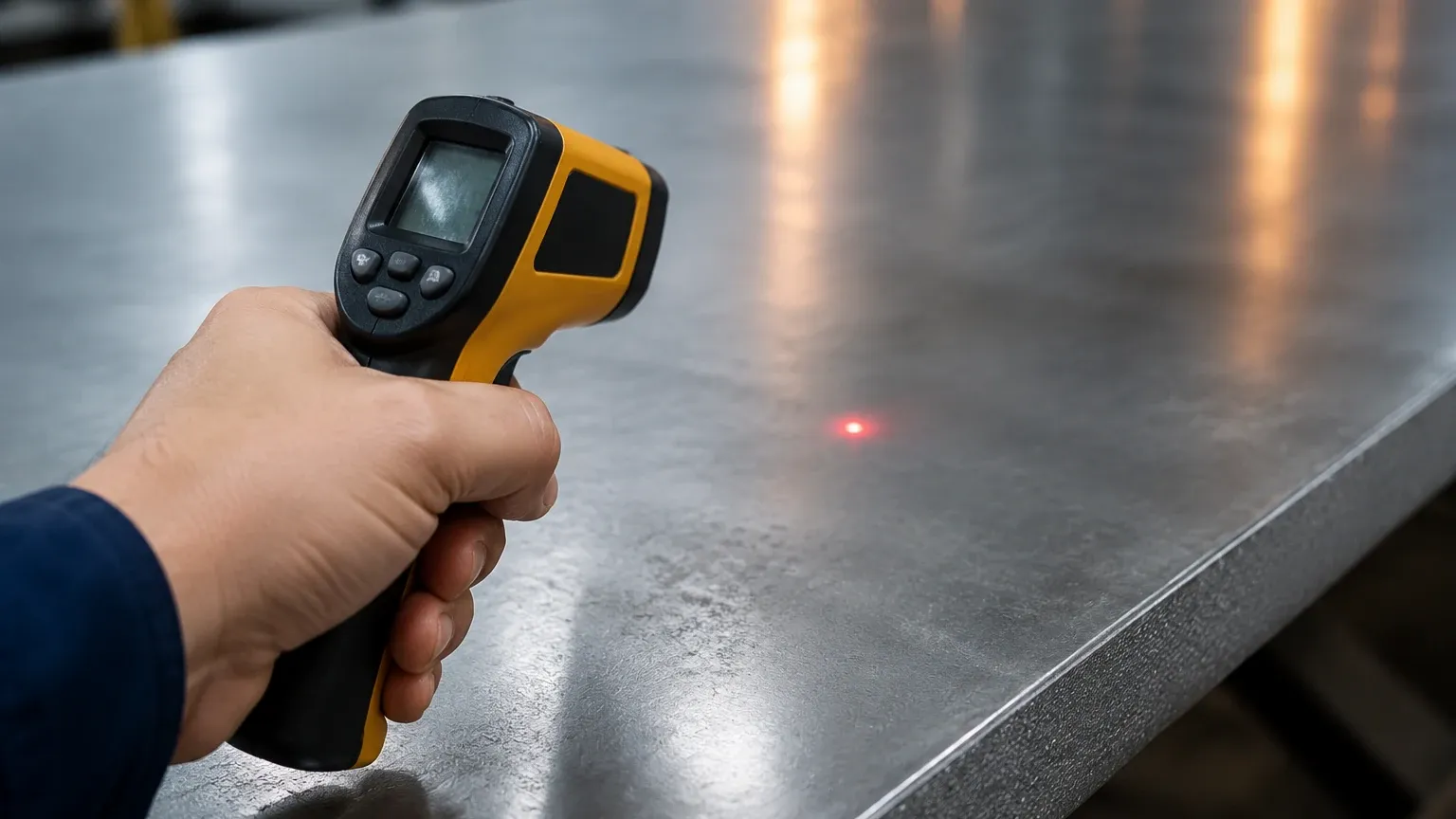
When considering which thermometer is used to measure surface temperatures in hazardous or hard-to-reach areas, infrared technology is the standard choice. These devices are ideal for moving parts, energized electrical components, or surfaces that would be contaminated by a contact probe.
Key Features of IR Thermometers
* Distance-to-Spot Ratio (D:S): This defines the size of the area being measured relative to the distance from the target. A 12:1 ratio means that at a distance of 120 cm, the thermometer measures a circle with a 10 cm diameter.
* Emissivity ($ε$): This is the measure of a material's ability to emit infrared energy. Shiny metals have low emissivity (reflecting ambient heat), while organic materials and matte surfaces have high emissivity (close to 1.0). High-quality industrial IR thermometers allow for adjustable emissivity settings to ensure accuracy.
Advantages and Limitations
IR thermometers provide instantaneous readings and can measure extremely high temperatures (up to 3000°C). However, they can be misled by "stray" reflections from nearby heat sources and are less accurate on polished, low-emissivity surfaces like stainless steel or aluminum unless the surface is treated with matte paint or tape.
Contact Surface Sensors: Thermocouples and RTDs
For permanent monitoring and high-precision applications, contact sensors are preferred. These are often integrated into broader industrial automation systems, including those managed by Main Page solutions where temperature data is used to compensate for level measurement fluctuations.
Surface Thermocouples
Thermocouples consist of two dissimilar metals joined at a junction. For surface measurement, these junctions are often flattened into a ribbon or a thin disk to maximize the contact area.
* Type K: The most common industrial thermocouple, suitable for a wide range of temperatures.
* Type T: Often used in cryogenic or low-temperature food processing due to high stability.
Surface RTDs (Pt100/Pt1000)
RTDs operate on the principle that the electrical resistance of a metal (usually platinum) changes predictably with temperature. Surface-mount RTDs are often thin-film elements encapsulated in a protective patch or a ceramic housing. They offer higher accuracy and better long-term stability than thermocouples but have a slower response time and a narrower temperature range.
Selection Criteria for Industrial Applications
Choosing the right instrument requires a balance between accuracy, response time, and environmental constraints. The following table provides a comparison to assist in the selection process.
| Feature | Infrared Thermometer | Surface Thermocouple | Surface RTD |
| :— | :— | :— | :— |
| Measurement Type | Non-contact | Contact | Contact |
| Response Time | < 1 second | 1–5 seconds | 5–30 seconds |
| Typical Accuracy | ±1.0% to ±2.0% | ±1.1°C or ±0.4% | ±0.1°C to ±0.3°C |
| Temperature Range | -50°C to 3000°C | -200°C to 1200°C | -200°C to 600°C |
| Best Use Case | Moving parts, high heat | Rapid spot checks, pipes | Precision process control |
| Common Risks | Emissivity errors | Poor thermal contact | Mechanical damage |
Installation and Operational Considerations
When implementing contact-based surface temperature measurement, the method of attachment is as important as the sensor itself.
1. Surface Preparation: The target surface must be clean of scale, rust, and oil. For RTDs, a smooth surface is required to ensure the thin-film element makes full contact.
2. Mounting Methods:
* Adhesive Patches: Suitable for temporary or low-temperature applications.
* Mechanical Clamps/Bolts: Used for permanent installation on pipes or motor housings.
* Magnetic Mounts: Ideal for ferrous metal surfaces where drilling is not permitted.
* Spring-Loaded Probes: Used in handheld applications to ensure consistent pressure against the surface, reducing operator error.
3. Thermal Insulation: To prevent the ambient air from cooling the sensor (causing a low reading), the back of the contact sensor should be insulated. This ensures the sensor reaches the true temperature of the surface rather than a midpoint between the surface and the room air.
Limitations and Common Errors
Identifying which thermometer is used to measure surface temperatures also involves recognizing where these tools fail.
* Thermal Lag: Contact sensors take time to reach equilibrium. In processes with rapidly changing temperatures, an RTD might lag significantly behind the actual surface temperature.
* Stem Conduction: Heat can travel along the lead wires of a thermocouple, pulling heat away from the measurement junction and resulting in an artificially low reading.
* Emissivity Mismanagement: In IR thermometry, assuming a default emissivity of 0.95 for a shiny copper pipe can result in errors of 50°C or more. Always verify the material's emissivity.
* Environmental Interference: Steam, dust, or smoke in the air can absorb infrared radiation, causing IR thermometers to under-read.
Integration with Level Measurement Systems
In the B2B industrial sector, surface temperature is rarely measured in isolation. At Welk, we recognize that temperature is a critical variable in accurate level measurement.
For instance, hydrostatic level transmitters calculate liquid levels based on pressure. Since the density of a liquid changes with its temperature, the surface temperature of the tank can provide a proxy for the internal fluid temperature, allowing the control system to apply density correction factors. Similarly, ultrasonic level sensors rely on the speed of sound, which varies with air temperature. Measuring the surface temperature of the vessel helps in calibrating these sensors for environmental changes.
For engineers looking to optimize their entire measurement suite, reviewing integrated solutions on our Main Page can provide insights into how temperature and level data work together to improve process efficiency.
Frequently Asked Questions (FAQ)
Q: Can I use a standard immersion probe to measure surface temperature?
No. Immersion probes are designed to be surrounded by a medium. When pressed against a surface, the point of contact is too small, and the ambient air will significantly skew the results. Specialized surface probes with flat junctions or high-surface-area tips are required.
Q: How do I measure the temperature of a shiny stainless steel tank with an IR thermometer?
The best method is to apply a small piece of electrical tape or a dab of matte black paint to the tank. Measure the temperature of the tape/paint using an emissivity setting of 0.95. This provides a reliable reading of the underlying metal's temperature.
Q: Which sensor is best for high-vibration environments?
In high-vibration areas, such as on a pump or compressor housing, mineral-insulated (MI) thermocouples or ruggedized RTDs with reinforced lead wires are preferred over IR thermometers, which may lose their alignment or suffer optical damage over time.
Q: Does the color of a surface affect IR measurement?
In the visible spectrum, yes, but in the infrared spectrum, color is less important than the texture and material. A white painted wall and a black painted wall usually have very similar emissivity values in the long-wave infrared range.
Conclusion
Determining which thermometer is used to measure surface temperatures depends entirely on the application's specific requirements for accuracy, safety, and accessibility. For quick, non-invasive checks and high-temperature scenarios, the infrared thermometer is the superior tool. For long-term, high-precision monitoring and integration into process control loops, contact sensors like surface-mount RTDs or thermocouples are the industry standard. By understanding the limitations of emissivity and thermal conduction, operators can ensure their temperature data remains a reliable pillar of their industrial automation strategy.
Download Which Thermometer Is Used to Measure Surface Temperatures as a PDF