Andress Hauser
Andress Hauser
In the complex landscape of industrial process automation, level measurement stands as a fundamental pillar for ensuring operational safety, inventory accuracy, and process efficiency. Whether managing volatile chemicals, wastewater, or crude oil, the ability to monitor the contents of a vessel with precision is non-negotiable. For many procurement specialists and process engineers, the name andress hauser (Endress+Hauser) represents a global standard in high-end instrumentation. However, selecting the right level measurement technology requires a deep understanding of physical principles, environmental constraints, and the specific requirements of the application at hand.
This guide explores the core technologies utilized in modern level measurement, provides a framework for selecting between various sensor types, and discusses how to evaluate market-leading solutions against specific project needs. For those seeking detailed technical specifications and product comparisons, visiting the Main Page provides a central resource for industrial-grade level meters.
Understanding Level Measurement Principles
Before selecting a device, it is essential to understand the physics governing different measurement methods. Level instruments generally fall into two categories: contact and non-contact. Each has distinct advantages depending on the media being measured.
Radar Level Measurement (Time-of-Flight)
Radar level meters utilize electromagnetic waves, typically in the microwave range (6GHz to 80GHz), to determine the distance to the product surface. The device emits a pulse or a continuous wave that travels to the surface, reflects, and returns to the sensor. The time taken for this round trip—the Time-of-Flight (ToF)—is directly proportional to the distance.
* Non-Contact Radar: Ideal for corrosive or high-temperature environments where the sensor should not touch the media. High-frequency radar (80GHz) offers a narrow beam angle, which is particularly useful in vessels with internal obstructions like agitators or heating coils.
* Guided Wave Radar (GWR): Uses a physical probe (rod or cable) to guide the microwave pulse. This is highly effective for low dielectric constants (εr) and applications involving foam or heavy turbulence, as the probe concentrates the signal energy.
Ultrasonic Level Measurement
Ultrasonic sensors operate on a similar ToF principle but use mechanical sound waves instead of electromagnetic pulses. The sensor emits an ultrasonic pulse (typically 20kHz to 70kHz) that reflects off the surface of the liquid or solid.
While cost-effective, ultrasonic measurement is sensitive to the medium through which the sound travels. Factors such as air temperature, pressure, and the presence of heavy vapors or dust can alter the speed of sound, necessitating temperature compensation for accurate readings. Ultrasonic sensors also have a "dead zone" or blocking distance—a minimum distance from the sensor face where measurement is impossible.
Hydrostatic Level Measurement
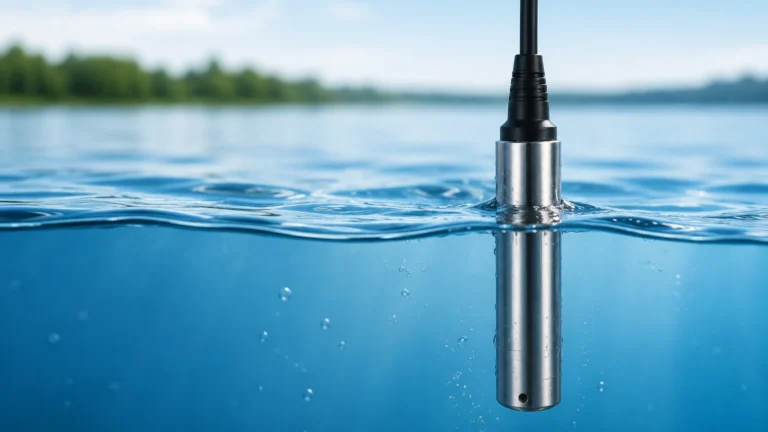
Hydrostatic transmitters measure the pressure exerted by a liquid column at the bottom of a tank. Based on the principle that pressure ($P$) equals density ($
ho$) multiplied by gravity ($g$) and height ($h$), the level can be calculated accurately if the liquid density remains constant. This method is widely used in water treatment and deep-well monitoring due to its reliability and ease of installation.
The Role of andress hauser in Global Instrumentation
When engineers discuss premium instrumentation, andress hauser is frequently cited for its extensive R&D and high-precision manufacturing. The brand has been instrumental in advancing 80GHz radar technology and Heartbeat Technology for self-diagnostics. For large-scale projects in the oil and gas or pharmaceutical sectors, these high-end solutions offer integrated digital communication protocols like HART, PROFIBUS, and Foundation Fieldbus.
However, the selection process for many industrial applications involves balancing these high-end features with cost-effectiveness and specific OEM requirements. While andress hauser provides a benchmark for performance, manufacturers like Welk provide robust, industrial-grade alternatives that focus on core reliability for water treatment, chemical processing, and general automation. Understanding the technical overlap between these solutions allows engineers to optimize their budgets without sacrificing the accuracy required for their specific process.
Practical Selection Table for Level Sensors
Choosing the correct instrument requires a comparison of media characteristics and environmental conditions. The following table summarizes the suitability of common technologies.
| Technology | Media Type | Max Range (Typical) | Accuracy | Key Advantage | Limitation |
| :— | :— | :— | :— | :— | :— |
| 80GHz Radar | Liquids/Solids | Up to 120m | ±1mm | Narrow beam, ignores obstructions | High initial cost |
| 26GHz Radar | Liquids/Slurries | Up to 30m | ±3mm | Versatile for most tanks | Sensitive to foam |
| Ultrasonic | Water/Wastewater | Up to 15m | ±0.25% | Low cost, non-contact | Affected by steam/dust |
| Hydrostatic | Clean/Dirty Liquids | Up to 200m | ±0.1% | Simple, submersible options | Requires constant density |
| Magnetic Gauge | Hazardous Liquids | Up to 6m | ±5mm | Visual & Electronic output | Contact-based, moving parts |
Installation Considerations and Best Practices
Even the most advanced sensor from a top-tier brand like andress hauser will fail to perform if installation guidelines are ignored. Proper mounting is the most critical factor in achieving long-term accuracy.
1. Avoid the "Inflow" Path: Sensors should never be mounted directly above the filling stream. The turbulence and the falling liquid will cause signal scatter and erratic readings.
2. Nozzle Height and Diameter: For radar and ultrasonic units, the sensor must be mounted such that the signal can clear the bottom edge of the mounting nozzle. If the nozzle is too long or narrow, it can create "ringing" or false echoes near the top of the tank.
3. Internal Obstructions: Agitators, ladders, and reinforcement struts can reflect signals. While modern software can "map out" these static echoes, it is best to position the sensor at a distance of at least 200mm from the tank wall and away from known obstructions.
4. Stilling Wells: In applications with heavy foam or extreme turbulence, installing the sensor (particularly GWR or non-contact radar) inside a stilling well or bypass pipe can provide a calm surface for measurement.

Common Risks and Limitations in Level Measurement
Identifying potential failure points early in the project phase prevents costly downtime. Engineers should confirm the following before finalizing an instrument choice:
* Dielectric Constant (εr): Radar signals reflect poorly off materials with low dielectric constants (e.g., oils, solvents, or plastic pellets). In these cases, a Guided Wave Radar or a specialized high-sensitivity non-contact radar is required.
* Vapor and Condensation: In closed tanks, condensation can form on the sensor face. While many modern radar antennas are designed with PTFE drippers to shed moisture, ultrasonic sensors may lose their signal entirely if the transducer face becomes wet.
* Foam: Foam is the "black hole" of level measurement. It absorbs ultrasonic waves and scatters radar signals. If the foam is thick and dense, hydrostatic or magnetic level gauges are often the only reliable contact-based alternatives.
* Vacuum Conditions: Ultrasonic sensors cannot operate in a vacuum because sound waves require a medium (air/gas) to travel. Radar, being electromagnetic, is unaffected by vacuum.
Maintenance and Long-Term Reliability
While many modern level meters are marketed as "maintenance-free," regular verification is necessary for ISO compliance and safety. For sensors used in critical safety loops (SIL2/SIL3), proof testing intervals must be strictly followed.
Instruments from manufacturers like andress hauser often include advanced diagnostics that monitor the signal-to-noise ratio and internal electronics health. Similarly, when sourcing from the Main Page, users should look for features such as modular electronics and easy-to-use calibration interfaces that simplify field service. For hydrostatic sensors, checking the breather tube for moisture or blockages is the most common maintenance task, while for radar, ensuring the antenna remains free of heavy buildup is paramount.
Frequently Asked Questions (FAQ)
Q: Can I use a radar level meter for solids like grain or cement?
A: Yes, but it requires a high-frequency radar (typically 80GHz) with a high dynamic range. Solids have an angle of repose that can scatter signals, so a narrow beam and high sensitivity are necessary to capture the reflection.
Q: What is the difference between 4-20mA and Modbus outputs?
A: 4-20mA is a traditional analog signal representing the level as a current loop. Modbus is a digital protocol that can transmit multiple variables (level, temperature, signal strength) over a single pair of wires, providing more diagnostic data.
Q: How does temperature affect hydrostatic level sensors?
A: Temperature changes the density of the liquid. Since hydrostatic sensors measure pressure to calculate level, a change in density will result in an error unless the system is programmed to compensate for temperature-induced density shifts.
Q: Why is my ultrasonic sensor reading "Full" when the tank is empty?
A: This is often caused by "ringing" in the mounting nozzle or a reflection from a nearby obstruction. The sensor interprets the first strong reflection it receives as the level. Adjusting the blanking distance or re-mounting the sensor usually resolves this.
By understanding these technical nuances and comparing the capabilities of established brands like andress hauser with the versatile offerings available on the Main Page, engineers can implement level measurement solutions that are both technically sound and economically viable.