Flow Meter Coriolis
Flow Meter Coriolis
In the landscape of industrial process control, the ability to measure mass flow directly, rather than inferring it from volume, represents a significant leap in precision. The flow meter Coriolis has emerged as the gold standard for high-accuracy applications across the chemical, oil and gas, and food processing industries. Unlike volumetric meters that require compensation for temperature and pressure, Coriolis instruments provide direct mass flow, density, and temperature data simultaneously. This article examines the engineering principles, selection criteria, and practical installation requirements for Coriolis technology, while also exploring how these instruments complement level measurement systems in a comprehensive process automation strategy.
The Physics of Coriolis Measurement
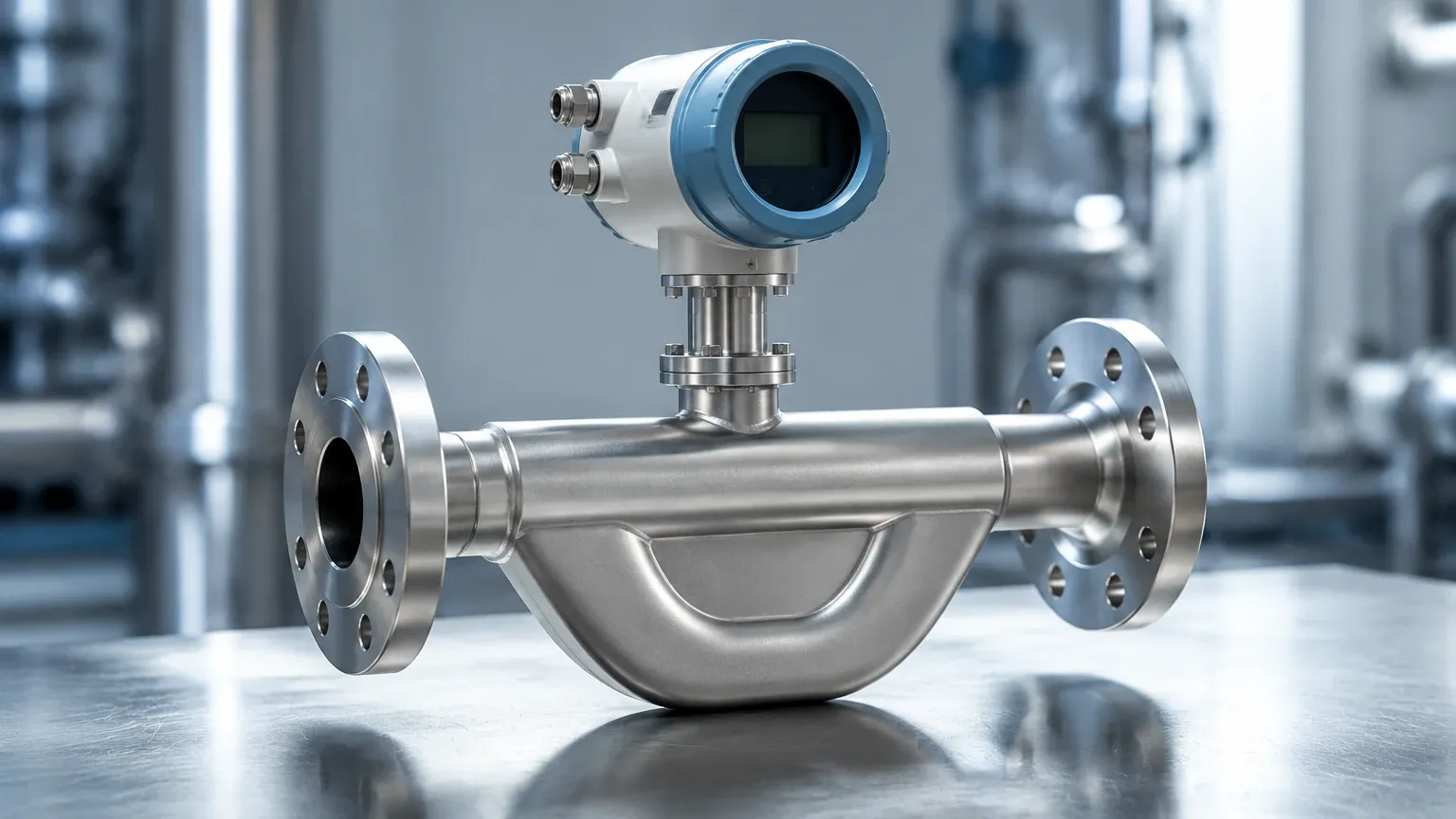
The operation of a flow meter Coriolis is based on the principles of motion and the Coriolis effect. To understand this, one must visualize the internal structure of the device, which typically consists of one or two measuring tubes. An electromagnetic drive coil causes these tubes to vibrate at their resonant frequency.
The Coriolis Effect in Action
When a fluid (liquid or gas) is stationary within the tubes, the tubes vibrate uniformly. However, as soon as the fluid begins to flow, it is subjected to a Coriolis force. Because the fluid is moving through a vibrating system, it resists the vertical motion of the tube.
1. Inlet Side: As the fluid enters the vibrating tube, it pushes against the vibration, causing the tube to lag behind its natural oscillation.
2. Outlet Side: As the fluid leaves the tube, it has already gained momentum from the vibration and resists being slowed down, causing the tube to lead the oscillation.
This results in a "twisting" of the measuring tubes. Highly sensitive sensors located at the inlet and outlet sections detect this phase shift. The time delay (delta-T) between the two points is directly proportional to the mass flow rate. Because mass remains constant regardless of changes in temperature or pressure, the measurement is inherently more stable than volumetric methods.
Density and Temperature Measurement
Beyond flow, these meters are exceptional at measuring fluid density. The resonant frequency at which the tubes vibrate depends on the total mass of the system (the tube plus the fluid inside). By monitoring changes in this frequency, the instrument can calculate the fluid's density in real-time. Furthermore, integrated PT100 or PT1000 sensors monitor the tube temperature to compensate for changes in material elasticity, providing a third vital data point for process monitoring.
Key Advantages in Industrial Applications
The adoption of Coriolis technology is driven by its versatility and the reduction of uncertainty in complex processes. In industries where Welk provides level measurement solutions, such as chemical processing and water treatment, the integration of high-precision flow data allows for a more complete mass balance.
* Direct Mass Measurement: Eliminates the need for external pressure and temperature compensation, reducing the "stacking" of errors found in multi-instrument loops.
* Multi-Variable Output: A single device provides mass flow, volume flow, density, and temperature, simplifying the Main Page of control architectures.
* High Accuracy: Most industrial Coriolis meters offer accuracies of ±0.1% for liquids and ±0.5% for gases, making them suitable for custody transfer.
* No Moving Parts: Unlike turbine or positive displacement meters, there are no bearings or gears to wear out, significantly reducing maintenance requirements.
* Universal Fluid Compatibility: They can measure everything from cryogenic liquids to highly viscous resins and non-conductive fluids that would baffle an electromagnetic flow meter.
Technical Selection Criteria for Coriolis Flow Meters
Choosing the right flow meter Coriolis requires a detailed analysis of the process fluid and the mechanical constraints of the piping system. Engineers must balance the high initial capital expenditure against the long-term gains in accuracy and reduced maintenance.
Material Compatibility
The measuring tubes are the most critical component. They must be thin enough to vibrate effectively but thick enough to withstand process pressures and corrosion. Common materials include:
* 316L Stainless Steel: The standard for water, food, and mild chemicals.
* Hastelloy C22: Used for highly aggressive acids and chlorides.
* Tantalum: Reserved for the most extreme corrosive environments.
Selection Table: Application Suitability
| Application | Suitability | Key Consideration |
| :— | :— | :— |
| Custody Transfer | Excellent | High repeatability and accuracy are mandatory. |
| Dosing/Batching | Excellent | Fast response times allow for precise shut-off. |
| Slurries | Good | Requires high-velocity flow to prevent settling in the tubes. |
| Gas Measurement | Moderate | Requires high pressure to ensure sufficient mass for detection. |
| Aerated Liquids | Fair | Entrained gas can dampen tube vibration and cause errors. |
Flow Range and Pressure Drop
Coriolis meters are often sized smaller than the process piping to maintain high fluid velocity, which improves the signal-to-noise ratio. However, this creates a pressure drop. Engineers must ensure the available pump head can overcome the resistance of the meter, especially when dealing with high-viscosity fluids.
Installation and Maintenance Best Practices
While Coriolis meters are robust, their reliance on micro-vibrations makes them sensitive to external mechanical interference. Proper installation is the difference between a high-precision instrument and a source of constant process errors.
Orientation and Support
1. Liquid Service: For liquids, the tubes should ideally point downward (in a "U" shape) or be installed in vertical pipes with upward flow. This ensures the tubes remain full and prevents gas bubbles from becoming trapped.
2. Gas Service: For gas applications, the tubes should point upward to prevent condensate or liquids from collecting in the bottom of the tubes.
3. Mechanical Isolation: The meter must be supported by the adjacent piping, but the piping itself must be rigidly anchored. Flexible connectors are sometimes used to isolate the meter from pump vibrations, though they must be installed with care to avoid introducing pipe stress.
Zero-Point Calibration
The most critical step in commissioning a flow meter Coriolis is the zero-point calibration. This must be performed under actual process conditions (temperature and pressure) with the meter full of fluid and the flow stopped completely. Any residual stress from the piping or slight misalignment will be zeroed out during this process.
Coriolis Flow Meters vs. Level Measurement Systems
In many B2B industrial scenarios, there is a choice between measuring inventory via flow (Coriolis) or via level (Radar or Ultrasonic). Understanding the synergy between these technologies is essential for effective plant management.
The Role of Level Measurement
Welk specializes in level measurement instruments like radar level meters and ultrasonic sensors. These are ideal for static inventory management in large storage tanks. Level measurement provides a direct reading of the volume available in a vessel. However, to convert that volume to mass, the density must be known and constant.
The Synergy of Flow and Level
In a process reactor, a flow meter Coriolis is used to precisely dose ingredients by mass. Simultaneously, a radar level meter monitors the vessel to prevent overfills and provide a secondary check on the total volume. In water treatment, hydrostatic level transmitters monitor the head pressure in tanks, while Coriolis meters might be used for the precise injection of chemical flocculants. By combining these data points, plant operators can detect leaks (discrepancy between flow-in and level-rise) and monitor density changes that might indicate a process deviation.
Common Limitations and Risks
Despite their advanced capabilities, Coriolis meters are not a "set and forget" solution for every application. Engineers should be aware of the following risks:
* Entrained Gas: Small amounts of gas in a liquid stream (slug flow) can cause the tubes to stop vibrating or produce "noise" that leads to massive inaccuracies. Advanced digital signal processing in modern meters has mitigated this, but it remains a concern.
* Vibration Interference: If the resonant frequency of the meter matches the vibration frequency of a nearby pump or motor, the readings will be erratic. Modern dual-tube designs are less susceptible to this than older single-tube models.
* Initial Cost: A Coriolis meter can be 3 to 5 times more expensive than an electromagnetic or vortex flow meter. The ROI must be justified by the need for mass accuracy or density data.
* Size Constraints: While available in sizes from DN1 (1 mm) to DN400 (400 mm), the larger units are extremely heavy and bulky, requiring significant structural support.
Frequently Asked Questions (FAQs)
Q: Can a Coriolis meter measure steam?
A: While technically possible, it is rarely done. The low mass of steam compared to the high velocity required makes it difficult to get an accurate reading. Vortex flow meters are generally preferred for steam applications.
Q: How often should a flow meter Coriolis be recalibrated?
A: Because there are no moving parts to wear, the physical calibration of the tubes rarely shifts. Most industrial standards recommend a "verification" every 12 to 24 months. If the meter passes internal diagnostics (Smart Meter Verification), a full wet-loop recalibration may not be necessary.
Q: Does pipe diameter affect the meter?
A: The meter's internal tube diameter is what matters for the measurement. It is very common for a 50 mm (2-inch) pipe to use a 25 mm (1-inch) Coriolis meter with reducers to ensure sufficient fluid velocity for accuracy.
Q: How does it handle high-viscosity fluids?
A: Coriolis meters are excellent for high-viscosity fluids because they do not rely on Reynolds numbers for accuracy. However, high viscosity leads to a higher pressure drop across the meter, which must be accounted for in the system design.
Conclusion
The flow meter Coriolis represents the pinnacle of flow measurement technology, offering unparalleled mass accuracy and multi-variable data. For engineers managing complex industrial processes, these instruments provide the data necessary for tight quality control and efficient resource management. When used in conjunction with reliable level measurement solutions—such as the radar and ultrasonic sensors offered by Welk—they form the backbone of a modern, automated facility. By understanding the principles of the Coriolis effect and following strict installation guidelines, organizations can ensure long-term reliability and precision in their most critical flow applications.