Wastewater Treatment for Food Processing Plants
Wastewater Treatment for Food Processing Plants
Effective wastewater treatment for food processing plants is a critical operational requirement driven by both environmental regulations and the need for resource efficiency. Unlike standard municipal sewage, food industry effluent typically contains high concentrations of biodegradable organic matter, suspended solids, and varying levels of fats, oils, and grease (FOG). Managing these streams requires a sophisticated combination of physical, chemical, and biological processes, all of which depend heavily on accurate level measurement for automation and safety.
In food processing facilities—ranging from dairies and meatpacking plants to breweries and fruit canneries—wastewater characteristics fluctuate significantly based on production cycles and cleaning-in-place (CIP) schedules. To maintain system stability and prevent costly overflows or pump failures, engineers must implement reliable instrumentation. This guide explores the principles of level measurement within these environments and provides practical selection criteria for wastewater management systems.
Core Measurement Principles for Level Monitoring
Before selecting specific instruments for wastewater treatment for food processing plants, it is essential to understand the physical principles behind the most common measurement technologies. Each method interacts differently with the physical properties of the wastewater, such as turbulence, foam, and chemical composition.
Radar Level Measurement (Non-Contact)
Radar transmitters, particularly those utilizing Frequency Modulated Continuous Wave (FMCW) technology, emit high-frequency electromagnetic signals (typically 26 GHz or 80 GHz). These signals reflect off the surface of the liquid and return to the sensor. The time of flight (ToF) or frequency shift is used to calculate the distance.
* Advantages: Radar is unaffected by air temperature, pressure, or the presence of steam and dust. It is highly accurate and requires no contact with the medium, which is ideal for corrosive or sticky food waste.
* Suitability: Best for process tanks with agitators, high-temperature effluents, or narrow vessels where a focused beam is required.
Ultrasonic Level Measurement (Non-Contact)
Ultrasonic sensors emit sound waves that bounce off the liquid surface. The sensor measures the time interval between the emission and the return of the echo.
* Advantages: Cost-effective and easy to install in open-air applications.
* Limitations: Because sound requires a medium (air) to travel, changes in air temperature, heavy foam, or high-pressure vapors can distort the signal. Integrated temperature compensation is usually required.
* Suitability: Ideal for open channels, sumps, and large equalization basins where conditions are relatively stable.
Hydrostatic Pressure Measurement (Contacting)
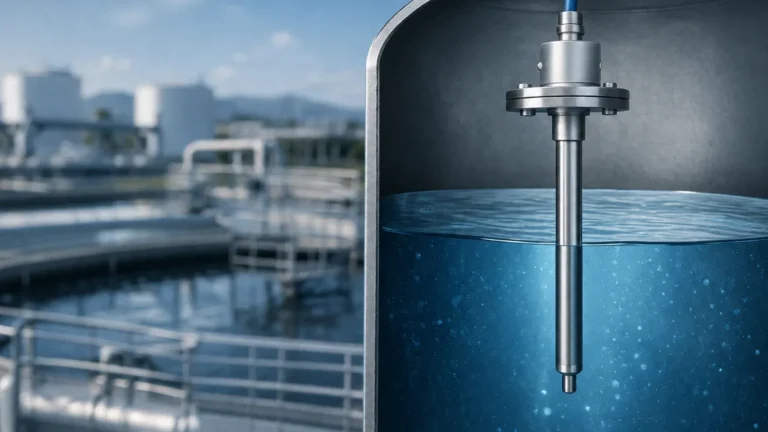
This principle relies on the relationship between the height of a liquid column and the pressure it exerts at the base of a tank ($P = \rho \cdot g \cdot h$). A submersible pressure transmitter or a flange-mounted sensor measures this head pressure.
* Advantages: Simple to install and highly reliable in deep tanks or wells where surface turbulence or foam might interfere with top-down sensors.
* Limitations: It is a contacting method, meaning the sensor diaphragm is exposed to the wastewater. It also requires a constant liquid density for accurate level calculation.
* Suitability: Deep storage tanks, lift stations, and vented vessels.
Level Measurement in Specific Treatment Stages
Wastewater treatment for food processing plants typically involves several stages, each presenting unique challenges for instrumentation.
1. Screening and Grit Removal
Initial stages involve removing large solids and grit. Level switches (such as tuning fork or float switches) are often used here to prevent overflows in intake channels. Ultrasonic sensors are frequently used in open channels to monitor flow rates using flumes or weirs.
2. Equalization Basins
Because food processing discharge is often intermittent (e.g., heavy flow during cleaning shifts), equalization basins are used to balance the flow and organic load before biological treatment. Continuous level monitoring is vital here to control the discharge pumps. Radar is preferred if the wastewater is hot or if there is significant surface agitation.
3. Fat, Oil, and Grease (FOG) Separation
In meat and dairy processing, Dissolved Air Flotation (DAF) units are used to remove fats. The surface of these tanks is often covered in a thick layer of foam or scum. Non-contact radar with high signal sensitivity is required to "see" through the foam to the liquid level, or specialized hydrostatic sensors are used to ignore the surface layer entirely.
4. Biological Reactors (Aerobic and Anaerobic)
Biological treatment uses microorganisms to break down organic matter. These tanks can be quite deep and may involve heavy aeration (bubbles) or anaerobic digestion (gas production).
* Aerobic Digesters: High turbulence from aeration makes ultrasonic measurement difficult; radar or hydrostatic sensors are more reliable.
* Anaerobic Digesters: These are sealed environments where biogas is produced. Radar is the gold standard here as it can measure through the gas layer without interference.
Practical Selection Table
The following table provides a comparison of technologies based on common environmental factors found in food processing wastewater applications.
| Feature | Radar (80 GHz) | Ultrasonic | Hydrostatic | Level Switch (Tuning Fork) |
| :— | :— | :— | :— | :— |
| Contact Type | Non-contact | Non-contact | Contacting | Contacting |
| Accuracy | ±1 mm to ±2 mm | ±0.25% of range | ±0.1% to ±0.5% | N/A (Point level) |
| Foam Resistance | Excellent | Poor | Excellent | Good |
| Steam/Vapor Resistance | High | Low | High | High |
| Maintenance | Very Low | Low | Moderate | Low |
| Primary Application | Process tanks, FOG | Open channels, sumps | Deep wells, lift stations | Overflow protection |
| Max Range | Up to 120 m | Up to 15 m | Up to 200 m | N/A |
Installation Considerations and Best Practices
To ensure the longevity and accuracy of level instruments in wastewater treatment for food processing plants, several installation factors must be addressed:
1. Blocking Distance (Dead Zone): Both radar and ultrasonic sensors have a minimum distance near the sensor face where measurement is impossible. Ensure the sensor is mounted high enough so the maximum liquid level never enters this zone.
2. Beam Angle and Obstructions: Top-down sensors emit a signal in a cone shape. Obstructions such as ladders, pipes, or agitators within this cone can cause false echoes. 80 GHz radar is often preferred in narrow tanks because it has a very narrow beam angle (typically 3° to 8°), allowing it to avoid these obstacles.
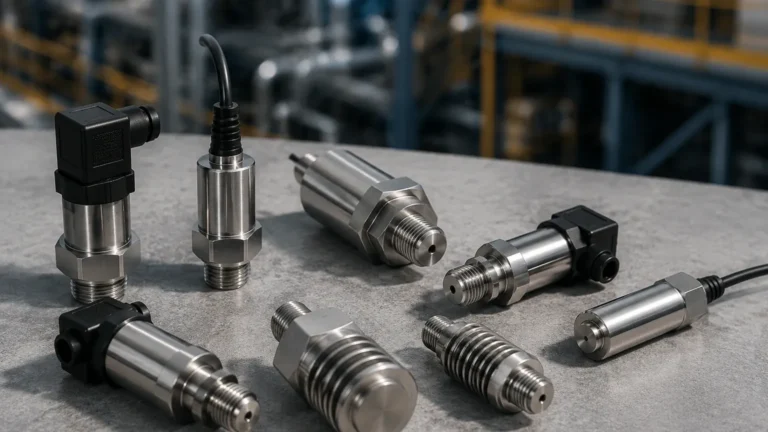
3. Chemical Compatibility: Food processing wastewater often contains caustic or acidic cleaning agents. For hydrostatic sensors, ensure the diaphragm material (e.g., 316L stainless steel, ceramic, or Hastelloy) and cable jacket (e.g., PUR or FEP) are resistant to the specific chemicals used in the plant.
4. Stilling Wells: In cases of extreme turbulence or heavy foam, mounting a sensor inside a stilling well (a vertical pipe) can provide a calm surface for measurement. This is particularly useful for ultrasonic and radar applications.
5. Venting: Hydrostatic sensors must be properly vented to the atmosphere via a capillary tube in the cable to compensate for changes in barometric pressure. Failure to keep this vent dry (using desiccant filters) will lead to measurement drift.
Limitations and Maintenance Requirements
While modern sensors are highly robust, they are not without limitations.
* Build-up: In food wastewater, proteins and fats can solidify on sensor faces. While non-contact radar is less susceptible, heavy build-up can eventually attenuate the signal. Periodic cleaning or using sensors with PTFE-faced antennas can mitigate this.
* Density Fluctuations: Hydrostatic sensors assume a constant liquid density. If the plant switches from processing one product to another with a significantly different specific gravity, the level reading will require recalibration.
* Environmental Noise: In some large-scale treatment plants, heavy machinery can create acoustic noise that interferes with ultrasonic sensors. Shielding or switching to radar is recommended in these environments.
For detailed technical support and to browse our full range of industrial level measurement instruments, please visit our Main Page.
Frequently Asked Questions (FAQ)
Q: Can ultrasonic sensors be used in tanks with heavy steam?
A: Generally, no. Steam changes the speed of sound and can cause the signal to be absorbed or reflected prematurely. Radar is the preferred technology for environments with steam or significant vapor.
Q: How do I handle level measurement in a tank with a thick foam layer?
A: High-frequency radar (80 GHz) is usually the best non-contact option, as it can often penetrate light foam. For very thick, dense foam, a hydrostatic pressure transmitter is more effective because it measures the liquid head pressure from the bottom and is unaffected by surface conditions.
Q: What is the benefit of 80 GHz radar over 26 GHz radar?
A: 80 GHz radar has a much shorter wavelength, which allows for a smaller antenna and a narrower beam. This makes it easier to install in tanks with many internal obstructions and provides better reflection from low-dielectric liquids.
Q: Are there specific sensors for hazardous areas in wastewater plants?
A: Yes. Many wastewater treatment areas, especially anaerobic digesters where methane is produced, are classified as hazardous zones. Sensors used in these areas must have appropriate Intrinsic Safety (Ex ia) or Flameproof (Ex d) certifications.
Q: How often should I calibrate my level sensors?
A: For most non-contact sensors in stable conditions, an annual check is sufficient. However, for hydrostatic sensors in contact with aggressive food waste, semi-annual inspection for diaphragm scaling or build-up is recommended to ensure continued accuracy.
By carefully matching the measurement principle to the specific characteristics of the wastewater stream, food processing plants can ensure reliable operation, maintain compliance, and optimize their treatment processes.
Download Wastewater Treatment for Food Processing Plants as a PDF