Fuel Delivery for Mining Industry
Fuel Delivery for Mining Industry
In the mining sector, fuel is often the single largest operational expense after labor. Remote sites, heavy machinery, and continuous 24/7 operations necessitate a highly sophisticated logistics chain. Efficient fuel delivery for mining industry operations depends not only on the physical transport of diesel and lubricants but also on the precision of the inventory management systems that govern storage and consumption. Without accurate level measurement, mining operators face risks ranging from costly stockouts that halt production to hazardous overfills and environmental contamination.
To manage these risks, engineers must implement robust level measurement technologies that can withstand the extreme temperatures, vibrations, and dust characteristic of mining environments. This article examines the core measurement principles and selection criteria for fuel storage and delivery infrastructure.
Measurement Principles for Fuel Storage and Delivery
Before selecting an instrument for fuel monitoring, it is essential to understand the physical principles that drive different measurement technologies. In the context of fuel delivery for mining industry tanks, four primary methods are commonly employed.
1. Radar Level Measurement (Time of Flight)
Radar level meters, specifically non-contact and guided wave radar (GWR), are the gold standard for fuel measurement. These devices emit high-frequency electromagnetic pulses (typically in the GHz range). In non-contact radar, the sensor transmits a signal from the top of the tank; the signal reflects off the fuel surface and returns to the sensor. The distance is calculated based on the time of flight (ToF).
Guided wave radar uses a probe (cable or rod) to direct the pulse. This is particularly effective for fuels with low dielectric constants, as the probe concentrates the energy, ensuring a stronger return signal even in deep tanks or turbulent conditions.
2. Hydrostatic Pressure Measurement
Hydrostatic level transmitters measure the pressure exerted by the liquid column at the bottom of the tank. The principle follows the formula: $P = \rho \cdot g \cdot h$, where $P$ is pressure, $\rho$ is the density of the fuel, $g$ is gravity, and $h$ is the height of the liquid.
Because diesel density changes with temperature, high-precision hydrostatic systems often incorporate temperature compensation to maintain accuracy. This method is favored for its simplicity and reliability in bulk storage tanks where internal obstructions might interfere with radar signals.
3. Ultrasonic Level Measurement
Ultrasonic sensors function similarly to radar but use sound waves instead of electromagnetic waves. A transducer emits an ultrasonic pulse that bounces off the fuel surface. While cost-effective, ultrasonic sensors are sensitive to air temperature fluctuations and the presence of heavy vapors or foam on the fuel surface, which can attenuate the sound wave.
4. Magnetic Level Gauges
Magnetic level gauges provide both a visual indication and a remote electronic signal. A float containing a permanent magnet moves with the fuel level inside a bypass chamber. Outside the chamber, a series of magnetic flaps flip to show the level. For automated systems, a magnetostrictive transmitter is often attached to the gauge to provide a 4-20mA or digital output to the control room.
Selecting Level Instruments for Mining Fuel Infrastructure
Choosing the right technology requires balancing accuracy requirements against the physical constraints of the mining site. The following table provides a comparison of the most common technologies used in fuel delivery for mining industry storage.
| Technology | Accuracy | Max Range | Media Suitability | Environmental Resistance | Relative Cost |
| :— | :— | :— | :— | :— | :— |
| Non-Contact Radar | ±2 mm | 30m – 120m | Excellent (All fuels) | High (Dust/Vapor) | High |
| Guided Wave Radar | ±3 mm | Up to 30m | Good (Low Dielectric) | High (Turbulence) | Medium-High |
| Hydrostatic | ±0.1% FS | Unlimited | Good (Requires Density) | Moderate | Medium |
| Ultrasonic | ±0.25% FS | 15m – 20m | Fair (Sensitive to Vapor) | Low (Temp sensitive) | Low |
| Magnetic Gauge | ±5 mm | Up to 6m | Excellent (Visual) | High (Mechanical) | Medium |
When planning new infrastructure or upgrading existing tanks, engineers should Review product options and application support to ensure the selected hardware meets the specific dielectric and pressure requirements of the fuel being stored.
Optimizing Fuel Delivery for Mining Industry Operations
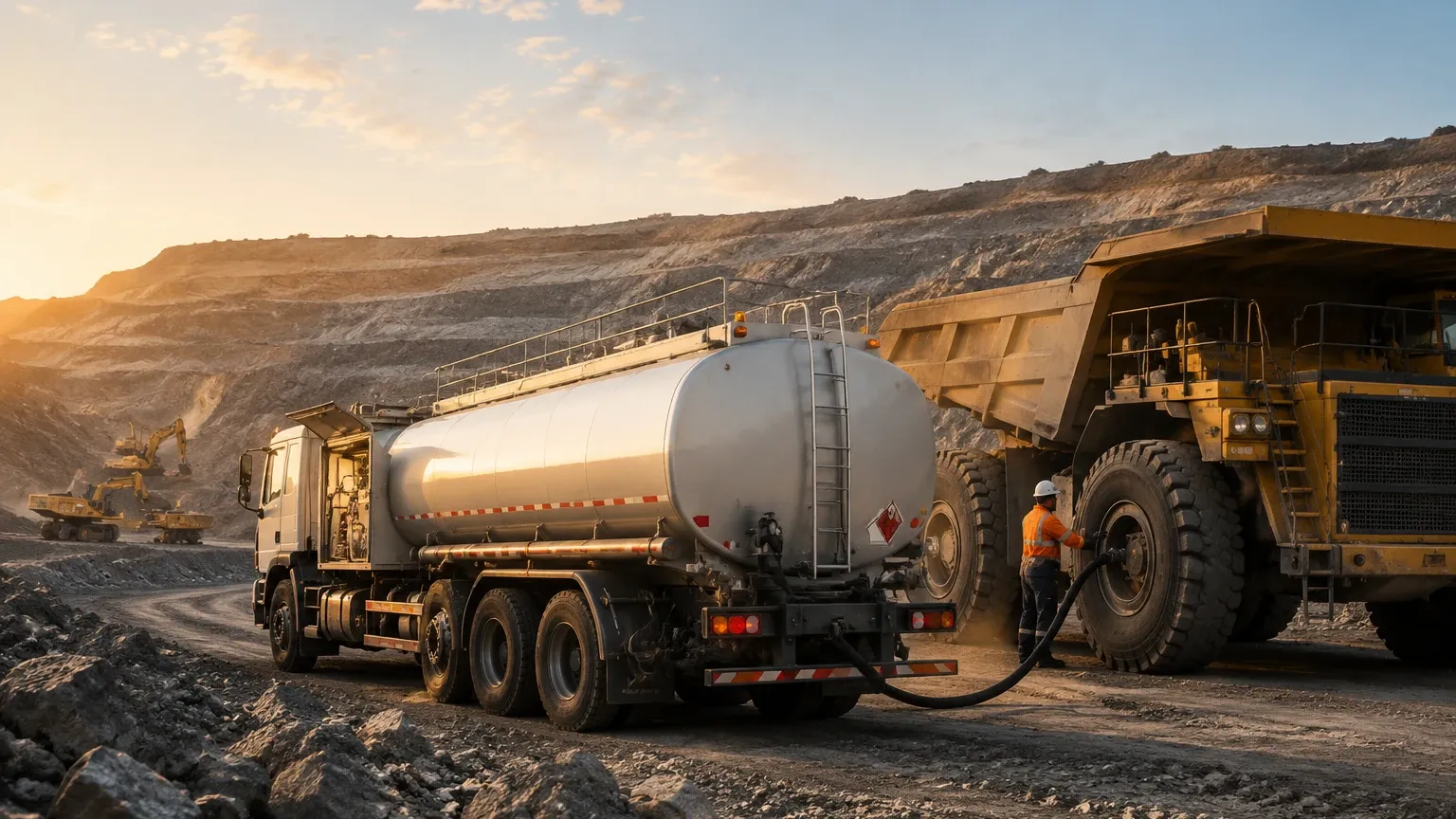
Fuel delivery for mining industry logistics is a complex cycle involving bulk delivery by rail or road, transfer to primary storage, and subsequent distribution to day tanks or mobile refueling bowsers. Level measurement instruments serve as the "eyes" of this system.
Preventing Stockouts and Overfills
In remote mining operations, the lead time for fuel delivery can be several days. Real-time level monitoring allows for automated reorder points. High-level alarms are equally critical; an overfill in a 100,000-liter tank is not just a financial loss but a major environmental disaster and fire hazard. Level switches, often used as redundant secondary safety systems, provide an independent physical break to the delivery pump if a critical high level is reached.
Custody Transfer and Reconciliation
Accurate measurement is the basis for fuel reconciliation. By comparing the volume delivered by the supplier (often measured by flow meters) against the volume received in the tank (measured by level meters), mining companies can identify discrepancies caused by leaks, theft, or temperature-induced volume changes. High-accuracy radar meters are typically required for this level of fiscal accountability.
Installation Considerations in Harsh Mining Environments
Installing level sensors in a mining fuel farm requires more than just threading a sensor into a flange. The following factors must be considered to ensure long-term reliability:
1. Explosion-Proof Ratings: Fuel storage areas are classified as hazardous zones. All instrumentation must carry appropriate ATEX, IECEx, or local equivalent certifications (e.g., Class I, Div 1). This includes the use of intrinsically safe barriers or explosion-proof housings.
2. Tank Geometry and Obstructions: Internal structures like heating coils, ladders, or agitators can create false echoes for radar and ultrasonic sensors. Using "false signal suppression" software or installing sensors in stilling wells (pipes that shield the sensor from turbulence and obstructions) can mitigate these issues.
3. Vibration and Mechanical Stress: Mining sites are high-vibration environments due to nearby blasting and heavy vehicle movement. Mounting brackets should be reinforced, and sensors should be rated for high-vibration tolerance to prevent electronic failure.
4. Grounding and Lightning Protection: Remote fuel farms are often the highest points in a landscape, making them susceptible to lightning strikes. Proper grounding of the instrument and the use of surge protectors are mandatory to prevent the destruction of the sensor electronics.
Limitations and Challenges of Level Measurement in Fuel Systems
While modern instrumentation is highly advanced, certain physical limitations remain:
* Dielectric Constant ($ε_r$): Diesel and other hydrocarbons have low dielectric constants (typically between 1.9 and 2.1). This means they reflect radar waves poorly compared to water. In very deep tanks, a guided wave radar or a high-frequency (80GHz) non-contact radar is necessary to ensure the signal is not lost.
* Temperature Stratification: In large bulk tanks, the fuel at the top may be significantly warmer than at the bottom. This affects density (impacting hydrostatic sensors) and the speed of sound (impacting ultrasonic sensors). Multi-point temperature probes are often installed alongside level meters to provide the data needed for volume correction.
* Condensation and Build-up: In humid environments, condensation can form on the antenna of a radar or ultrasonic sensor. While radar can often see through thin layers of moisture, heavy droplets can cause signal scattering. Selecting sensors with PTFE-coated antennas or drip-off designs helps minimize this effect.
Frequently Asked Questions (FAQs)
Q: How often should fuel level sensors be calibrated?
A: For standard inventory management, an annual calibration check is recommended. However, if the system is used for custody transfer or fiscal reconciliation, semi-annual or quarterly verification may be required by local regulations or corporate policy.
Q: Can one sensor be used for multiple types of fuel?
A: Yes, provided the sensor is compatible with the chemical properties of the fuels. Radar and magnetic gauges are generally versatile. Hydrostatic sensors, however, must be recalibrated if the fuel density changes significantly (e.g., switching from diesel to a heavy fuel oil).
Q: What is the benefit of 80GHz Radar over 26GHz Radar for fuel?
A: 80GHz radar has a narrower beam angle, which allows it to avoid internal tank obstructions more easily and provides a stronger reflection from low-dielectric surfaces like fuel. It is generally preferred for modern mining fuel installations.
Q: How do I monitor fuel levels in mobile refueling trucks?
A: Mobile bowsers require specialized sensors that can handle constant sloshing and movement. Guided wave radar with a coaxial probe is often used because the probe acts as a stilling well, and the electronic filtering can smooth out the fluctuations caused by vehicle motion.
Conclusion
Effective fuel delivery for mining industry operations is underpinned by the accuracy and reliability of level measurement data. By understanding the measurement principles of radar, hydrostatic, and ultrasonic technologies, and by accounting for the unique challenges of the mining environment—such as hazardous zone requirements and low dielectric constants—operators can ensure a continuous, safe, and cost-effective fuel supply. Selecting the correct instrumentation is not merely a technical choice but a strategic investment in the uptime and safety of the entire mining project.