What Does a Downstream Oxygen Sensor Do
What Does a Downstream Oxygen Sensor Do
In the realm of process automation and industrial combustion control, the precise measurement of gas constituents is as critical as monitoring fluid levels in a storage tank. Among the various analytical instruments used in modern engineering, the oxygen sensor—specifically the downstream oxygen sensor—plays a pivotal role in system diagnostics and environmental compliance. While often associated with automotive exhaust systems, the underlying technology and the functional requirements of downstream sensing are fundamental to various industrial emission monitoring and feedback control loops.
Understanding what does a downstream oxygen sensor do requires a foundational look at electrochemical sensing principles and the architecture of a standard exhaust or flue gas treatment system. This article explores the technical mechanics, the diagnostic purpose, and the industrial relevance of downstream oxygen sensing, providing a reference for engineers and technicians involved in process instrumentation.
Measurement Principles of Oxygen Sensors
Before examining the specific role of the downstream sensor, it is essential to understand how these devices detect oxygen levels. Most industrial and automotive oxygen sensors (often called Lambda sensors) operate on the Nernst principle using a solid-state electrochemical cell.
The Zirconia Element
The core of the sensor is typically a ceramic element made of zirconium dioxide (ZrO2), stabilized with yttrium oxide. This ceramic becomes conductive to oxygen ions at high temperatures, usually above 300°C (572°F). The ceramic element is coated with thin layers of platinum, which serve as electrodes.
The Nernst Equation
One side of the zirconia element is exposed to the exhaust gas (the process side), while the other side is exposed to a reference gas (usually ambient air with a constant 20.9% oxygen content). The difference in oxygen concentration between the two sides causes oxygen ions to migrate through the ceramic lattice. This movement generates a voltage (electromotive force) that can be measured. The voltage produced is logarithmic relative to the oxygen partial pressure, allowing the control system to calculate the exact oxygen concentration in the gas stream.
Defining the Downstream Position
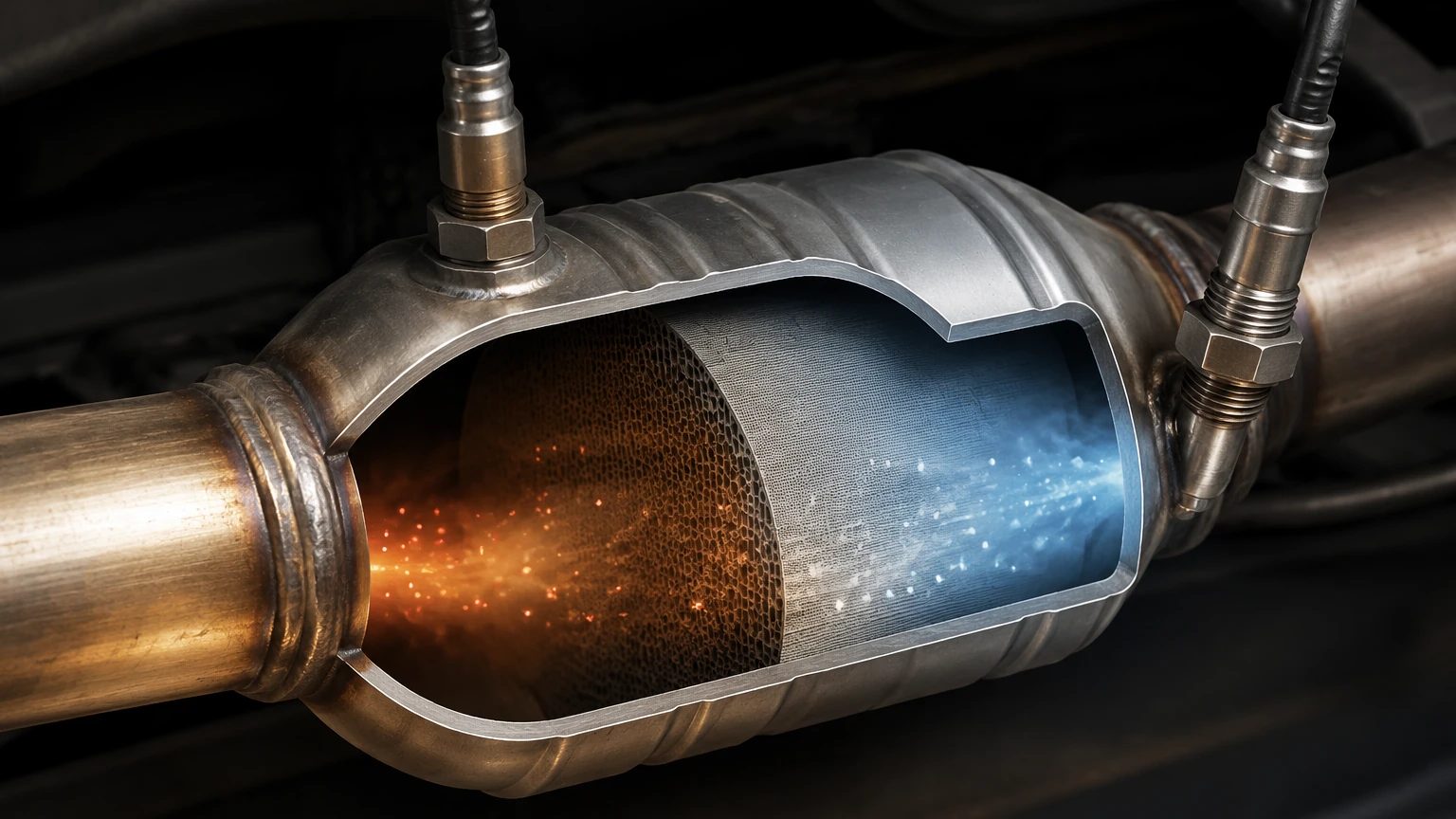
In a typical emission control setup, sensors are placed in two distinct locations relative to the catalyst (the catalytic converter in automotive terms or a Selective Catalytic Reduction [SCR] unit in industrial terms):
1. Upstream Sensor (Sensor 1): Located before the catalyst, its primary job is to monitor the oxygen content of the raw combustion gases to adjust the air-fuel ratio in real-time.
2. Downstream Sensor (Sensor 2): Located after the catalyst, its primary role is diagnostic. It monitors the efficiency of the treatment process itself.
What Does a Downstream Oxygen Sensor Do?
The primary function of a downstream oxygen sensor is to verify that the catalyst is successfully reducing pollutants. It acts as the "quality control" inspector for the emission system.
1. Monitoring Catalyst Efficiency
A healthy catalyst should consume or store oxygen as it facilitates chemical reactions to neutralize carbon monoxide (CO), hydrocarbons (HC), and nitrogen oxides (NOx). If the catalyst is functioning correctly, the oxygen levels downstream should be relatively stable and significantly different from the fluctuating levels seen upstream. If the downstream sensor begins to mirror the upstream sensor's fluctuations, it indicates that the catalyst has lost its storage capacity and is failing.
2. Fine-Tuning Long-Term Fuel Trim
While the upstream sensor handles immediate fuel adjustments, the downstream sensor provides data for "long-term fuel trim." By observing the oxygen levels after the catalyst, the system's controller can make subtle adjustments to the base fuel map to compensate for sensor aging or minor vacuum leaks, ensuring the system remains within its optimal operating window.
3. Regulatory Compliance and Diagnostics
In many jurisdictions, industrial plants and vehicles are required to have On-Board Diagnostics (OBD) or Continuous Emissions Monitoring Systems (CEMS). The downstream sensor is the primary source of data for the "Catalyst Efficiency" fault code. Without this sensor, the system would have no way of knowing if the expensive catalyst is actually working or if it has been fouled by contaminants.
Technical Comparison: Upstream vs. Downstream Sensors
While the physical construction may appear similar, the behavior and signal processing of these two sensors differ significantly.
| Feature | Upstream Sensor (Pre-Catalyst) | Downstream Sensor (Post-Catalyst) |
| :— | :— | :— |
| Primary Purpose | Air-Fuel Ratio Control | Catalyst Monitoring / Diagnostics |
| Signal Behavior | Rapidly fluctuating (switching) | Stable, slow-moving voltage |
| Impact on Performance | High (affects engine/burner efficiency) | Low (primarily affects emissions status) |
| Operating Environment | High heat, high turbulence | Lower heat, filtered gas stream |
| Typical Voltage Range | 0.1V to 0.9V (switching) | Constant ~0.45V to 0.7V (ideal) |
Industrial Applications and Process Integration
In industrial settings, oxygen sensing is often integrated into broader process control strategies. Just as a facility might use a Main Page to monitor the volume of chemicals in a reactor, oxygen sensors monitor the "health" of the combustion or chemical reaction occurring in the flue.
For example, in industrial boilers, downstream oxygen sensing is used to ensure that the flue gas treatment systems are meeting environmental permits. In these high-stakes environments, the sensor must withstand fly ash, sulfur compounds, and extreme thermal cycling. The data from these sensors is frequently logged into a Distributed Control System (DCS) alongside data from level transmitters and pressure gauges to provide a holistic view of plant efficiency.
Installation and Maintenance Considerations
To ensure accurate readings from a downstream oxygen sensor, several engineering factors must be addressed during installation:
Orientation and Placement
* Angle: Sensors should be installed at an angle at least 10 degrees above the horizontal. This prevents moisture (condensate) from collecting inside the sensor housing, which could crack the ceramic element upon heating.
* Distance: The sensor must be placed far enough downstream of the catalyst to allow the gas to mix, but close enough to maintain the required operating temperature.
Wiring and Protection
Because the sensor generates a low-voltage signal (0-1V), it is highly susceptible to electrical noise. Shielded cabling is often required in industrial environments. Furthermore, the sensor's external vent (which allows reference air to enter) must be kept clear of oil, undercoating, or industrial debris.
Common Failure Modes
* Silicone Poisoning: Silicone vapors from certain sealants or lubricants can coat the platinum electrodes, rendered the sensor "lazy" or unresponsive.
* Soot Accumulation: In heavy oil or coal-fired applications, carbon soot can block the protective louvers of the sensor, preventing gas from reaching the ceramic element.
* Thermal Shock: If liquid water hits a hot sensor element, the ceramic will shatter instantly.
Selecting the Right Sensor Technology
When specifying a sensor for a downstream application, engineers must choose between Narrowband and Wideband (UEGO) technologies.
1. Narrowband Sensors: These are the most common for downstream use. They are highly accurate at the stoichiometric point (the ideal balance of air and fuel) but act essentially as a binary switch (Rich vs. Lean).
2. Wideband Sensors: These provide a linear output across a broad range of oxygen concentrations. While more expensive, they are increasingly used in sophisticated industrial burners where precise control over "excess air" is required to maximize thermal efficiency.
Frequently Asked Questions (FAQ)
Q: Can a downstream oxygen sensor cause poor fuel economy?
A: Generally, no. The upstream sensor is the primary driver of fuel consumption. However, if the downstream sensor detects a major catalyst failure, the system may enter a "limp home" or "safety" mode that increases fuel consumption to protect the engine or burner.
Q: Can I swap the upstream and downstream sensors?
A: While they may have the same thread pitch (typically M18x1.5), they often have different wire lengths, connector types, and internal heater resistances. It is critical to use the specific part number designated for the downstream position.
Q: How often should downstream sensors be replaced?
A: In industrial applications, these are often replaced on a preventative maintenance schedule, typically every 2-3 years or 50,000 to 100,000 operating hours, depending on the purity of the fuel and the stability of the process.
Conclusion
The downstream oxygen sensor is an essential component for any system requiring verified emission control. By providing a feedback loop that monitors the effectiveness of the catalyst, it ensures that industrial processes remain compliant with environmental regulations and operate at peak diagnostic health. Whether you are managing a complex chemical refinery or a simple commercial boiler, understanding the relationship between different sensing technologies—from gas analysis to liquid Main Page solutions—is key to maintaining a safe and efficient facility.
By prioritizing correct installation, regular calibration, and an understanding of the Nernstian physics behind the device, engineers can ensure that their downstream sensing remains a reliable pillar of their process instrumentation suite.