Conductivity Monitor
Conductivity Monitor
In the landscape of industrial process control, the ability to quantify the ionic concentration of a liquid is as critical as measuring its volume or pressure. A conductivity monitor serves as the primary analytical tool for this purpose, providing real-time data on a solution's ability to conduct an electrical current. This measurement is a direct proxy for the total dissolved solids (TDS) and ionic concentration within a process fluid, making it indispensable in applications ranging from ultrapure water production to heavy chemical manufacturing. For engineers managing complex tank systems, integrating conductivity monitoring with reliable level measurement solutions—such as those found on the Main Page—ensures both the quantity and quality of the stored media are strictly maintained.
Measurement Principles of Conductivity
To effectively select and deploy a conductivity monitor, one must first understand the physics governing the measurement. Electrolytic conductivity is defined as the inverse of electrical resistivity. In a liquid, current is carried by dissolved ions; therefore, higher ionic concentrations result in higher conductivity. The standard unit of measurement is Siemens per meter (S/m), though in industrial contexts, microsiemens per centimeter (µS/cm) or millisiemens per centimeter (mS/cm) are more common.
Contacting Conductivity (Potentiometric)
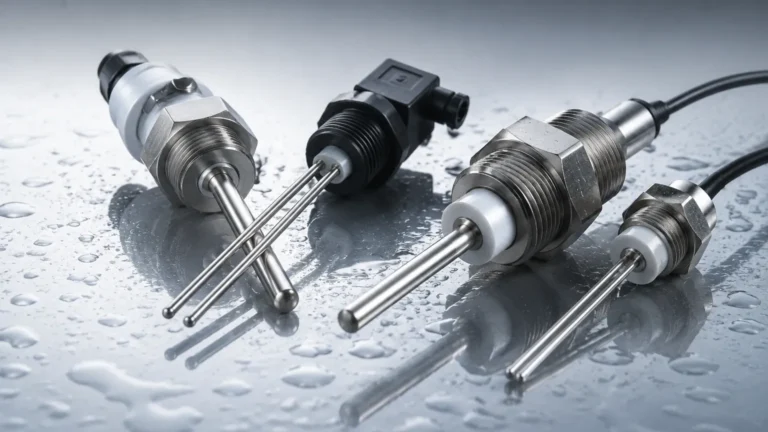
The contacting measurement principle utilizes two or more electrodes (typically made of stainless steel, graphite, or titanium) placed in direct contact with the process fluid. An alternating voltage is applied between the electrodes, and the resulting current is measured. According to Ohm’s Law, the conductance is proportional to the current.
A critical factor in this method is the "Cell Constant" (K), defined as the ratio of the distance between the electrodes to the cross-sectional area of the liquid between them ($K = L/A$).
* Low Cell Constants (e.g., K=0.01 or 0.1): Used for low-conductivity fluids like deionized water, where electrodes are placed close together.
* High Cell Constants (e.g., K=1.0 or 10.0): Used for high-conductivity fluids like wastewater or seawater.
Inductive Conductivity (Toroidal)
Inductive or toroidal conductivity monitors operate without direct electrode contact. The sensor consists of two wire-wound metal toroids encapsulated in a plastic housing (often PEEK or PFA). One coil acts as a transmitter, inducing an alternating current in the liquid loop passing through the center of the sensor. The second coil acts as a receiver, measuring the strength of this induced current, which is directly proportional to the conductivity of the solution. This method is highly resistant to fouling and chemical corrosion.
The Relationship Between Level and Conductivity
In many industrial B2B environments, conductivity and level measurement are complementary. While radar or ultrasonic sensors provide the physical height of a liquid, conductivity monitors provide the "identity" or "state" of that liquid.
1. Interface Detection: In tanks containing two immiscible liquids with different conductive properties (e.g., oil and water), a conductivity probe can detect the exact point where the interface occurs. This data, combined with a hydrostatic level transmitter, allows for precise separation processes.
2. Concentration Control: In chemical blending tanks, as a level meter monitors the filling process, the conductivity monitor ensures the chemical concentration remains within specification. If the conductivity deviates, the system can automatically trigger dosing pumps.
3. Phase Separation in CIP: In Food and Beverage Clean-in-Place (CIP) systems, conductivity monitors detect the transition between rinse water and cleaning chemicals, allowing the system to divert the flow to the correct recovery tank based on the liquid's ionic signature.
Key Evaluation Criteria for Industrial Monitors
Selecting the right conductivity monitor requires an analysis of the process environment and the required data precision. Engineers should evaluate the following criteria:
Temperature Compensation
Conductivity is highly temperature-dependent; typically, the conductivity of an aqueous solution increases by 1% to 3% per degree Celsius. A professional-grade monitor must include an integrated temperature sensor (usually a Pt100 or Pt1000 RTD) and sophisticated algorithms to provide "Temperature Compensated" readings, usually referenced to 25°C.
Sensor Material Compatibility
The wetted parts of the sensor must withstand the chemical aggressiveness of the process. For ultrapure water, 316L Stainless Steel is standard. For highly corrosive acids or bases, electrodeless (inductive) sensors made of PFA (Perfluoroalkoxy) or PEEK (Polyether ether ketone) are preferred to prevent electrode degradation.
Measurement Range and Accuracy
Contacting sensors are superior for low-range measurements (0.055 µS/cm to 200 µS/cm). However, at high concentrations, they suffer from "polarization," where ions build up near the electrode surface and distort the reading. Inductive sensors are the industry standard for high-range measurements (up to 2,000 mS/cm).
Practical Selection Table
The following table provides a general guideline for selecting a conductivity monitor based on common industrial applications:
| Application | Typical Range | Recommended Technology | Wetted Materials | Key Consideration |
| :— | :— | :— | :— | :— |
| Ultrapure Water (UPW) | 0.055 – 1.0 µS/cm | Contacting (K=0.01) | 316L Stainless Steel | Trace contamination risks |
| Boiler Feed Water | 1 – 50 µS/cm | Contacting (K=0.1) | Stainless Steel / Titanium | High temperature/pressure |
| Cooling Tower Water | 500 – 5,000 µS/cm | 4-Electrode Contacting | Graphite / Epoxy | Scaling and bio-fouling |
| Wastewater Treatment | 10 – 2,000 µS/cm | Inductive (Toroidal) | Polypropylene / PVC | Suspended solids/coatings |
| Chemical Dosing | 10 – 1,000 mS/cm | Inductive (Toroidal) | PEEK / PFA | Aggressive corrosion |
| CIP Phase Detection | 1 – 500 mS/cm | Inductive (Toroidal) | Food-grade PEEK | Rapid temperature changes |
Installation Considerations
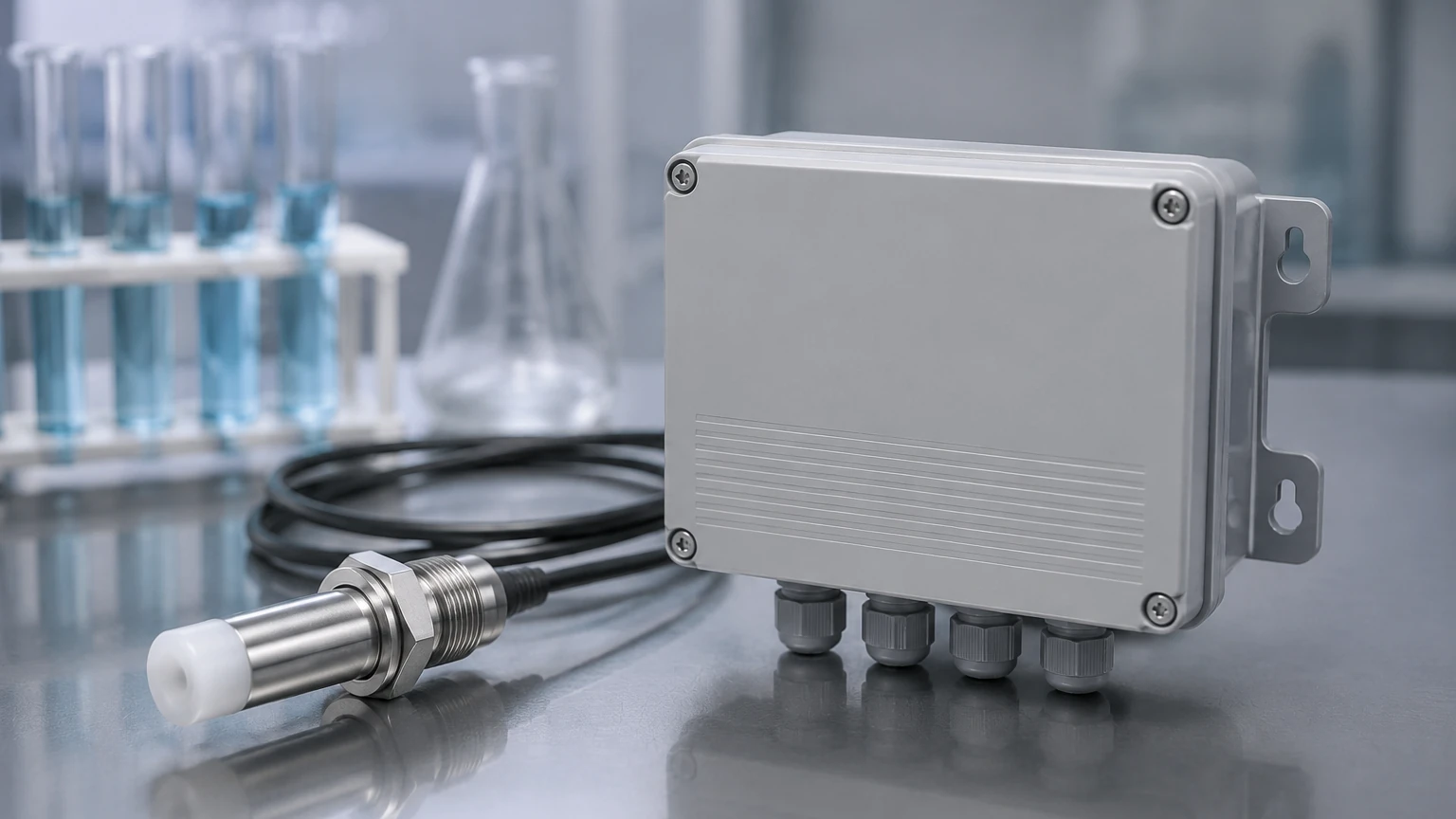
Correct installation is paramount to ensuring the longevity and accuracy of a conductivity monitor. Below are the primary engineering considerations for field deployment:
* Avoid Air Pockets: Sensors must be installed in a location where they are always fully submerged. In horizontal pipes, mount the sensor at the 3 o'clock or 9 o'clock position to avoid air bubbles at the top or sediment at the bottom.
* Flow Velocity: While some flow is necessary to ensure a representative sample, excessively high velocity can cause cavitation or physical wear on the sensor body. Conversely, stagnant flow can lead to localized concentration gradients.
* Wall Effects: For inductive (toroidal) sensors, the magnetic field extends beyond the sensor body. If the sensor is installed too close to a metallic pipe wall, the reading will be offset. A minimum clearance (typically 20-50mm) from the pipe wall is required unless the monitor is calibrated specifically for that pipe size.
* Cable Length and Interference: For contacting sensors, the cable acts as part of the measuring circuit. Long cable runs can introduce capacitance that affects the reading. Use shielded cables and keep them away from high-voltage power lines to prevent EMI (Electromagnetic Interference).
Limitations and Maintenance
Despite their robustness, conductivity monitors have specific limitations that must be managed through regular maintenance:
1. Fouling and Coating: In contacting sensors, the buildup of oil, biological growth, or scale on the electrodes acts as an insulator, leading to erroneously low readings. Inductive sensors are less sensitive to this but still require periodic cleaning to ensure the "bore" of the toroid is not restricted.
2. Polarization: This occurs in 2-electrode contacting sensors at high conductivities. Using a 4-electrode design or an inductive sensor mitigates this risk.
3. Calibration Requirements: Accuracy drifts over time due to electrode wear or electronic aging. Calibration should be performed using certified standard solutions that bracket the expected process range. For ultrapure water, "air calibration" or comparison against a master meter is often used because standard solutions are easily contaminated by atmospheric CO2.
Frequently Asked Questions (FAQs)
Q: Can a conductivity monitor measure the concentration of a specific chemical?
A: Only if the solution is a binary mixture (one chemical in water). Since conductivity measures the total ionic content, it cannot distinguish between different types of ions. If multiple salts or acids are present, the monitor provides the sum of their contributions.
Q: What is the difference between Conductivity and TDS?
A: Conductivity is the measure of current flow, while TDS (Total Dissolved Solids) is the mass of dissolved solids. Most monitors convert conductivity to TDS using a multiplier (typically 0.5 to 0.7), but this factor varies depending on the specific ions present in the water.
Q: How often should I calibrate my conductivity monitor?
A: In clean water applications, semi-annual calibration is often sufficient. In harsh chemical processes or wastewater, monthly checks or even weekly cleanings may be required to maintain ±1% accuracy.
Q: Why does my reading fluctuate when the pump starts?
A: This is likely due to electrical noise (EMI) from the pump motor or VFD affecting the low-voltage signal from the sensor. Ensure proper grounding of the sensor and use double-shielded cabling.
Summary for Project Procurement
When integrating a conductivity monitor into your facility's automation architecture, it is essential to view the instrument as part of a broader process control strategy. Reliable data allows for the optimization of chemical usage, the protection of expensive downstream equipment like RO membranes, and the assurance of product consistency. For comprehensive process monitoring, ensure your analytical instruments are paired with high-quality level measurement hardware. For more information on selecting the right instrumentation for your specific industrial application, you can Review product options and application support to find solutions that meet your accuracy and durability requirements.