Industrial Edible Oil Refining Equipment Trends
Industrial Edible Oil Refining Equipment Trends
The global edible oil industry is undergoing a significant transformation driven by the demand for higher purity, improved nutritional profiles, and sustainable production methods. As consumer awareness regarding trans-fats and contaminants like 3-MCPD and Glycidyl Esters (GE) grows, industrial edible oil refining equipment trends have shifted toward more sophisticated, automated, and energy-efficient systems. Central to these trends is the integration of advanced process control and instrumentation, ensuring that every stage of the refining process—from degumming to deodorization—is optimized for yield and quality.
Modern refining plants are no longer just mechanical assemblies; they are data-driven environments where precision measurement is critical. Understanding the principles of the instrumentation used within these systems is essential for engineers and plant managers looking to align with current industry standards.
Core Measurement Principles in Oil Refining
Before selecting equipment to meet modern refining trends, it is vital to understand how level measurement—a cornerstone of process control—functions within these environments. Edible oils present unique challenges, including low dielectric constants, varying viscosities, and high-temperature processing.
Radar Level Measurement
Radar technology is the gold standard in modern oil refining. It operates on the Time-of-Flight (ToF) principle, where microwave pulses are emitted toward the product surface and reflected back to the sensor.
* Non-contact Radar: Ideal for storage tanks and processes where hygiene is paramount. It is unaffected by the density or conductivity of the oil. However, because edible oils typically have a low dielectric constant (εr ≈ 2.0 to 3.0), high-frequency radar (80 GHz) is preferred to ensure a strong return signal.
* Guided Wave Radar (GWR): Uses a physical probe to guide the signal. This is particularly effective in small vessels or tanks with internal obstructions, as the concentrated signal provides a reliable measurement even with low-dielectric fluids.
Ultrasonic Level Sensors
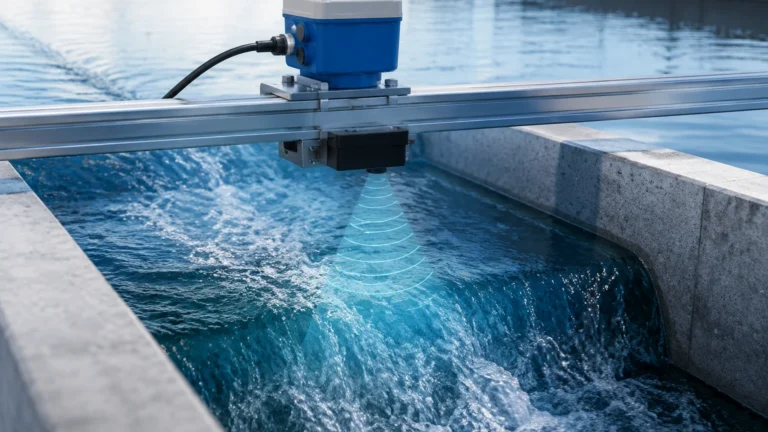
Ultrasonic sensors emit high-frequency sound waves. The time taken for the echo to return determines the distance. While cost-effective, their use in refining is generally limited to ambient-temperature storage. They are sensitive to vacuum conditions—common in deodorizers—and surface foam, which can absorb sound waves.
Hydrostatic Pressure Measurement
This principle measures the pressure exerted by the liquid column. Since pressure is proportional to height and density ($P = \rho gh$), it is a reliable method for vented tanks. In refining, where temperatures fluctuate, density compensation is required to maintain accuracy, as the specific gravity of oil changes with temperature.
Magnetic Level Gauges
Magnetic gauges provide a visual bypass indication. A float containing a magnet moves with the liquid level, flipping bicolored flaps on an external scale. These are favored for high-pressure and high-temperature applications where a local visual reference is required for safety.
Key Industrial Edible Oil Refining Equipment Trends
1. Automation and IIoT Integration
One of the most prominent industrial edible oil refining equipment trends is the move toward full automation. Modern plants utilize centralized control systems (DCS or PLC) that rely on continuous feedback from field instruments. Real-time data allows for precise dosing of phosphoric acid in degumming or bleaching earth in the bleaching stage, reducing waste and ensuring consistent product quality. For those exploring the latest in sensor integration, the Main Page of leading instrument providers offers a glimpse into how these components fit into automated architectures.
2. Energy Recovery and Thermal Efficiency
Energy is a significant operational cost in refining, particularly during the high-heat deodorization process (typically 230°C to 260°C). Trends show an increase in the use of sophisticated heat exchangers that recover heat from the outgoing hot oil to preheat the incoming cold oil. This requires precise level control in heat recovery vessels to prevent dry-running or overflow, which could compromise thermal efficiency.
3. Mitigation of Process Contaminants
Refining equipment is being redesigned to minimize the formation of harmful substances. For instance, shorter residence times in deodorizers and lower operating temperatures help reduce GE formation. This necessitates high-precision level and flow control to manage the throughput speed accurately without sacrificing the removal of volatile impurities.
4. Modular and Scalable Plant Design
To reduce onsite construction time and costs, many manufacturers are moving toward modular refining units. These pre-assembled skids include the vessels, piping, and instrumentation required for a specific process step. This trend emphasizes the need for compact, vibration-resistant level sensors that can withstand the rigors of transport and rapid commissioning.
Application-Specific Selection Table
Choosing the right instrumentation depends on the specific stage of the refining process. The following table summarizes the recommended technologies based on typical process conditions.
| Refining Stage | Process Conditions | Recommended Technology | Why? |
| :— | :— | :— | :— |
| Crude Oil Storage | Ambient temp, large tanks | 80 GHz Non-contact Radar | High accuracy, no maintenance. |
| Degumming | Agitation, steam injection | Guided Wave Radar | Ignores steam and surface turbulence. |
| Bleaching | Slurry (oil + clay), vacuum | Radar (High Frequency) | Unaffected by vacuum; handles dust. |
| Deodorization | High temp (>240°C), High vacuum | High-temp Guided Wave Radar | Handles extreme heat and vacuum. |
| Fractionation | Controlled cooling, crystallization | Hydrostatic (with temp comp) | Monitors density changes during cooling. |
| Finished Oil Tanks | Food grade, ambient | Ultrasonic or Radar | Clean, non-contact measurement. |
Installation and Engineering Considerations
When implementing new industrial edible oil refining equipment trends, installation geometry is often overlooked. To ensure accurate measurement and long-term reliability, consider the following:
* Agitator Interference: Many refining tanks use mixers. Radar sensors must be installed in a location where the signal beam does not intersect the path of the agitator blades. Alternatively, a stilling well or bypass pipe can be used to isolate the sensor from turbulence.
* Vacuum Effects: In the bleaching and deodorization stages, high vacuum levels are maintained. Ultrasonic sensors will not function in a vacuum because sound requires a medium to travel. Radar is the only viable non-contact option here.
* Nozzle Geometry: For radar installations, the height and diameter of the mounting nozzle can cause signal interference (ringing). Ensure the sensor antenna extends slightly below the nozzle or use a sensor with a narrow beam angle.
* Steam and Condensation: Steam is frequently used for heating or stripping. Sensors should have a high-quality seal (such as PTFE or PEEK) and features like "tank mapping" to ignore reflections from internal heating coils.
Limitations and Challenges
While technology has advanced, certain limitations remain in edible oil refining:
1. Low Dielectric Constant: As mentioned, oils do not reflect radar signals as strongly as water-based liquids. If the dielectric constant is below 1.5, GWR or high-sensitivity non-contact radar is mandatory.
2. Coating and Buildup: Bleaching earth and waxes can build up on probes. In these cases, non-contact radar or hydrostatic transmitters with flush diaphragms are preferred over contact-based probes.
3. Temperature Extremes: Standard electronics cannot survive the 250°C temperatures of a deodorizer. Remote-mounted electronics or specialized cooling fins are necessary to protect the sensor head.
Frequently Asked Questions (FAQ)
Q: Why is 80 GHz radar becoming the trend for oil storage?
A: Higher frequency radar (80 GHz) has a much narrower beam angle. This allows it to avoid internal obstructions like ladders or heating coils and provides a stronger reflection from low-dielectric oils compared to older 26 GHz models.
Q: Can I use a single level sensor for all refining stages?
A: Generally, no. The conditions in a deodorizer (high temp/vacuum) are vastly different from a storage tank. While radar is versatile, the specific model and sealing materials must be matched to the process temperature and pressure.
Q: How does the trend toward "Green Refining" affect equipment choice?
A: Green refining focuses on reducing water and chemical use. This leads to "dry degumming" and enzymatic processes, which require more precise dosing and level control to manage the slower, more sensitive chemical reactions.
Conclusion
Staying current with industrial edible oil refining equipment trends requires a holistic view of the process. From the adoption of IIoT-ready sensors to the implementation of high-efficiency thermal systems, the goal remains the same: maximizing yield while ensuring food safety. By selecting the appropriate measurement principle—whether it be radar for its versatility or hydrostatic for its reliability—and adhering to rigorous installation standards, producers can ensure their refining operations remain competitive in a demanding global market. For further technical specifications and product comparisons, visiting the Main Page of a dedicated instrumentation manufacturer is a recommended next step for engineering professionals.
Download Industrial Edible Oil Refining Equipment Trends as a PDF