Reducing Water
Reducing Water
In the modern industrial landscape, the mandate for reducing water consumption is no longer merely a matter of corporate social responsibility; it is a critical operational requirement driven by rising utility costs, stringent environmental regulations, and the global push toward sustainable manufacturing. For process engineers and facility managers, the path to reducing water waste begins with precise measurement. Without accurate, real-time data on fluid levels across storage tanks, treatment basins, and processing units, identifying inefficiencies and implementing conservation strategies is impossible.
Welk, a professional manufacturer of industrial level measurement instruments, provides the technical foundation for these conservation efforts. By deploying advanced radar, ultrasonic, and hydrostatic sensors, industries can move from reactive water management to proactive optimization. This article explores the technical principles of level measurement and how selecting the right instrumentation is the first step toward significant water reduction in industrial B2B environments.
The Role of Level Measurement in Water Conservation
Reducing water usage in a B2B context involves three primary pillars: leak detection, process optimization, and wastewater recycling. Each of these pillars relies on the reliability of level sensors.
1. Leak and Overflow Prevention: High-accuracy level switches and continuous transmitters act as the first line of defense against accidental spills and hidden leaks. In large-scale cooling towers or chemical mixing tanks, even a minor overflow can result in thousands of liters of lost water and potential environmental fines.
2. Process Optimization: In industries like food and beverage or textiles, water is used for cleaning and processing. Precise level control ensures that only the necessary amount of water is drawn for each cycle, preventing over-consumption.
3. Recycling and Reuse: Many facilities now implement Zero Liquid Discharge (ZLD) systems. These systems require complex monitoring of gray water, treated effluent, and permeate tanks. Accurate measurement ensures that recycling loops operate at peak efficiency, significantly reducing the demand for fresh intake water.
For those evaluating their current infrastructure, the Main Page of the Welk technical catalog provides a comprehensive overview of the instruments designed to support these high-precision applications.
Core Measurement Principles
Before selecting an instrument to assist in reducing water waste, it is essential to understand the underlying physics of the most common measurement technologies.
Radar Level Measurement (FMCW)
Radar level meters, particularly those operating on the Frequency Modulated Continuous Wave (FMCW) principle, are the gold standard for accuracy. The sensor emits a high-frequency signal (often 26GHz or 80GHz) that travels to the surface of the water and reflects back. By measuring the frequency shift of the returning signal, the device calculates the distance with millimeter precision.
* Advantages: Non-contact, unaffected by steam, pressure, or temperature fluctuations.
* Application: High-precision chemical dosing and boiling water tanks.
Ultrasonic Level Measurement
Ultrasonic sensors utilize piezoelectric crystals to emit sound waves. The time taken for the sound pulse to hit the water surface and return (Time-of-Flight) determines the level. Because the speed of sound is affected by air temperature, these sensors usually include integrated temperature compensation.
* Advantages: Cost-effective, easy to install, and ideal for standard water treatment applications.
* Application: Open channels, sumps, and atmospheric storage tanks.
Hydrostatic Level Measurement
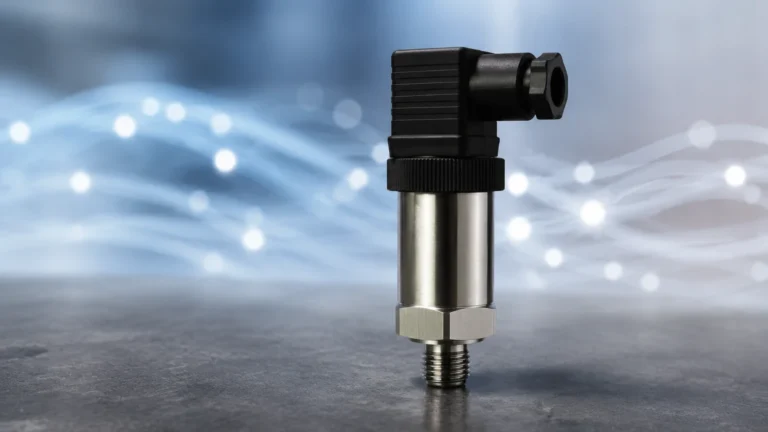
This technology operates on the principle that the pressure at the bottom of a liquid column is directly proportional to the height of the liquid (P = ρgh). A submersible or externally mounted pressure transmitter measures this head pressure and converts it into a level reading.
* Advantages: Excellent for deep wells and underground reservoirs where top-down access is limited.
* Application: Deep-well pumping and large reservoir monitoring.
Magnetic Level Gauges
For pressurized vessels where visual confirmation is required alongside electronic output, magnetic level gauges are used. A float containing a permanent magnet moves with the liquid level, flipping external magnetic flaps or triggering reed switches.
* Advantages: No power required for visual indication; highly durable in high-pressure environments.
* Application: Boiler drums and high-pressure storage.
Technical Selection Guide
Choosing the right technology is vital for the long-term goal of reducing water loss. The following table summarizes key selection criteria for common industrial water applications.
| Application Type | Recommended Technology | Accuracy | Key Benefit for Water Reduction |
| :— | :— | :— | :— |
| Open Channel Flow | Ultrasonic | ±0.25% FS | Monitors discharge rates to prevent waste. |
| Chemical Storage | 80GHz Radar | ±2 mm | Prevents overfilling of expensive treatment chemicals. |
| Deep Well/Borehole | Hydrostatic | ±0.5% FS | Tracks groundwater depletion levels. |
| Process Mixing Tank | Radar (FMCW) | ±1 mm | Ensures exact water-to-product ratios. |
| Wastewater Sump | Ultrasonic | ±0.5% FS | Automates pump cycles to prevent overflow. |
Installation Considerations for Maximum Accuracy
To ensure that level meters contribute effectively to reducing water waste, they must be installed correctly. Improper installation leads to "false echoes" or inaccurate readings, which can cause systems to draw more water than necessary.
1. Blocking Distance (Dead Zone): Every top-down sensor (Radar and Ultrasonic) has a minimum distance it cannot measure directly below the sensor face. Ensure the tank’s maximum fill level does not enter this zone.
2. Beam Angle and Obstructions: Sensors should be positioned away from tank walls, inlet pipes, and internal structures like agitators or ladders. For radar, a narrower beam angle (common in 80GHz units) helps avoid these obstacles.
3. Turbulence and Foam: Heavy foam can absorb ultrasonic signals, leading to signal loss. In such cases, radar or hydrostatic sensors are preferred. If the surface is turbulent, a stilling well may be required to provide a steady surface for measurement.
4. Nozzle Height: The mounting nozzle should be short enough to ensure the sensor face protrudes or sits just above the vessel entry to prevent signal interference from the nozzle walls.

Limitations and Environmental Factors
While modern instrumentation is highly robust, certain factors can limit performance:
* Dielectric Constant: Radar relies on the reflectivity of the medium. While water has a high dielectric constant (approx. 80) and is easy to measure, pure deionized water or oil-water mixtures may require more sensitive radar settings.
* Ambient Vapors: Heavy steam or chemical vapors can attenuate ultrasonic signals. In high-vapor environments, radar is the more reliable choice for reducing water measurement errors.
* Density Fluctuations: Hydrostatic sensors are sensitive to changes in liquid density. If the temperature of the water changes significantly, the density—and therefore the pressure reading—will change, necessitating compensation.
Frequently Asked Questions (FAQ)
Q: How does upgrading to digital level meters assist in reducing water costs?
A: Digital meters provide real-time data integration with SCADA systems. This allows for automated leak detection algorithms that compare inflow versus outflow, identifying losses that manual inspections would miss.
Q: Can ultrasonic sensors be used in outdoor reservoirs?
A: Yes, but they must be equipped with sunshields to prevent temperature errors on the sensor face and should have a high IP rating (IP68) to withstand weather conditions.
Q: Is radar overkill for simple water storage?
A: Not necessarily. While the initial cost is higher, the lack of maintenance and higher precision of 80GHz radar often results in a lower Total Cost of Ownership (TCO) compared to ultrasonic sensors that may struggle with condensation or foam.
Q: How often should these instruments be calibrated?
A: For standard water applications, an annual calibration check is recommended. However, in critical water-reduction projects where every liter counts, bi-annual verification ensures the system remains within the required accuracy tolerances.
Conclusion
Reducing water consumption in industrial processes is a complex challenge that requires a combination of policy, behavior change, and technology. By selecting and properly installing high-quality level measurement instruments from manufacturers like Welk, facilities gain the precision needed to eliminate waste. Whether it is through the non-contact reliability of radar or the rugged simplicity of hydrostatic transmitters, the right data is the essential first step toward a more sustainable and cost-effective water management strategy.