Flowmeter Differential Pressure
Flowmeter Differential Pressure
Differential pressure (DP) flow measurement is one of the most established and versatile technologies in industrial process control. Used for over a century, it remains a cornerstone for measuring the flow of liquids, gases, and steam across diverse sectors, including water treatment, chemical processing, and oil and gas. The reliability of a flowmeter differential pressure system depends on the synergy between the primary element—which creates the pressure drop—and the secondary element, typically a differential pressure transmitter, which converts that physical change into a readable signal.
Understanding the nuances of DP technology is essential for engineers tasked with selecting the right instrumentation for complex industrial environments. This guide explores the principles, hardware configurations, and practical selection criteria for implementing differential pressure flow measurement.
Measurement Principles of DP Flowmeters
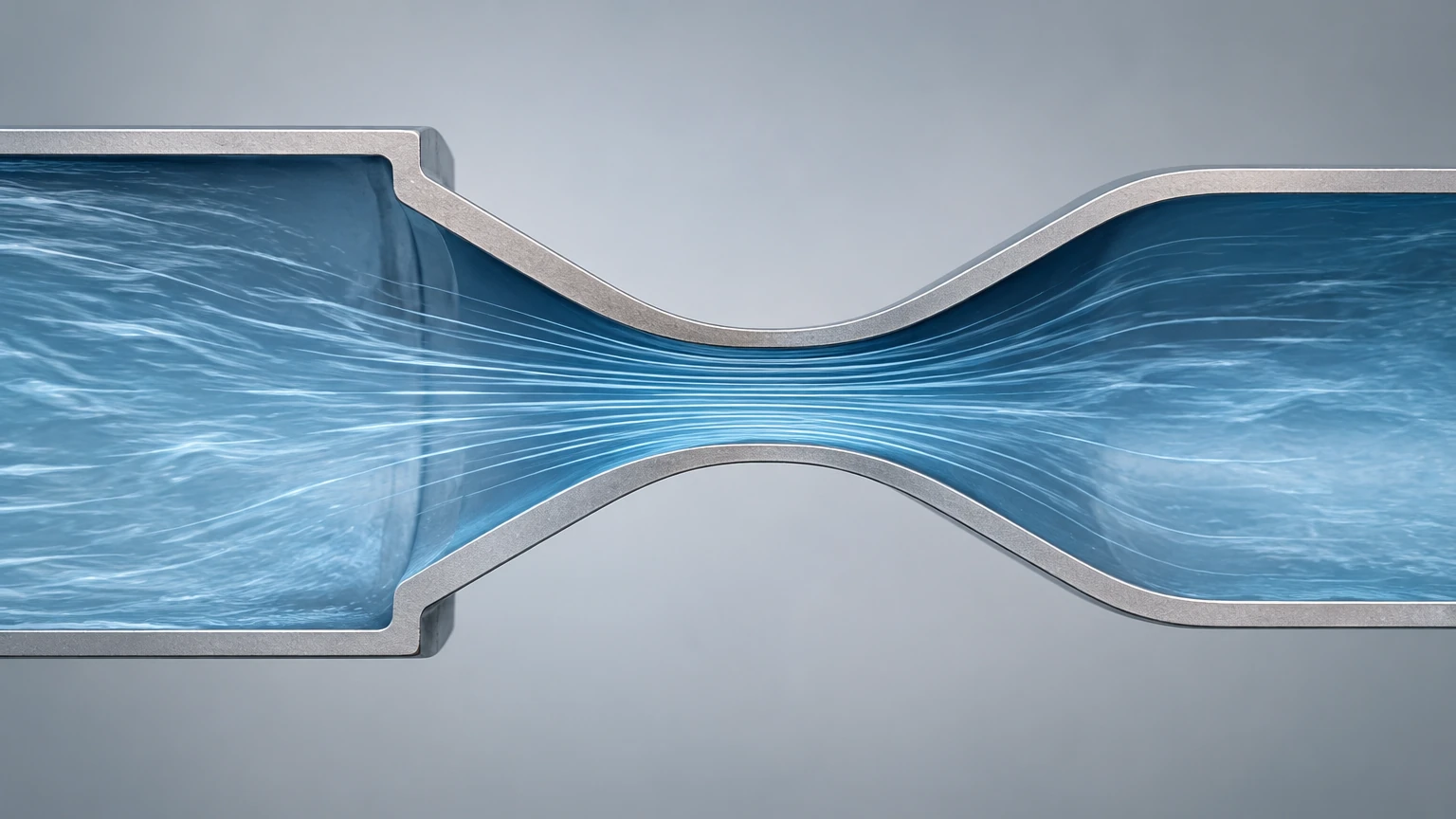
The operation of a flowmeter differential pressure system is rooted in fluid mechanics, specifically Bernoulli’s principle and the Law of Continuity. When a fluid passes through a restriction in a pipe, its velocity increases. According to the principle of energy conservation, this increase in kinetic energy must be balanced by a decrease in static pressure.
The relationship between the flow rate and the pressure drop (differential pressure) is expressed by the following simplified equation:
Q = k × √ΔP
Where:
* Q is the flow rate (volume or mass).
* k is a constant derived from the pipe diameter, the restriction size (beta ratio), and the fluid's properties.
* ΔP is the differential pressure measured across the restriction.
A critical characteristic of DP flow measurement is this square-root relationship. Because the flow rate is proportional to the square root of the differential pressure, the sensitivity of the measurement decreases at lower flow rates. For example, if the flow rate drops to 10% of the maximum scale, the differential pressure drops to only 1% of the maximum. This physical reality dictates the "turndown ratio" (the range of accurate measurement) of most DP systems, which is typically limited to 3:1 or 4:1 unless specialized multi-variable transmitters are employed.
Primary Flow Elements
The primary element is the physical component installed in the pipeline to create the pressure drop. The choice of element significantly impacts accuracy, permanent pressure loss, and the system's ability to handle specific fluid types.
Orifice Plates
An orifice plate is a thin metal disk with a precision-machined hole (bore) in the center. It is the most common primary element due to its low cost, ease of installation, and wealth of available historical data. However, orifice plates create a high permanent pressure loss (PPL) because of the turbulence generated downstream of the plate. They are best suited for clean liquids and gases where energy loss is not a primary concern.
Venturi Tubes
Venturi tubes consist of a converging conical section, a cylindrical throat, and a diverging recovery section. Unlike the abrupt restriction of an orifice plate, the Venturi tube gradually accelerates and decelerates the fluid. This design results in very low permanent pressure loss and makes the Venturi tube ideal for high-velocity flows or systems where pumping costs must be minimized. They are also highly resistant to erosion and can handle fluids with suspended solids.
Flow Nozzles
Flow nozzles are essentially a hybrid between an orifice plate and a Venturi tube. They feature a contoured inlet and a short cylindrical throat. They are more rugged than orifice plates and are frequently used in high-temperature, high-velocity applications, such as superheated steam measurement in power plants.
Pitot Tubes and Averaging Pitot Tubes
While other elements measure the pressure drop across a restriction, Pitot tubes measure the difference between the impact (total) pressure and the static pressure at a specific point in the flow stream. Averaging Pitot tubes (often referred to by trade names like Annubar) use multiple sensing ports across the pipe diameter to provide a more representative average of the velocity profile. These elements offer the lowest pressure loss and are often used in large-diameter air ducts and gas pipelines.
Technical Selection Criteria
Selecting the appropriate flowmeter differential pressure configuration requires an evaluation of the process conditions and the desired performance outcomes. Engineers should consult the Main Page for technical specifications and compatibility charts when integrating these sensors into broader automation systems.
Fluid State and Properties
* Clean Liquids: Orifice plates or Venturi tubes are standard.
* Slurries and Dirty Fluids: Venturi tubes or wedge meters are preferred because they lack sharp edges or stagnant zones where solids can accumulate.
* Steam: Flow nozzles are preferred for their durability against high-velocity erosion.
* Gases: Pitot tubes or orifice plates are common, though gas density must be compensated for if pressure or temperature fluctuates.
Reynolds Number (Re)
DP flowmeters are sensitive to the flow profile, which is characterized by the Reynolds number. Most primary elements require a fully developed turbulent flow (typically Re > 10,000) to maintain their calibrated accuracy. In laminar or transitional flow regimes, the discharge coefficient (k) becomes unstable, leading to significant measurement errors.
Permanent Pressure Loss (PPL)
Energy efficiency is increasingly important in B2B industrial applications. If a process involves high-volume pumping, the energy required to overcome the pressure drop created by an orifice plate can be substantial. In such cases, the higher upfront cost of a Venturi tube or an averaging Pitot tube is often offset by long-term energy savings.
Installation and Engineering Best Practices
The accuracy of a DP flow system is often determined more by the installation quality than by the instrument itself. Because DP meters rely on a stable velocity profile, the following considerations are mandatory:
Straight Pipe Requirements
Disturbances such as elbows, valves, and pumps create swirls and velocity profile distortions. To mitigate this, primary elements require a specific length of straight pipe upstream and downstream.
* Upstream: Typically 10 to 40 pipe diameters (D), depending on the upstream disturbance.
* Downstream: Typically 5 diameters (5D).
If space is limited, flow conditioners (vane or plate type) may be installed to artificially straighten the flow.
Impulse Line Configuration
Impulse lines are the small-bore pipes that carry the pressure signal from the primary element to the DP transmitter.
* Liquid Service: The transmitter should be mounted below the pipe to allow gas bubbles to vent back into the process line.
* Gas Service: The transmitter should be mounted above the pipe so that any condensate drains back into the process line.
* Sloping: Impulse lines should always be sloped (at least 1:12) to prevent the trapping of air or liquid.
Manifolds
A three-valve or five-valve manifold is essential for maintenance. These allow the transmitter to be isolated from the process, zeroed under static pressure, and removed for calibration without shutting down the entire pipeline.
Comparative Analysis of Primary Elements
| Feature | Orifice Plate | Venturi Tube | Flow Nozzle | Averaging Pitot Tube |
| :— | :— | :— | :— | :— |
| Accuracy | Good (±0.5% to 2%) | Excellent (±0.5% to 1%) | Good (±1% to 2%) | Fair (±1% to 3%) |
| Pressure Loss | High | Very Low | Medium | Negligible |
| Relative Cost | Low | High | Medium | Medium |
| Installation | Easy (Between Flanges) | Difficult (Long Body) | Moderate | Easy (Probe Insert) |
| Suitability | Clean Fluids | Slurries/High Flow | Steam/High Temp | Large Pipes/Gases |
Limitations and Challenges
While robust, flowmeter differential pressure technology has inherent limitations that must be managed:
1. Square Root Law: As mentioned, the accuracy of the meter degrades significantly at the lower end of the flow range. If a wide range of flow must be measured (high turndown), DP may not be the best choice compared to ultrasonic or magnetic flowmeters.
2. Wear and Erosion: Orifice plates rely on a sharp upstream edge. If this edge becomes rounded due to erosion from abrasive particles, the meter will under-read the flow. Regular inspection is required in harsh services.
3. Impulse Line Clogging: In viscous or dirty applications, impulse lines can clog, leading to sluggish or frozen readings. Diaphragm seals or purging systems may be required to isolate the transmitter from the process fluid.
Frequently Asked Questions (FAQ)
Q: How often should a DP flowmeter be calibrated?
A: The secondary element (the DP transmitter) should typically be calibrated annually. The primary element (e.g., the orifice plate) should be inspected for wear or buildup every 2 to 5 years, depending on the fluid's corrosivity and abrasiveness.
Q: Can DP flowmeters measure bidirectional flow?
A: Standard orifice plates and Venturi tubes are unidirectional. However, specialized bi-directional orifice plates and symmetrical Pitot tubes are available for applications like storage tank filling and emptying.
Q: What is the impact of temperature changes on DP flow measurement?
A: Temperature changes affect fluid density. Since DP meters measure the pressure drop related to velocity, a change in density will result in a mass flow error. For high-accuracy gas or steam measurement, "compensated flow" is used, where a temperature sensor and a static pressure sensor provide data to a flow computer to adjust the reading in real-time.
Q: Are metric units standard for DP calculations?
A: Most international standards, such as ISO 5167, use metric units (millimeters for diameter, pascals or bar for pressure, and kilograms per hour for mass flow). However, many industrial sites in North America still utilize imperial units (inches, PSI, and GPM). Modern transmitters can usually be configured for either.
For engineers and procurement professionals, selecting a flowmeter differential pressure system requires balancing initial capital expenditure against long-term operational costs like maintenance and energy loss. By adhering to strict installation standards and choosing the appropriate primary element for the specific fluid characteristics, DP flow measurement remains one of the most reliable methods for industrial process monitoring.