Low Flow Rate Flow Meter
Low Flow Rate Flow Meter
In industrial process control, the measurement of low flow rates presents a unique set of engineering challenges that differ significantly from standard high-volume applications. A low flow rate flow meter is specifically designed to capture accurate data when fluid velocities are minimal, often in the range of milliliters per hour (mL/h) to a few liters per minute (L/min). Whether the application involves chemical injection in water treatment, precise dosing in pharmaceutical manufacturing, or fuel consumption monitoring in aerospace, selecting the correct technology is critical for maintaining system efficiency and product quality.
Accurate measurement at these scales requires an understanding of fluid dynamics at low Reynolds numbers, where viscous forces dominate over inertial forces. This article provides a technical overview of low flow measurement principles, selection criteria, and installation best practices for process engineers and system integrators.
Measurement Principles for Low Flow Rates
Unlike standard flow meters that may rely on significant kinetic energy to drive a mechanism or generate a signal, low flow meters must be sensitive enough to detect minute changes in fluid movement. Several distinct physical principles are employed to achieve this sensitivity.
Thermal Mass Flow Measurement
Thermal mass flow meters operate on the principle of heat transfer. There are two primary methods: the constant temperature differential and the constant power method. In a typical capillary-style thermal mass meter, a small amount of heat is applied to the outside of a sensor tube. As the fluid flows through the tube, it carries heat away from the upstream sensor toward the downstream sensor. The resulting temperature difference is directly proportional to the mass flow rate.
This technology is highly effective for gases and clean liquids because it measures mass flow directly, independent of pressure and temperature fluctuations. It is particularly valued in laboratory settings and semiconductor manufacturing where gas flows must be controlled with extreme precision.
Coriolis Mass Flow Measurement
Coriolis meters utilize the Coriolis effect, where a vibrating tube experiences a phase shift proportional to the mass flow of the fluid passing through it. While historically used for high-flow applications, modern advancements in sensor sensitivity and tube design have made Coriolis technology a "gold standard" for low-flow liquid measurement.
Because Coriolis meters measure mass directly and are unaffected by changes in viscosity, density, or conductivity, they are ideal for complex chemical dosing applications. They provide high accuracy (often up to 0.1% of rate) even at flow rates as low as 10 grams per hour.
Positive Displacement (PD)
Positive displacement meters, such as micro-gear or piston meters, work by trapping a fixed volume of fluid and moving it through the meter. Each rotation of the gear or stroke of the piston corresponds to a specific volume. These are mechanical meters that excel in measuring high-viscosity fluids at low flow rates. The mechanical seal between the moving parts and the housing ensures that even at low pressures, the fluid cannot "slip" past the sensor without being counted.
Ultrasonic (Transit-Time)
Ultrasonic flow meters for low flow often use the transit-time principle. Two transducers send ultrasonic signals back and forth through the fluid. The time difference between the signal traveling with the flow and the signal traveling against the flow is used to calculate velocity. For low flow rates, specialized small-bore sensors are required to ensure the path length and signal resolution are sufficient to detect slow-moving fluids.
Technical Selection Criteria
Choosing the right low flow rate flow meter requires a comprehensive evaluation of the process environment. Engineers should consult the Main Page for technical specifications and application support when integrating these instruments into larger automation frameworks.
Fluid Properties
* Viscosity: High-viscosity fluids (like oils or polymers) favor positive displacement meters, while low-viscosity gases are best served by thermal mass or Coriolis meters.
* Conductivity: If using an electromagnetic meter (though rare for extremely low flows), the fluid must be conductive. For non-conductive fluids like deionized water or hydrocarbons, ultrasonic or thermal methods are preferred.
* Cleanliness: Particulates can clog capillary-style thermal meters or damage the precision gears of PD meters. Filtration is often a prerequisite.
Flow Range and Turndown Ratio
The turndown ratio (the ratio of maximum to minimum measurable flow) is vital. If a process requires measuring between 1 mL/min and 100 mL/min, a meter with a 100:1 turndown ratio is necessary. Thermal mass and Coriolis meters typically offer the best turndown ratios in the low-flow category.
Accuracy vs. Repeatability
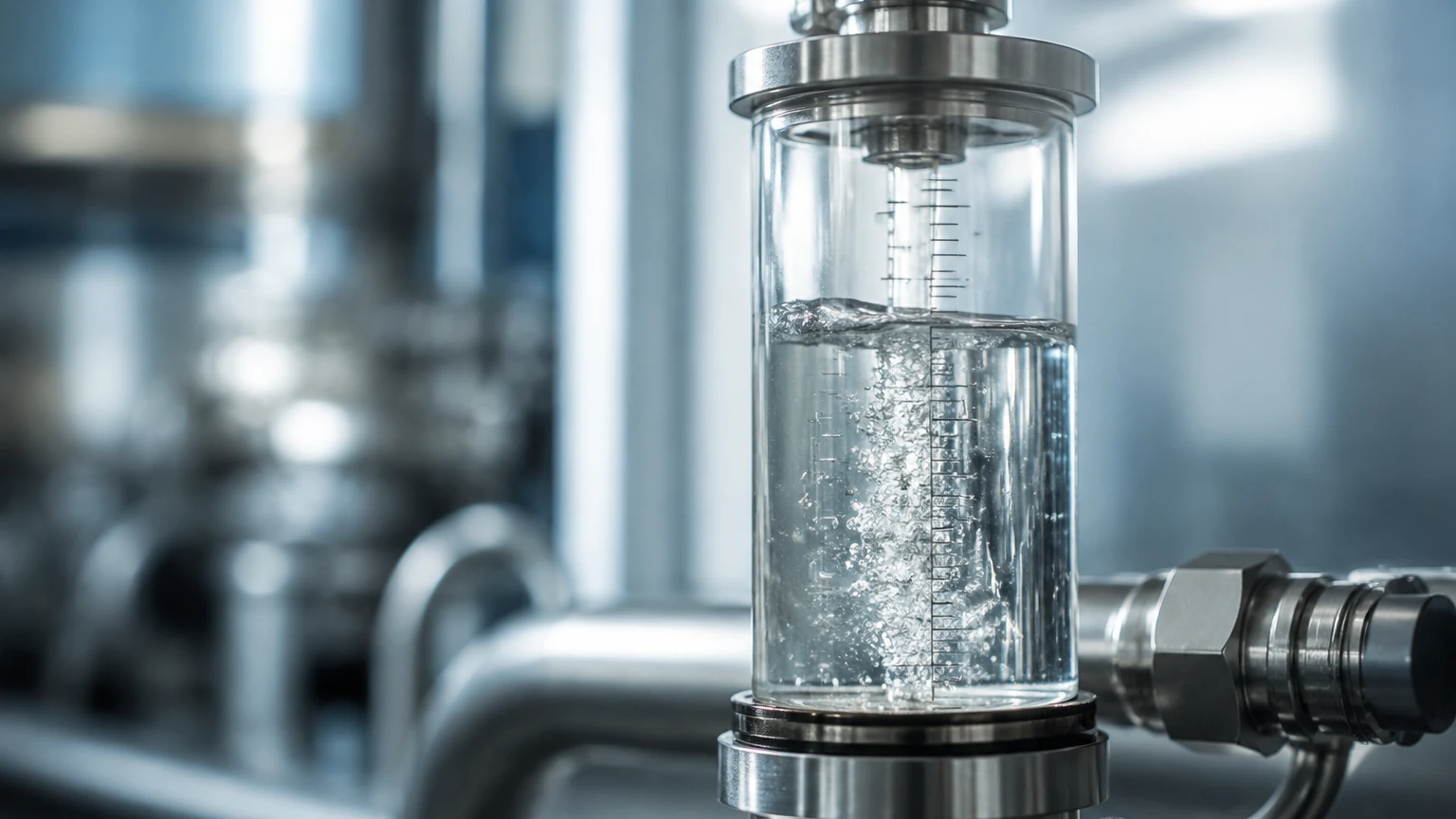
In dosing applications, repeatability is often more important than absolute accuracy. A meter that consistently delivers the same volume, even if it requires a slight calibration offset, allows for stable process control. High-precision Coriolis meters provide both, whereas variable area meters (rotameters) provide lower accuracy but excellent visual indication.
Practical Selection Table
| Technology | Fluid Type | Typical Min. Flow | Accuracy (Typical) | Best For |
| :— | :— | :— | :— | :— |
| Thermal Mass | Gas / Clean Liquid | 0.01 mL/min | ±1.0% FS | Lab research, gas blending |
| Coriolis | Liquid / Gas | 0.1 g/h | ±0.1% to 0.5% | Chemical dosing, high precision |
| Positive Displacement | Viscous Liquids | 0.5 mL/min | ±0.5% | Lubrication, fuel additives |
| Ultrasonic | Clean Liquids | 10 mL/min | ±1.0% | Non-invasive pharmaceutical |
| Variable Area | Liquid / Gas | 5 mL/min | ±2.0% to 5.0% | Visual monitoring, low cost |
*Note: "FS" refers to Full Scale. All measurements are approximate and vary by manufacturer.*
Installation Considerations and Best Practices
The physical installation of a low flow rate flow meter is as critical as the technology selection itself. Because the signals being measured are so small, external factors can easily introduce errors.
1. Orientation and Air Entrainment
For liquid applications, the meter should ideally be installed in a vertical section of pipe with the flow moving upward. This ensures that the meter remains full of liquid and prevents air bubbles from becoming trapped in the sensor. Air pockets are the leading cause of measurement drift and "noisy" signals in low-flow systems.
2. Filtration
Small-bore flow meters are susceptible to clogging. A 10-micron to 50-micron filter installed upstream is standard practice. This protects the internal sensors (especially in thermal mass and PD meters) from damage and prevents flow disturbances caused by debris.
3. Vibration and Mounting
Coriolis and thermal mass meters can be sensitive to environmental vibrations. Rigid mounting to a stable structure is necessary to prevent mechanical noise from interfering with the sensor's frequency or temperature readings. Flexible tubing can sometimes be used to decouple the meter from pump vibrations.
4. Zeroing the Meter
Zero-point stability is the most significant factor in low-flow accuracy. After installation and under actual process pressure and temperature, the flow should be stopped completely (using high-quality shut-off valves) to perform a "zero calibration." This accounts for the specific installation environment and ensures the meter reads zero when there is no flow.
Limitations and Common Risks
While highly capable, low flow meters have specific limitations that must be managed:
* Pressure Drop: Positive displacement and some capillary thermal meters can introduce a significant pressure drop across the device. In low-pressure systems, this might restrict flow below the required setpoint.
* Response Time: Thermal mass meters have a thermal lag, meaning they may not respond instantly to rapid changes in flow. For high-speed batching, Coriolis or PD meters are more appropriate.
* Material Compatibility: At low flow rates, the surface-area-to-volume ratio is high. Any corrosion or chemical reaction between the fluid and the meter internals will happen more rapidly and have a greater impact on measurement.
Integration with Level Measurement Systems
In many industrial applications, flow measurement and level measurement are intrinsically linked. For instance, in a chemical storage tank, a hydrostatic level transmitter or a radar level meter monitors the total inventory, while a low flow rate flow meter monitors the precise amount of chemical being discharged into the process.
By comparing the decrease in tank level (calculated via a level sensor) with the integrated total of the flow meter, operators can perform a mass balance check. This redundancy is essential for identifying leaks or detecting if a flow meter has drifted out of calibration. For comprehensive solutions in industrial automation, reviewing the technologies available on the Main Page can help engineers design systems that utilize both flow and level data for maximum reliability.
Frequently Asked Questions (FAQs)
Can a low flow meter handle pulsating flow?
Pulsating flow, often caused by peristaltic or diaphragm pumps, can be difficult for many flow meters. Coriolis and PD meters handle pulsation better than thermal or ultrasonic types, but installing a pulsation dampener upstream is usually recommended to ensure steady readings.
How does temperature affect low flow measurement?
Temperature changes affect fluid viscosity and density. While Coriolis and thermal mass meters compensate for these changes internally, volumetric meters (like PD or ultrasonic) may require external temperature compensation to maintain high accuracy.
What is the minimum flow a meter can detect?
This depends on the technology. Some thermal mass controllers can detect flows as low as 0.01 mL/min. However, as the flow rate approaches the "noise floor" of the sensor, the uncertainty increases significantly.
Is straight pipe run required for low flow meters?
Most low-flow technologies (Coriolis, PD, Thermal Mass) are relatively insensitive to flow profile and do not require the long straight pipe runs (e.g., 10D upstream/5D downstream) typically associated with larger turbine or orifice plate meters. However, always consult the specific manufacturer's manual for requirements.
By understanding the physics of low flow and selecting a meter that matches the chemical and physical properties of the fluid, engineers can achieve the precision necessary for modern industrial processes. Proper installation and regular zero-point verification remain the most effective ways to ensure long-term performance in these demanding applications.