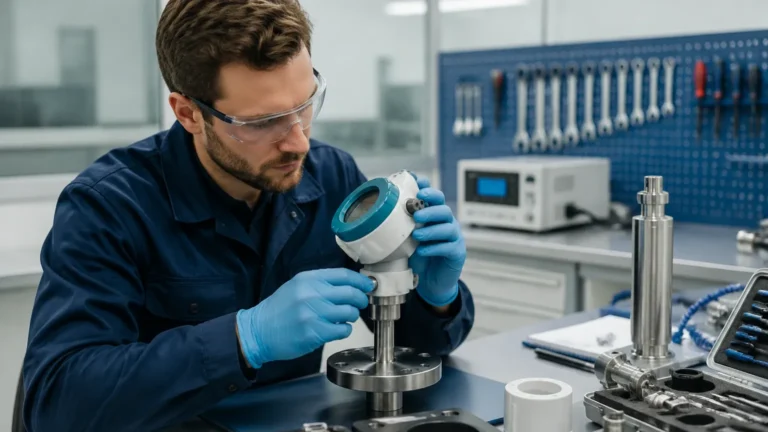
Liquid Pressure Transmitter
Liquid Pressure Transmitter
In the landscape of industrial process control, the liquid pressure transmitter serves as a cornerstone technology for both pressure monitoring and hydrostatic level measurement. These instruments convert the mechanical force exerted by a liquid into an electrical signal, typically 4-20mA, HART, or RS485 Modbus, allowing for precise monitoring in tanks, reservoirs, and pipelines. For engineers and procurement specialists, understanding the nuances of sensor construction, measurement physics, and application-specific constraints is essential for ensuring long-term reliability and accuracy.
As a professional manufacturer of industrial level measurement instruments, Welk provides a comprehensive range of solutions including radar, ultrasonic, and hydrostatic sensors. This guide explores the technical foundations of the liquid pressure transmitter to assist in informed decision-making for water treatment, chemical processing, and industrial automation projects.
Fundamental Measurement Principles
The operation of a liquid pressure transmitter in a level-sensing context is based on the principle of hydrostatic pressure. According to Stevin's Law, the pressure exerted by a static liquid column at a specific depth is directly proportional to the height of the liquid above it, the density of the liquid, and the force of gravity.
The mathematical relationship is expressed as:
P = ρ · g · h
Where:
* P is the hydrostatic pressure (measured in Pascals or Bar).
* ρ (Rho) is the density of the liquid (kg/m³).
* g is the local acceleration due to gravity (approximately 9.81 m/s²).
* h is the height of the liquid column (meters).
Because gravity is relatively constant and the density of many liquids (like water) is known, the transmitter can calculate the height (h) by measuring the pressure (P). In vented tanks, the sensor measures gauge pressure, which ignores the atmospheric pressure pressing down on the liquid surface. In sealed or pressurized vessels, a differential liquid pressure transmitter is required to subtract the headspace pressure from the total pressure at the bottom of the tank.
Types of Liquid Pressure Transmitters
Selecting the correct hardware configuration is the first step in engineering a reliable measurement system. Transmitters are generally categorized by their mounting style and how they interface with the process media.
1. Submersible Level Transmitters
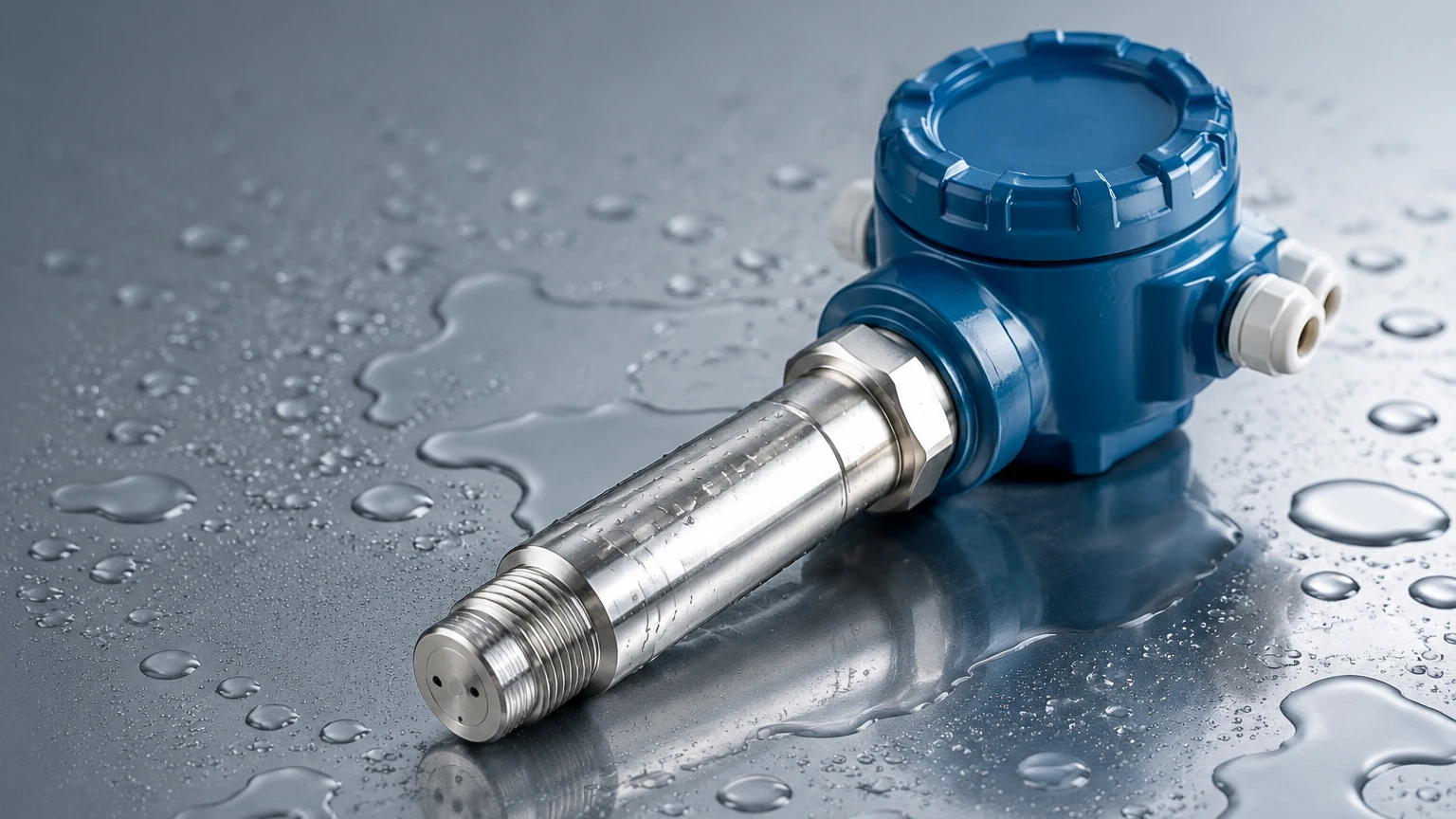
These are designed to be lowered directly into the liquid. The sensor is housed in a waterproof stainless steel casing, and the cable includes a vent tube to allow the internal side of the pressure diaphragm to reference atmospheric pressure. These are ideal for deep wells, reservoirs, and open-top tanks.
2. External Mount (Threaded or Flanged)
These transmitters are installed through the side wall of a tank near the bottom. They are preferred for industrial process tanks where the sensor needs to be accessible for maintenance without emptying the vessel. Flush diaphragm versions are used for viscous liquids or food-grade applications to prevent media buildup in the sensor cavity.
3. Differential Pressure (DP) Transmitters
In pressurized tanks (such as those containing liquefied gases or chemical reactors), the pressure at the bottom is the sum of the liquid height and the gas pressure in the headspace. A DP transmitter uses two ports: one at the bottom (high-pressure side) and one at the top (low-pressure side). The device calculates the difference, effectively "canceling out" the gas pressure to provide an accurate liquid level reading.
Technical Comparison Table
| Feature | Submersible Transmitter | External Gauge Transmitter | Differential Pressure Transmitter |
| :— | :— | :— | :— |
| Typical Application | Deep wells, water towers | Process tanks, pipelines | Pressurized chemical vessels |
| Installation | Suspended by cable | Side-wall flange or thread | Dual-port piping/capillaries |
| Maintenance | Easy to pull up | Requires tank isolation valve | Complex calibration required |
| Media Compatibility | Clean water, light oils | Corrosive chemicals, slurries | High-pressure gases/liquids |
| Standard Range | 0–200m H2O | 0–600 bar | 0–100 bar (differential) |
Key Evaluation Criteria for Selection
When specifying a liquid pressure transmitter, engineers must confirm several technical parameters to avoid premature sensor failure or measurement drift.
Media Compatibility and Material Selection
The wetted parts of the transmitter—specifically the diaphragm and the housing—must be chemically compatible with the liquid. While 316L stainless steel is standard, highly corrosive media like hydrochloric acid or seawater may require Tantalum, Hastelloy C, or ceramic diaphragms. For food and beverage applications, the sensor must meet sanitary standards (e.g., 3-A or EHEDG) and utilize food-grade fill fluids.
Pressure Range and Overpressure Protection
The nominal range of the transmitter should be selected so that the maximum expected liquid height corresponds to approximately 75-80% of the sensor—this provides a buffer for surges. Furthermore, the "overpressure limit" is critical; if a pump starts abruptly (water hammer), the resulting pressure spike can permanently deform the sensing diaphragm if the limit is too low.
Temperature Compensation
Liquid density changes with temperature. A high-quality liquid pressure transmitter includes internal temperature compensation to adjust the electronic output. However, in applications with extreme temperature fluctuations, the physical density change of the liquid itself must be accounted for in the control system (PLC/SCADA) to maintain level accuracy.
Signal Output and Integration
* 4-20mA Analog: The industry standard for long-distance transmission with high noise immunity.
* HART Protocol: Allows for digital communication over the analog loop, enabling remote calibration and diagnostics.
* RS485/Modbus: Ideal for multi-drop networks where multiple sensors are connected to a single controller.
Installation Considerations and Best Practices
Proper installation is as important as the sensor quality itself. Poor placement can lead to erratic readings or physical damage.
1. Avoid Turbulence: Do not install the transmitter near an inlet pipe or an agitator. If turbulence is unavoidable, use a "stilling well" (a perforated pipe) to protect the sensor and provide a stable liquid column.
2. Venting Requirements: For submersible sensors, ensure the vent tube in the cable is not kinked or blocked. Use a desiccant cartridge at the end of the vent tube to prevent moisture from entering the sensor housing, which can cause internal corrosion.
3. Isolation Valves: For external transmitters, always install an isolation valve (ball or needle valve). This allows the sensor to be removed for calibration or replacement without draining the entire tank.
4. Cable Protection: In outdoor installations, submersible cables should be protected from mechanical damage and UV exposure. Use conduit where possible, but ensure the vent tube remains open to the atmosphere.
Common Risks and Limitations
While the liquid pressure transmitter is a versatile tool, it is not suitable for every scenario. Engineers should be aware of the following limitations:
* Density Variations: If the tank is used for different liquids with varying densities, the level reading will be incorrect unless the system is recalibrated for each fluid. In these cases, non-contact methods like radar may be more appropriate.
* Sediment and Clogging: In wastewater or slurries, solids can settle in the pressure port or on the diaphragm. Using a flush diaphragm or a large-diameter flange can mitigate this risk.
* Vacuum Conditions: Some sensors are not designed to handle negative pressure. If a tank is vacuum-cleaned or operated under a vacuum, the diaphragm may be pulled outward, damaging the sensor.
Frequently Asked Questions (FAQ)
Q: How often should a liquid pressure transmitter be calibrated?
A: In most industrial applications, annual calibration is recommended. However, in critical processes or harsh environments, semi-annual checks may be necessary to account for sensor drift.
Q: Can I use a standard pressure transmitter for liquid level?
A: Yes, provided the transmitter has the sensitivity required for the liquid height. For example, 1 meter of water exerts only about 9.8 kPa (0.1 bar). A transmitter with a 100-bar range would be too insensitive to measure a 5-meter tank accurately.
Q: What is the difference between a gauge and an absolute pressure transmitter?
A: A gauge transmitter references atmospheric pressure (0 bar at sea level), making it suitable for vented tanks. An absolute transmitter references a perfect vacuum, which is rarely used for simple liquid level measurement unless the headspace is also under a vacuum.
Conclusion and Next Steps
The liquid pressure transmitter remains one of the most cost-effective and reliable methods for monitoring fluid processes. By matching the sensor type, material, and range to the specific requirements of the application, facilities can achieve high precision with minimal maintenance.
For technical assistance in selecting the right instrumentation for your project, or to review product options and application support, please visit our Main Page. Welk's engineering team is available to provide customized OEM/ODM services and reliable measurement solutions tailored to your industrial automation needs.