Temperature Measurement Systems
Temperature Measurement Systems
In the landscape of industrial process control, temperature measurement systems are as fundamental as pressure or level monitoring. For engineers and plant operators, understanding the thermal state of a medium is not merely a matter of monitoring a single variable; it is often the key to ensuring the accuracy of other measurements, maintaining product quality, and safeguarding equipment. Whether in water treatment, chemical processing, or oil and gas applications, temperature data provides the context necessary for precise automation.
Temperature measurement systems consist of a sensing element, a transmitter to convert the signal, and often a protective housing such as a thermowell. In many modern industrial setups, these systems are integrated directly into other instruments, such as ultrasonic level sensors or hydrostatic transmitters, to compensate for environmental variables that affect accuracy. This guide explores the principles, selection criteria, and practical installation of industrial temperature measurement technologies.
Fundamental Principles of Temperature Measurement
Industrial temperature measurement systems generally fall into two categories: contact and non-contact. Contact sensors rely on physical touch to reach thermal equilibrium with the process medium, while non-contact sensors measure thermal radiation emitted by an object.
Resistance Temperature Detectors (RTDs)
RTDs operate on the principle that the electrical resistance of a metal increases as its temperature rises. This relationship is highly predictable and repeatable. The most common RTD is the Pt100, which uses a platinum element with a resistance of 100 ohms at 0°C.
RTDs are prized for their high accuracy and stability over time. They are typically used in applications where precision is paramount, such as in chemical reactors or laboratory environments. They are available in various wiring configurations (2-wire, 3-wire, and 4-wire) to compensate for the resistance of the lead wires themselves, with 3-wire being the industrial standard and 4-wire offering the highest precision.
Thermocouples
Thermocouples function based on the Seebeck effect: when two dissimilar metals are joined at one end (the sensing junction) and there is a temperature difference between that end and the other (the reference junction), a small voltage (millivolts) is produced.
Thermocouples are exceptionally rugged and can measure much higher temperatures than RTDs—up to 2300°C in some configurations. They are categorized by "types" (e.g., Type K, Type J, Type T) based on the metal alloys used. While they are less accurate than RTDs and prone to drift over long periods, their fast response time and durability make them ideal for high-heat industrial furnaces and heavy-duty machinery.
Infrared (IR) Pyrometers
Non-contact temperature measurement systems utilize infrared sensors to detect the thermal energy radiated by a surface. This is governed by the Stefan-Boltzmann law. IR sensors are essential when the target is moving, extremely hot, or located in a vacuum where contact is impossible. However, their accuracy depends heavily on the "emissivity" of the target surface—the measure of how effectively a surface emits thermal radiation.
The Relationship Between Temperature and Level Measurement
In the context of industrial automation, temperature measurement systems are frequently paired with level measurement instruments. This is because many level sensing technologies are sensitive to temperature fluctuations in the medium or the surrounding atmosphere.
1. Ultrasonic Level Sensors: These devices calculate distance based on the speed of sound. However, the speed of sound in air changes by approximately 0.6 meters per second for every degree Celsius change in temperature. Without integrated temperature compensation, an ultrasonic sensor would report significant errors as the ambient temperature shifts throughout the day.
2. Hydrostatic Level Transmitters: These sensors measure the pressure exerted by a liquid column. Since the density of a liquid changes with temperature, the calculated level will fluctuate if the temperature is not monitored. High-end hydrostatic systems use temperature data to normalize density calculations.
3. Radar Level Meters: While radar (microwaves) is largely unaffected by air temperature, the electronics within the housing still require thermal management. Furthermore, in high-temperature steam applications, the dielectric constant of the vapor space may shift slightly, requiring temperature-aware processing for maximum precision.
For comprehensive solutions involving both level and thermal monitoring, engineers often consult the Main Page of specialized manufacturers like Welk to find integrated instruments that handle these variables simultaneously.
Key Evaluation Criteria for Selection
Choosing the right temperature measurement system requires a detailed analysis of the process environment. Engineers should evaluate the following factors before procurement:
Measurement Range
The first filter is the expected temperature range. RTDs are generally limited to -200°C to 850°C. If the process exceeds 1000°C, a thermocouple (such as Type S or Type R) is usually required. For cryogenic applications, specific RTDs or Type T thermocouples are preferred.
Accuracy and Repeatability
If the process involves a custody transfer or a sensitive chemical reaction where a 0.5°C deviation could ruin a batch, a Class A or 1/10 DIN RTD is the standard choice. For general monitoring of cooling water or ambient air where a 2°C margin is acceptable, thermocouples offer a more cost-effective solution.
Response Time
How quickly does the system need to react to a temperature change? A thin-film RTD or a small-diameter thermocouple has a low thermal mass and reacts quickly. If the sensor is placed inside a heavy-duty thermowell, the response time will be significantly slowed due to the time required for the thermowell itself to heat up or cool down.
Environmental Conditions
Is the medium corrosive? Is there high vibration? RTDs are more sensitive to vibration than thermocouples. If the environment is chemically aggressive, the material of the probe sheath (e.g., Stainless Steel 316, Inconel, or PTFE coating) must be selected to match the chemical compatibility of the process.
Technical Comparison Table
| Feature | RTD (Pt100/Pt1000) | Thermocouple (Type K/J) | Infrared (IR) Sensor |
| :— | :— | :— | :— |
| Measurement Principle | Change in Resistance | Voltage (Seebeck Effect) | Thermal Radiation |
| Typical Range | -200°C to +850°C | -200°C to +2300°C | -50°C to +3000°C |
| Accuracy | High (±0.1°C to ±0.5°C) | Moderate (±1.0°C to ±2.2°C) | Low to Moderate |
| Long-term Stability | Excellent | Fair (Drifts over time) | Fair |
| Response Speed | Slower (5–30 seconds) | Fast (1–10 seconds) | Very Fast (<1 second) |
| Cost | Higher | Lower | Variable |
| Best For | Precision & Stability | High Temp & Durability | Non-contact/Moving parts |
Installation Considerations and Best Practices
Proper installation is critical to the performance of temperature measurement systems. Even the most accurate sensor will provide false data if installed incorrectly.
Thermowell Selection and Placement
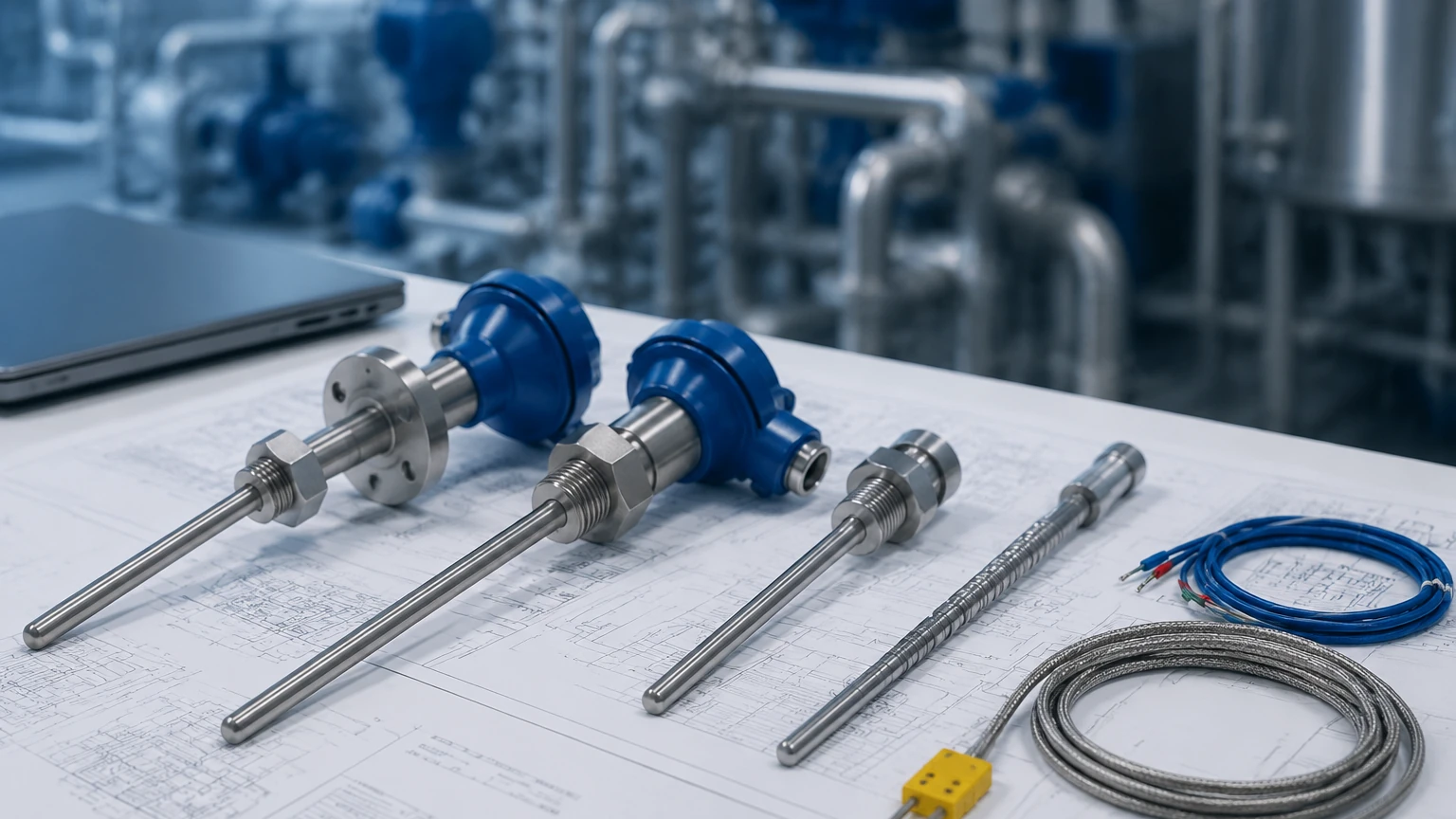
A thermowell is a cylindrical fitting used to protect temperature sensors from pressure, high flow velocities, and corrosion.
* Immersion Depth: To avoid errors caused by thermal conduction (heat traveling up the sensor probe to the cooler outside air), the sensor should be immersed to a depth of at least 10 times the diameter of the protection tube.
* Flow Velocity: In high-flow pipelines, thermowells must be subjected to a wake frequency calculation (per ASME PTC 19.3 TW) to ensure they do not snap off due to vibration induced by the fluid flow.
Wiring and Signal Integrity
Because RTDs and thermocouples produce low-level signals, they are susceptible to electromagnetic interference (EMI).
* Transmitters: It is highly recommended to use a head-mounted transmitter. This converts the weak resistance or millivolt signal into a robust 4-20mA or digital (HART, Modbus) signal right at the point of measurement, reducing the risk of signal degradation over long cable runs.
* Shielding: Use twisted-pair shielded cables and ensure the shield is grounded at only one end to prevent ground loops.
Calibration
Temperature measurement systems should be calibrated regularly. For RTDs, this often involves a dry-block calibrator or a constant-temperature bath. For thermocouples, the entire loop—including the extension wire—should be checked, as the wire itself contributes to the measurement circuit.
Common Risks and Limitations
Understanding the limitations of these systems prevents premature failure and data inaccuracies:
1. Self-Heating in RTDs: The current passed through an RTD to measure its resistance generates a small amount of heat. If the current is too high, the sensor will report a temperature higher than the actual medium. Modern transmitters typically limit this current to less than 1 mA.
2. Cold Junction Compensation (CJC) Errors: Thermocouples measure the difference between the hot junction and the cold junction (usually at the transmitter). If the transmitter's internal temperature sensor is inaccurate or exposed to rapid drafts, the entire measurement will be offset.
3. Decalibration: In high-temperature environments, the metals in a thermocouple can slowly diffuse into one another, changing their electrical characteristics. This is a permanent change and requires sensor replacement.
Frequently Asked Questions (FAQs)
Q: Can I use copper wire to extend a thermocouple signal?
A: No. You must use specific thermocouple extension wire or compensation wire that matches the alloys of the thermocouple itself. Using copper wire creates new junctions that will introduce significant errors.
Q: What is the difference between a Pt100 and a Pt1000?
A: A Pt100 has 100 ohms at 0°C, while a Pt1000 has 1000 ohms. Pt1000 sensors are often used in battery-powered or low-power applications because the higher resistance allows for lower current, reducing self-heating and power consumption.
Q: How do I know if my sensor has failed?
A: An open circuit (infinite resistance) usually indicates a broken wire or element. A short circuit (zero resistance) indicates a breach in the insulation. For thermocouples, a "downscale" or "upscale" burnout setting on the transmitter can notify the control system immediately upon sensor failure.
Q: Is a thermowell always necessary?
A: No. In low-pressure, non-corrosive air ducts, a bare probe may be used for faster response. However, in any pressurized liquid system, a thermowell is required to allow for sensor removal without shutting down the process.
Conclusion
Temperature measurement systems are the backbone of thermal process control. By selecting the appropriate technology—whether the stable RTD, the rugged thermocouple, or the non-contact IR sensor—and adhering to strict installation standards, industrial operators can ensure long-term reliability. As processes become more automated, the integration of temperature data with level and pressure systems continues to be a hallmark of sophisticated engineering. For those seeking specific hardware or technical support for integrated measurement solutions, reviewing professional product options and application support is the recommended next step in project planning.