Pressure Sensors Manufacturers
Pressure Sensors Manufacturers
In the landscape of industrial automation and process control, pressure sensors serve as the fundamental sensory organs of a system. Whether monitoring the output of a hydraulic pump, ensuring the safety of a steam boiler, or calculating the volume of liquid in a storage tank via hydrostatic head, the reliability of the data depends entirely on the quality of the instrument. For procurement managers and lead engineers, identifying the right pressure sensors manufacturers involves more than comparing price points; it requires a deep understanding of measurement principles, material science, and the specific environmental rigors of the application.
Pressure sensors, often referred to as pressure transmitters or transducers, convert physical force into an electrical signal. In B2B environments—ranging from wastewater treatment to chemical processing—these devices must maintain accuracy over years of continuous operation. This article provides a technical framework for evaluating manufacturers and selecting the appropriate sensing technology for industrial level and pressure monitoring.
Understanding Pressure Measurement Principles
Before engaging with pressure sensors manufacturers, technical teams must determine which sensing principle aligns with their process conditions. Most modern industrial sensors rely on one of three primary technologies to detect diaphragm deflection.
Piezoresistive Sensors
This is the most common technology used by manufacturers. These sensors utilize a silicon or ceramic base with integrated resistors. When pressure is applied, the diaphragm deforms, changing the electrical resistance of the material (the piezoresistive effect).
* Advantages: High sensitivity, excellent linearity, and compact size.
* Best For: General-purpose industrial applications and hydrostatic level measurement in non-corrosive liquids.
Capacitive Sensors
Capacitive pressure sensors measure the change in electrical capacitance between a sensing diaphragm and a fixed reference plate. As pressure moves the diaphragm, the distance between the plates changes, altering the capacitance.
* Advantages: Extremely high accuracy, high overpressure resistance, and stability at low pressure ranges.
* Best For: Critical process control where precision is paramount, such as in laboratory settings or high-accuracy tank gauging.
Strain Gauge Sensors
In this design, metal foil or thin-film strain gauges are bonded to the back of a diaphragm. As the diaphragm flexes, the gauges stretch or compress, changing their resistance. This is typically measured using a Wheatstone bridge circuit.
* Advantages: Exceptional durability and resistance to high-pressure spikes or mechanical shock.
* Best For: Heavy-duty hydraulic systems and high-pressure oil and gas applications.
The Role of Pressure Sensors in Level Measurement
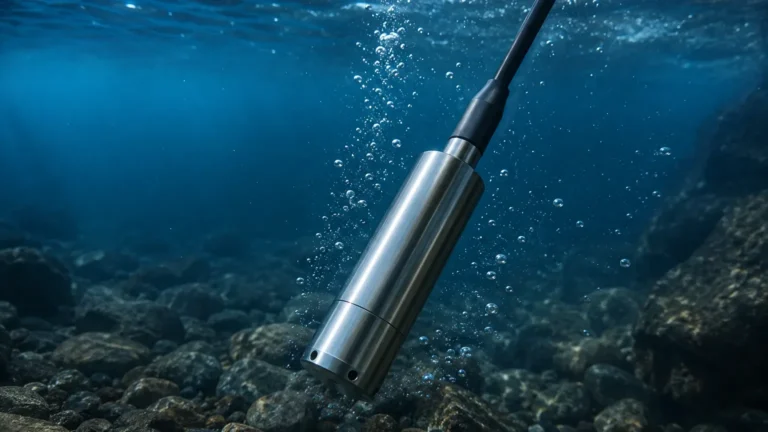
While pressure sensors are used for direct line monitoring, they are also the core component of hydrostatic level transmitters. In this application, the sensor is placed at the bottom of a tank or submerged in a well. It measures the "head pressure" exerted by the liquid column above it.
Manufacturers calibrate these sensors based on the formula:
P = ρ × g × h
*(Where P is pressure, ρ is liquid density, g is gravity, and h is the height of the liquid).*
By knowing the density of the fluid, the pressure reading is converted directly into a level measurement. Leading pressure sensors manufacturers, such as Welk, specialize in these hydrostatic solutions, providing vented cables that allow the sensor to compensate for atmospheric pressure changes, ensuring the reading reflects only the liquid level.
Key Evaluation Criteria for Pressure Sensors Manufacturers
When vetting potential suppliers, technical specifications are only the starting point. A B2B partnership requires a manufacturer capable of supporting the full lifecycle of the instrument.
1. Material Compatibility and Housing
The internal sensing element must be protected from the process media. Standard industrial sensors often use 316L stainless steel diaphragms. However, for aggressive chemicals or seawater, manufacturers should offer specialized materials such as Tantalum, Hastelloy C, or ceramic (Al2O3) faces. The housing should meet IP67 or IP68 standards for ingress protection.
2. Signal Output and Communication Protocols
Modern industrial ecosystems require seamless integration. While the 4-20mA analog signal remains the industry standard due to its noise immunity over long distances (up to 1,000 meters), manufacturers are increasingly requested to provide digital protocols. Look for suppliers offering:
* HART Protocol: Allows digital communication over the existing 4-20mA loop.
* Modbus RTU (RS485): Ideal for multi-drop configurations and integration with PLCs.
* 0-10V DC: Common in HVAC and building automation.
3. Certification and Compliance
In hazardous environments, sensors must be certified to prevent explosions. Confirm that the manufacturer provides ATEX or IECEx certified intrinsically safe models. For water treatment applications, NSF or WRAS certifications for wetted materials may be required.
4. Customization (OEM/ODM) Services
Many industrial projects have unique constraints, such as non-standard thread sizes (e.g., specific G-threads or NPT sizes) or unique cable lengths. A manufacturer with robust OEM/ODM capabilities can provide tailored solutions that reduce the need for field adapters, which are common failure points.
Practical Selection Table
The following table provides a quick reference for selecting a sensor type based on common industrial requirements:
| Application Requirement | Recommended Sensor Type | Key Consideration |
| :— | :— | :— |
| High Corrosive Media | Ceramic Piezoresistive | Ensure housing is PVC, PVDF, or PTFE. |
| Deep Well Level (Submersible) | Hydrostatic Transmitter | Requires vented cable for atmospheric compensation. |
| High-Pressure Hydraulics | Thin-film Strain Gauge | Must handle pressure spikes (water hammer). |
| Low-Pressure Gas Monitoring | Capacitive | High sensitivity required for small fluctuations. |
| Food & Beverage | Flush Diaphragm | Prevents media buildup and allows for CIP (Clean-in-Place). |

Installation Considerations and Best Practices
Even the highest quality sensor from the most reputable pressure sensors manufacturers will fail if installed incorrectly. Engineers should adhere to the following guidelines:
1. Mounting Position: For liquid applications, sensors should be mounted at the side or bottom of the pipe/tank to ensure the sensing face remains wetted. For gas applications, top mounting is preferred to prevent condensate from pooling on the diaphragm.
2. Pressure Ports: Use appropriate thread sealant (like PTFE tape) but ensure it does not obstruct the pressure port. For metric systems, G1/2" or M20×1.5 threads are standard, while NPT 1/2" is common in North American markets.
3. Electrical Grounding: Ensure the sensor housing is properly grounded to prevent electrical noise from interfering with the 4-20mA signal. Shielded cabling is highly recommended for runs exceeding 50 meters (approx. 164 feet).
4. Temperature Management: If the process temperature exceeds the sensor's rated limit (typically 85°C for standard units), use a cooling element or siphon to protect the electronics.
Limitations and Common Risks
No sensor is universal. Understanding the limitations of pressure sensing technology is vital for system safety:
* Overpressure Events: Every sensor has a "burst pressure" and a "proof pressure." Exceeding the proof pressure can permanently shift the zero-point calibration, while exceeding burst pressure will cause physical failure.
* Temperature Drift: All sensors experience some degree of error as temperatures change. High-end manufacturers include internal temperature compensation to minimize this effect.
* Clogging: In applications involving slurries or viscous fluids (like pulp or wastewater), standard pressure ports can clog. In these cases, a flush diaphragm design is necessary.
Frequently Asked Questions (FAQ)
Q: What is the difference between Gauge, Absolute, and Sealed Gauge pressure?
A: Gauge pressure is measured relative to local atmospheric pressure. Absolute pressure is measured relative to a perfect vacuum. Sealed gauge is measured relative to a fixed reference pressure (usually 1 bar) and is used in applications where the sensor must be fully sealed from the environment.
Q: How often should industrial pressure sensors be calibrated?
A: For most industrial applications, an annual calibration check is standard. However, in critical safety systems or highly corrosive environments, semi-annual checks may be required to account for potential sensor drift.
Q: Can a pressure sensor be used to measure the level of a pressurized tank?
A: Yes, but it requires a differential pressure (DP) sensor. One port measures the liquid head at the bottom, and the other measures the gas pressure at the top. The sensor subtracts the gas pressure to provide an accurate liquid level.
Conclusion
Selecting from the vast array of pressure sensors manufacturers requires a balanced focus on technical specifications, material durability, and the supplier’s ability to provide long-term application support. By understanding the underlying physics of piezoresistive, capacitive, and strain gauge technologies, engineers can specify instruments that not only provide accurate data but also withstand the rigors of the industrial environment.
For those seeking comprehensive level and pressure measurement solutions, including radar, ultrasonic, and hydrostatic technologies, it is essential to Review product options and application support on our Main Page to ensure your project benefits from the latest advancements in sensor accuracy and reliability.