Wirelesshart
Wirelesshart
In the landscape of industrial automation, the transition from wired to wireless instrumentation has been driven by the need for cost-efficiency, scalability, and the ability to monitor assets in remote or hazardous locations. WirelessHART, standardized as IEC 62591, represents the first international wireless standard designed specifically for the requirements of process measurement and control. For engineers managing level measurement in water treatment, chemical processing, or oil and gas facilities, understanding the integration of WirelessHART with level sensing technologies is essential for modernizing infrastructure.
Understanding WirelessHART in Level Measurement
WirelessHART is a self-organizing, multi-hop mesh networking technology that operates in the 2.4 GHz ISM (Industrial, Scientific, and Medical) radio band. It is built upon the established HART (Highway Addressable Remote Transducer) protocol, which has been the industry standard for 4-20 mA analog communication for decades. By utilizing the same command structure, WirelessHART allows for a seamless transition for technicians already familiar with wired HART devices.
The protocol employs Time Division Multiple Access (TDMA) to coordinate communication between devices. This ensures that data packets are sent during specific time slots, reducing the risk of collisions and ensuring predictable data delivery. Furthermore, WirelessHART uses Channel Hopping to mitigate interference from other wireless networks, such as Wi-Fi or Bluetooth, which may be operating in the same frequency space.
Measurement Principles and Sensor Integration
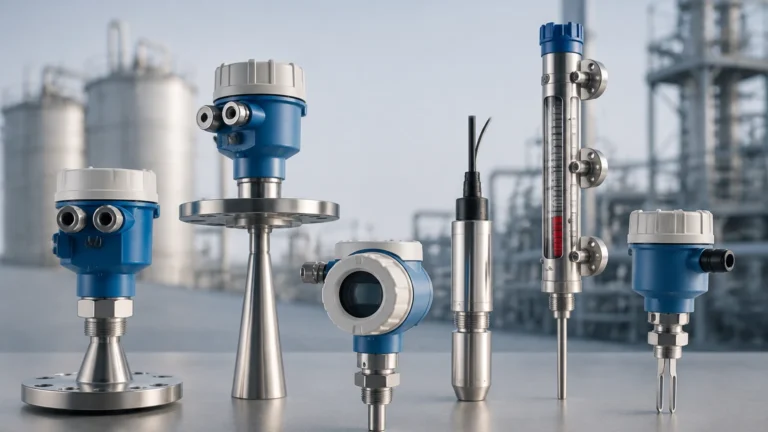
Before selecting a WirelessHART transmission system, it is critical to understand the underlying measurement principles of the level sensors being deployed. Welk provides a variety of instruments that can be integrated into a WirelessHART network, either as native wireless devices or through the use of wireless adapters.
Radar Level Measurement
Radar level meters utilize Time of Flight (ToF) technology. High-frequency microwave pulses are emitted from the antenna, reflected off the surface of the medium, and received back by the sensor. The distance is calculated based on the time taken for the pulse to travel. When integrated with WirelessHART, radar meters are ideal for large storage tanks where cabling costs would be prohibitive. Because radar is non-contact and unaffected by pressure or temperature fluctuations, it provides highly reliable data for the mesh network.
Ultrasonic Level Measurement
Similar to radar, ultrasonic sensors use ToF but rely on sound waves. A transducer emits an ultrasonic pulse that bounces off the liquid or solid surface. These are cost-effective solutions for water treatment applications. However, in a WirelessHART configuration, engineers must account for the power consumption of the transducer, as frequent ultrasonic pulses can deplete the battery of a wireless unit faster than low-power hydrostatic sensors.
Hydrostatic Level Measurement
Hydrostatic transmitters measure the pressure exerted by a liquid column. This pressure is directly proportional to the height of the liquid based on its density. These sensors are often used in deep wells or vented tanks. In a wireless setup, the hydrostatic transmitter sends the pressure data to a WirelessHART adapter, which then transmits the signal to the gateway.
Core Components of a WirelessHART Network
A functional WirelessHART ecosystem for level monitoring consists of four primary components:
1. WirelessHART Field Devices: These are the level meters (radar, ultrasonic, or pressure) equipped with wireless radios. They can act as routers for other devices in the mesh.
2. WirelessHART Adapters: These devices allow existing wired 4-20 mA HART instruments to join the wireless network. The adapter extracts the digital HART signal and transmits it wirelessly.
3. Gateways: The gateway is the bridge between the wireless field devices and the plant’s host system (DCS, PLC, or SCADA). It manages the network security and communication scheduling.
4. Network Manager: Often integrated into the gateway, this software component determines the best communication paths and manages the health of the mesh network.
Selection Criteria: Wired vs. WirelessHART
When evaluating whether to implement a WirelessHART solution for level measurement, engineers should consider the following comparison table:
| Feature | Wired (4-20 mA / HART) | WirelessHART (IEC 62591) |
| :— | :— | :— |
| Installation Cost | High (Conduit, cabling, labor) | Low (No signal wiring required) |
| Data Update Rate | Continuous / Real-time | Periodic (1 second to 1 hour) |
| Power Source | Loop-powered or external | Battery, solar, or local AC/DC |
| Flexibility | Fixed infrastructure | Easy to relocate or add devices |
| Range | Limited by cable length | Up to 200m (650ft) between nodes |
| Security | Physical security required | AES-128 Encryption & Authentication |
For comprehensive details on specific sensor hardware and configuration options, engineers can visit the Main Page to explore the full range of level measurement solutions.
Installation and Commissioning Guidelines
Successful deployment of WirelessHART level meters requires careful planning of the physical environment to ensure robust signal propagation.
Antenna Placement and Orientation
For optimal performance, antennas should be mounted at least 0.5 meters (1.6 ft) away from large metal surfaces to prevent signal reflection and detuning. In a mesh network, each device should ideally have a clear Line of Sight (LoS) to at least two other devices. This provides the "self-healing" capability; if one path is blocked by a temporary obstacle (like a moving crane), the data can be rerouted through another node.
Power Management
Since many WirelessHART level meters are battery-powered, the update rate (the frequency at which the device sends a measurement) is the most significant factor affecting battery life. For a standard radar level meter, an update rate of once per minute might yield a battery life of 3 to 5 years, whereas an update rate of every 8 seconds may reduce it to less than a year. Engineers must balance the process dynamics (how fast the level changes) with the desired maintenance interval.
Gateway Positioning
The gateway should be positioned centrally relative to the field devices, typically at a high elevation to maximize its coverage area. In large-scale industrial plants, multiple gateways may be required to cover different process areas, with data aggregated at the control room level.
Operational Limitations and Risk Mitigation
While WirelessHART is highly reliable, it is not suitable for every application. Engineers should be aware of the following limitations:
* Bandwidth Constraints: WirelessHART is designed for process variables (PVs) and diagnostic data. It is not intended for high-speed control loops or video streaming. For level monitoring where the surface moves slowly, the bandwidth is more than sufficient.
* Latency: Because data may hop through several nodes before reaching the gateway, there is an inherent latency (usually in the range of hundreds of milliseconds to seconds). This makes it unsuitable for emergency shutdown (ESD) systems.
* Battery Maintenance: In large deployments, the logistical task of replacing batteries must be factored into the long-term maintenance budget. Using high-capacity lithium-thionyl chloride (Li-SOCl2) batteries is standard for these applications.
Security Protocols
Security is a paramount concern in B2B industrial environments. WirelessHART employs a multi-layered security approach:
1. Encryption: All data is encrypted using 128-bit AES encryption.
2. Authentication: Devices must have a unique Join Key to enter the network, preventing unauthorized devices from intercepting or injecting data.
3. Integrity: Message Integrity Codes (MIC) ensure that the data has not been tampered with during transmission.
Frequently Asked Questions (FAQs)
Q1: Can WirelessHART coexist with existing Wi-Fi networks?
Yes. WirelessHART uses IEEE 802.15.4 radios and employs blacklisting and channel hopping. It can identify which channels are being heavily used by Wi-Fi and automatically avoid them to prevent interference.
Q2: What is the maximum distance between a level meter and the gateway?
While the theoretical range of a single hop can be up to 200 meters (650 ft) in clear outdoor conditions, the effective range in a dense industrial environment with metal obstructions is typically 30 to 50 meters (100 to 165 ft). However, because it is a mesh network, the total distance can be much further as long as there are intermediate nodes to relay the signal.
Q3: Is WirelessHART suitable for hazardous areas?
Yes, many WirelessHART level meters and adapters are designed with Intrinsic Safety (IS) or Explosion-Proof ratings (ATEX/IECEx), making them suitable for Zone 0, 1, or 2 environments common in the chemical and oil industries.
Q4: How many devices can a single WirelessHART gateway support?
Most industrial gateways can support up to 100 field devices, though for optimal performance and lower latency, a limit of 50 to 75 devices per gateway is often recommended in high-density mesh networks.
Conclusion
WirelessHART has proven to be a robust and flexible solution for industrial level measurement, particularly in brownfield projects where adding new cabling is cost-prohibitive. By combining the precision of Welk’s radar, ultrasonic, and hydrostatic sensors with the reliability of the WirelessHART protocol, facilities can achieve better visibility into their processes with reduced installation complexity. When selecting a system, engineers must prioritize the measurement principle suitable for their medium and carefully plan the mesh topology to ensure long-term operational stability.