Tunable Diode Laser Absorption
Tunable Diode Laser Absorption
In the landscape of industrial process monitoring and environmental safety, Tunable Diode Laser Absorption (TDLA) has emerged as a cornerstone technology for high-precision gas analysis. Often referred to as TDLAS (Tunable Diode Laser Absorption Spectroscopy), this method allows for the non-contact, real-time measurement of specific gas concentrations within complex mixtures. For engineers and plant managers specialized in level measurement and vessel monitoring, understanding TDLA is essential, as gas composition in the headspace of a tank can significantly influence the performance of traditional level sensors or indicate critical process shifts.
As industrial facilities move toward higher degrees of automation and stricter safety protocols, the integration of TDLA with standard level measurement instrumentation provides a more holistic view of process health. Whether monitoring moisture in natural gas pipelines or detecting trace oxygen in volatile chemical storage, TDLA offers a level of selectivity and speed that traditional electrochemical or catalytic sensors often cannot match.
Principles of Tunable Diode Laser Absorption
To effectively implement TDLA in a B2B or industrial environment, it is necessary to first understand the underlying physics that govern its operation. The technology is based on the Beer-Lambert Law, which describes the relationship between the absorption of light and the properties of the material through which the light is traveling.
The Beer-Lambert Law
At its core, TDLA measures the attenuation of laser light as it passes through a gas medium. The fundamental equation is:
I(ν) = I₀(ν) ⋅ exp[-α(ν) ⋅ L ⋅ C]
Where:
* I(ν) is the intensity of the light reaching the detector.
* I₀(ν) is the initial intensity of the laser light.
* α(ν) is the absorption coefficient (specific to the gas molecule and wavelength).
* L is the optical path length (usually measured in meters).
* C is the concentration of the target gas.
Wavelength Tunability and Selectivity
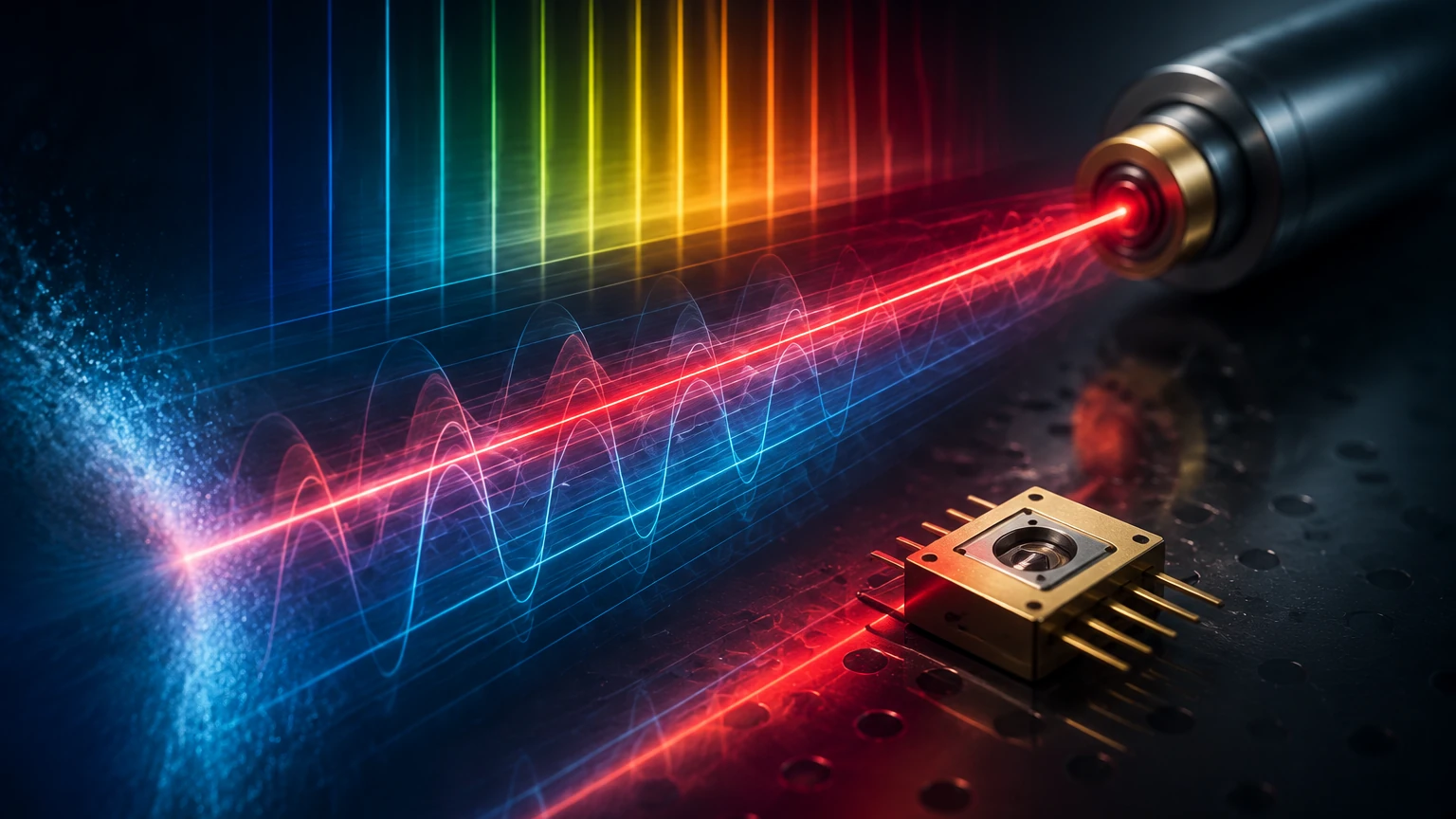
The "Tunable" aspect of TDLA is what differentiates it from broad-spectrum infrared sensors. A diode laser is designed to emit light at a very narrow frequency. By varying the injection current or the temperature of the laser diode, the wavelength can be precisely "tuned" to scan across a specific absorption line of the target gas molecule.
Because different gas molecules (such as H₂O, NH″, CH₄, or CO₂) have unique, high-resolution absorption spectra, the laser can be tuned to a frequency where only the target gas absorbs light. This eliminates cross-interference from other gases in the process stream, a common problem in complex chemical environments where multiple vapors are present in a tank's headspace.
Industrial Applications and Level Measurement Integration
While TDLA is primarily a gas sensing technology, its application is frequently intertwined with industrial level measurement. Accurate level monitoring often requires a stable environment, and TDLA provides the data necessary to confirm that environment.
1. Headspace Monitoring in Chemical Storage
In many chemical processes, the space above the liquid level (the headspace) must be inerted with nitrogen to prevent combustion. TDLA sensors are used to monitor trace oxygen levels in real-time. If the oxygen concentration rises, it indicates a leak or a failure in the inerting system. This data, combined with readings from a Main Page radar level meter, ensures both the volume and the safety of the stored medium are accounted for.
2. Moisture Analysis in Hydrocarbons
In the oil and gas industry, water vapor (moisture) in natural gas can lead to corrosion and the formation of hydrates, which can block pipelines. TDLA offers a rapid response to moisture spikes, allowing operators to divert gas or adjust dehydration processes immediately. This is often paired with hydrostatic level transmitters in separator vessels to manage the liquid-gas interface effectively.
3. Ammonia Slip Detection
In power plants and refineries using Selective Catalytic Reduction (SCR) to reduce NOx emissions, TDLA is used to monitor "ammonia slip" (excess ammonia passing through the reactor). Because TDLA can operate in high-temperature, high-dust environments, it provides a reliable feedback loop for chemical injection systems.
Key Evaluation Criteria for TDLA Systems
Selecting the right tunable diode laser absorption system requires an assessment of the process conditions and the required detection limits. Engineers should evaluate the following criteria before procurement:
| Feature | Description | Importance |
| :— | :— | :— |
| Detection Limit | The lowest concentration the sensor can reliably detect (often in ppm or ppb). | Critical for safety-critical trace detection. |
| Response Time | The time taken to register a change in gas concentration (typically <2 seconds). | Essential for fast-loop process control. |
| Optical Path Length | The distance the laser travels through the gas. | Longer paths increase sensitivity but require better alignment. |
| Temperature/Pressure Compensation | Built-in algorithms to adjust for process fluctuations. | Necessary for accuracy in dynamic industrial reactors. |
| Calibration Stability | How long the sensor maintains accuracy without manual intervention. | Reduces maintenance overhead in remote locations. |
| Materials of Construction | The compatibility of the probe or windows with corrosive gases. | Ensures long-term durability in harsh environments. |
| Alignment Tolerance | The system's ability to maintain a signal despite mechanical vibration. | Vital for installations on large tanks or vibrating structures. |
Installation and Engineering Considerations
Successful deployment of tunable diode laser absorption technology depends heavily on the physical installation. Unlike contact sensors, TDLA relies on a clear optical path.
Path Alignment and Stability
TDLA systems can be configured as "Cross-Stack" (laser on one side, detector on the other) or "Probe-Style" (laser and detector in one unit with a reflecting mirror). For cross-stack installations on large vessels (e.g., 5 to 10 meters in diameter), mechanical stability is paramount. Thermal expansion of the tank or structural vibrations can cause the laser to miss the detector, leading to a loss of signal. Using reinforced mounting flanges or auto-alignment motors can mitigate these risks.
Purging and Window Maintenance
To prevent the process gas from fouling the optical windows, a constant purge of clean, dry air or nitrogen is typically required. The purge gas creates a protective curtain in front of the lens. If the process involves heavy dust or sticky vapors, the purge flow rate must be carefully calculated to ensure the windows remain clear without diluting the sample gas significantly at the point of measurement.
Integration with Level Instrumentation
When installing TDLA sensors alongside level meters, such as ultrasonic or radar sensors, ensure that the mounting nozzles do not interfere with each other. For example, the turbulent surface of a liquid detected by a radar level meter should not splash onto the TDLA probe. Ideally, the gas analysis point should be located in a relatively calm area of the headspace to ensure a representative sample of the vapor phase.
Limitations and Common Risks
Despite its advantages, tunable diode laser absorption is not a universal solution. Engineers must be aware of its factual boundaries:
1. Particulate Interference: High concentrations of dust or aerosols can scatter the laser light. While TDLA can handle moderate dust loads better than NDIR (Non-Dispersive Infrared) sensors, extreme opacity will eventually block the signal.
2. Pressure and Temperature Limits: While TDLA can operate at high temperatures (up to 600°C or more), the absorption lines of gases change shape and intensity with temperature and pressure. If the system does not have active compensation for these variables, the concentration reading will drift.
3. Specific Gas Requirements: TDLA is a "one-gas-one-laser" technology. If you need to measure five different gases, you typically need five different laser sources (or a complex multi-laser system). It is not a scanning spectrometer capable of identifying unknown gases.
4. Optical Path Obstructions: Any physical obstruction in the laser's path, such as internal tank baffles, ladders, or agitators, will render a cross-stack TDLA system inoperable.
Comparison: TDLA vs. Alternative Technologies
To justify the investment in TDLA, it is helpful to compare it against more traditional gas sensing methods used in industrial automation.
* TDLA vs. Electrochemical Sensors: Electrochemical sensors are inexpensive but suffer from "poisoning" and require frequent replacement (every 6-24 months). TDLA is non-contact and can last for years with minimal maintenance.
* TDLA vs. NDIR: NDIR uses a broad-spectrum light source and filters. It is prone to cross-interference from other gases (e.g., CO₂ interfering with hydrocarbon measurements). TDLA’s narrow-band laser eliminates this interference.
* TDLA vs. Gas Chromatography (GC): GCs are highly accurate but slow, often taking 5-15 minutes per sample. TDLA provides a measurement every second, making it the preferred choice for safety-critical shutdowns.
Frequently Asked Questions (FAQ)
Q: Can TDLA measure liquids or solids?
A: No. TDLA is strictly for gas-phase molecules. For liquid or solid level measurement, you should refer to the Main Page of an industrial instrument manufacturer to select radar or ultrasonic sensors.
Q: How often does a TDLA system need calibration?
A: Most industrial TDLA systems are designed for "calibration-free" operation for 6 to 12 months. Many units include an internal reference cell that allows the laser to lock onto the correct wavelength automatically, compensating for any diode aging.
Q: Is TDLA safe for explosive atmospheres?
A: Yes, TDLA systems are available with ATEX, IECEx, and North American Class/Division hazardous area certifications. Since the laser power is typically very low (milliwatts), it is inherently safe if the enclosure and electrical components meet the required standards.
Q: Does the gas pressure affect the measurement?
A: Yes. Increased pressure causes "pressure broadening" of the absorption lines. High-quality TDLA analyzers use an integrated pressure sensor to adjust the calculation in real-time, ensuring accuracy even as process pressures fluctuate.
Conclusion
Tunable Diode Laser Absorption represents a significant leap forward in process gas analysis, offering speed, selectivity, and reliability that traditional methods struggle to provide. For engineering projects involving complex chemical storage or high-temperature reactors, TDLA provides the necessary data to maintain safety and efficiency. By understanding the principles of the Beer-Lambert Law and the practicalities of optical alignment and purging, process engineers can successfully integrate these sensors into their wider instrumentation strategy. When paired with robust level measurement solutions, TDLA ensures that both the liquid and gas phases of a process are monitored with the highest possible precision.