Real Time Gas Analyzer
Real Time Gas Analyzer
In modern industrial processing, the ability to monitor atmospheric and process gases instantaneously is a cornerstone of safety, environmental compliance, and operational efficiency. A real time gas analyzer serves as a continuous monitoring solution, providing immediate data on gas concentrations without the delays associated with laboratory sampling. For engineers and facility managers, understanding the intersection of gas analysis and process vessel monitoring—including how these systems integrate with level measurement technologies—is essential for maintaining a secure and optimized facility.
Whether managing a chemical reactor, a wastewater treatment plant, or an oil storage terminal, the presence of specific gases can indicate process health, potential leaks, or the risk of combustion. This guide examines the fundamental principles of real-time gas analysis, selection criteria, and practical installation strategies for industrial applications.
Measurement Principles of Real Time Gas Analyzers
Before selecting a specific instrument, it is necessary to understand the physics behind gas detection. Different technologies are suited for specific gas species and environmental conditions. The most common principles used in industrial real time gas analyzers include:
Non-Dispersive Infrared (NDIR)
NDIR sensors operate on the principle that many gases absorb specific wavelengths of infrared (IR) light. The analyzer consists of an IR source, a sample chamber, and a detector with an optical filter. As the gas passes through the chamber, it absorbs a portion of the IR energy. The detector measures the attenuation of the light, which is proportional to the gas concentration. This method is highly effective for measuring carbon dioxide (CO2), methane (CH4), and other hydrocarbons.
Tunable Diode Laser Absorption Spectroscopy (TDLAS)
TDLAS is a high-precision, non-contact method that uses a laser to scan across a specific absorption line of the target gas. Because the laser's linewidth is extremely narrow, TDLAS is highly selective and resistant to interference from other gases. It is frequently used for monitoring moisture (H2O), ammonia (NH3), and hydrogen sulfide (H2S) in harsh process environments. Its "in-situ" capability allows for measurement directly within a stack or pipe without a sampling system.
Electrochemical Sensors
Electrochemical analyzers measure gas concentration by reacting with the gas of interest and producing an electrical signal. The gas diffuses through a membrane into a cell containing electrodes and an electrolyte. The resulting chemical reaction generates a current proportional to the gas volume. These are commonly used for toxic gases like carbon monoxide (CO), chlorine (Cl2), and oxygen (O2) deficiency monitoring.
Catalytic Bead (Pellistor)
Used primarily for combustible gases, catalytic bead sensors consist of two coils of platinum wire. One is coated with a catalyst that facilitates oxidation of the gas, while the other is a reference. When flammable gas burns on the catalyst, the temperature and resistance of the wire change. This resistance change is measured via a Wheatstone bridge circuit.
Integration with Level Measurement Systems
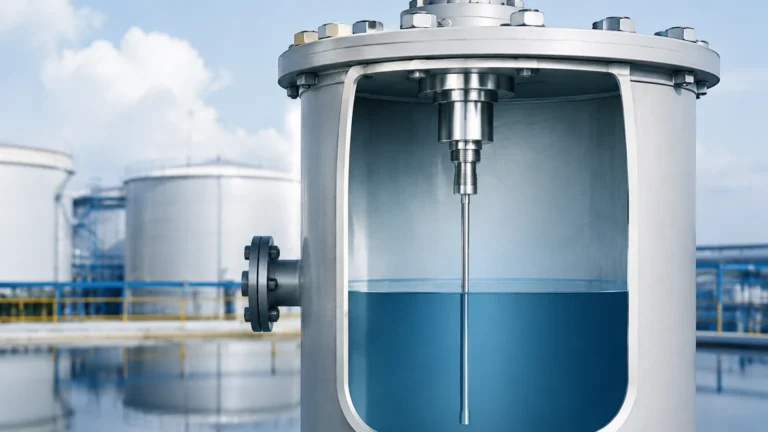
In industrial automation, gas analysis and level measurement often go hand-in-hand. For instance, in a chemical storage tank monitored by a radar level meter, the "headspace" (the area above the liquid) may contain volatile organic compounds (VOCs) or inerting gases like nitrogen.
Integrating a real time gas analyzer with level data provides a comprehensive view of the vessel's status. If a level transmitter indicates a rapid drop in liquid while a gas analyzer detects an increase in hydrocarbon concentration outside the tank, it provides immediate confirmation of a leak. Furthermore, in nitrogen-blanketed tanks, gas analyzers ensure that oxygen levels remain below the Limiting Oxygen Concentration (LOC) to prevent explosions, while level sensors ensure the tank is not overfilled. For comprehensive instrumentation solutions, engineers often consult the Main Page of specialized manufacturers to align their level sensing and gas monitoring strategies.
Key Evaluation Criteria for Selection
Selecting the correct real time gas analyzer requires a detailed assessment of the application environment and the specific gas properties. Engineers should evaluate the following factors:
1. Selectivity and Cross-Sensitivity: Does the sensor react to gases other than the target? For example, some electrochemical CO sensors may show a false positive in the presence of hydrogen. High-selectivity technologies like TDLAS are preferred in complex gas mixtures.
2. Response Time (T90): This is the time it takes for the analyzer to reach 90% of its final stable reading after a step change in concentration. For safety-critical leak detection, a T90 of less than 10–30 seconds is often required.
3. Operating Environment: Industrial sites often involve extreme temperatures, high humidity, or corrosive atmospheres. Analyzers must be rated for these conditions, often requiring IP66/67 ingress protection and ATEX/IECEx certifications for hazardous areas.
4. Calibration Requirements: All gas analyzers experience drift over time. Consider how easily the unit can be calibrated. Some modern systems offer "auto-calibration" features or long-term stability that reduces the need for monthly manual checks.
5. Sampling vs. In-Situ: Determine if the gas needs to be extracted and conditioned (cooled, dried, filtered) via a Sample Conditioning System (SCS) or if the sensor can be placed directly in the process flow.
Practical Selection Table
| Technology | Typical Target Gases | Advantages | Limitations |
| :— | :— | :— | :— |
| NDIR | CO2, CH4, CO, Refrigerants | Long lifespan, stable, low maintenance | Susceptible to high moisture; cannot detect O2 or H2 |
| TDLAS | NH3, H2S, H2O, HCl | Fast response, no contact, very high selectivity | Higher initial cost; requires clear optical path |
| Electrochemical | O2, CO, H2S, SO2 | Low cost, compact, low power | Limited sensor life (1–3 years); sensitive to temperature |
| Catalytic Bead | Methane, Propane, Hydrogen | Robust, detects most flammable gases | Requires oxygen to function; can be "poisoned" by silicones |
| Zirconia | Oxygen (O2) | Excellent for high-temp combustion | Only measures O2; sensor must be heated to ~600°C |
Installation and Maintenance Considerations
Proper installation is as critical as the technology itself. A poorly placed real time gas analyzer will fail to provide actionable data, regardless of its accuracy.
Placement and Gas Density
When installing sensors for leak detection, the density of the gas relative to air (1.29 kg/m³) must be considered.
* Lighter-than-air gases (e.g., Hydrogen, Methane): Sensors should be placed high, near the ceiling or above potential leak points.
* Heavier-than-air gases (e.g., Propane, Chlorine, CO2): Sensors should be placed low to the ground or in pits where gas may accumulate.
Sample Conditioning Systems (SCS)
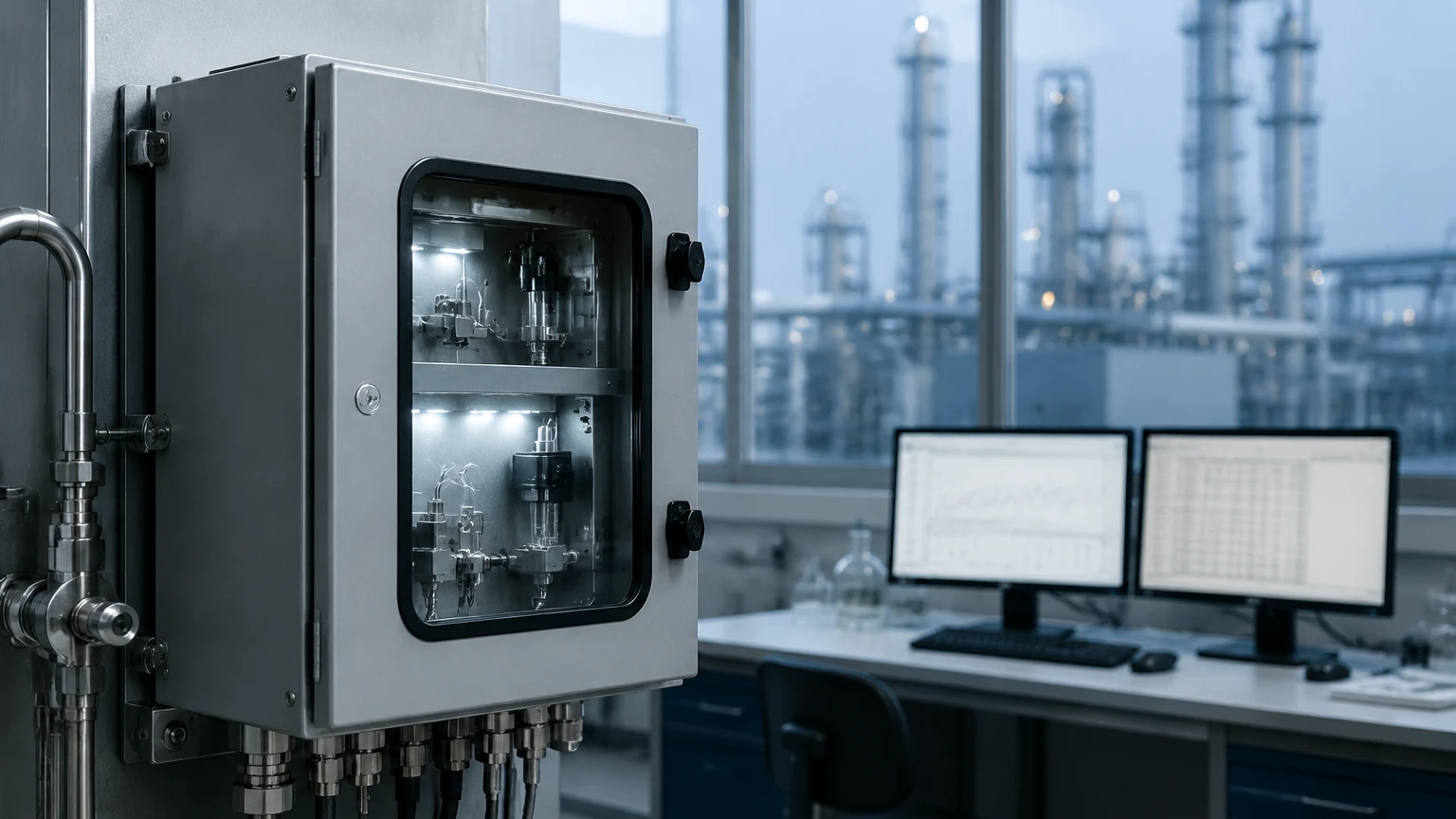
For extractive analyzers, the SCS is often the most complex part of the installation. If a process gas is hot and saturated with water vapor, it must be cooled and the condensate removed before it reaches the sensor. Failure to manage moisture is the leading cause of analyzer failure in industrial settings. Heat-traced sample lines may be necessary to prevent gas from condensing back into a liquid state during transport to the analyzer cabinet.
Calibration and Testing
Regular "bump tests" (applying a known concentration of gas to verify response) and full calibrations are mandatory. For fixed systems, ensure that the sensors are accessible. If a sensor is mounted 10 meters high on a gantry without a platform, maintenance will likely be neglected, leading to system unreliability.
Common Risks and Limitations
While real-time analyzers are powerful tools, they have inherent limitations that must be managed:
* Sensor Poisoning: Catalytic bead sensors can be permanently deactivated by exposure to certain chemicals, such as silicones, lead, or sulfur compounds. In environments where these are present, NDIR or TDLAS may be more appropriate.
* Environmental Interference: High humidity can cause IR-based sensors to drift if the system does not account for water vapor absorption. Similarly, extreme pressure fluctuations in a pipe can affect the partial pressure of the gas, leading to inaccurate concentration readings.
* Maintenance Lag: Unlike level meters, which are often "set and forget," gas analyzers are chemical-physical devices that degrade. Budgeting for replacement sensor heads and calibration gas cylinders is a necessity for any B2B procurement plan.
Frequently Asked Questions (FAQs)
Q: How often should a real time gas analyzer be calibrated?
A: This depends on the technology and the manufacturer's recommendations. Typically, electrochemical sensors require calibration every 3–6 months, while TDLAS systems may remain stable for a year or more. Always perform a bump test after any significant process upset.
Q: Can one analyzer detect multiple gases simultaneously?
A: Yes, many modern units are "multi-gas" analyzers. NDIR systems can often be configured with multiple channels to detect CO, CO2, and CH4 in a single enclosure. However, ensure there is no cross-interference between the selected channels.
Q: What is the difference between a gas detector and a gas analyzer?
A: While the terms are often used interchangeably, a "detector" usually refers to a safety device that triggers an alarm at specific thresholds (e.g., LEL or TLV). An "analyzer" typically provides a continuous, quantified measurement of gas concentration for process control or environmental reporting.
Q: Do these systems work in vacuum conditions?
A: Most gas sensors require a certain ambient pressure to function correctly. Electrochemical and catalytic sensors usually require oxygen and atmospheric pressure. For vacuum applications, specialized mass spectrometry or modified TDLAS systems may be required.
Conclusion
Implementing a real time gas analyzer is a vital step for any industrial operation aiming to enhance safety and process transparency. By understanding the specific measurement principles—from NDIR to TDLAS—and considering the physical properties of the gases involved, engineers can select a system that provides reliable, long-term performance.
When integrated with other process instruments, such as the level measurement solutions found on the Main Page, gas analyzers complete the picture of facility health. Proper selection, coupled with a rigorous maintenance and calibration schedule, ensures that these instruments provide the critical data needed to prevent accidents and optimize industrial output.