Scfm Flow Meter
Scfm Flow Meter
In industrial gas measurement, precision is not merely a preference but a requirement for safety, billing, and process efficiency. When discussing gas flow, the term "SCFM" (Standard Cubic Feet per Minute) is the industry standard for quantifying the volume of gas moving through a system. Unlike liquids, which are largely incompressible, gases change volume significantly based on pressure and temperature. An scfm flow meter is designed to account for these variables, providing a standardized reading that allows engineers to compare flow rates across different operating environments.
For professionals managing complex industrial systems, understanding the nuances of SCFM is critical. Whether you are monitoring compressed air usage, natural gas distribution, or specialized chemical vapors, selecting the right instrumentation ensures that your mass balance calculations remain accurate. This guide explores the principles, selection criteria, and practical applications of SCFM flow measurement in modern B2B environments.
Understanding SCFM: Standard vs. Actual Flow
Before evaluating hardware, it is essential to distinguish between SCFM and ACFM (Actual Cubic Feet per Minute). This distinction is the foundation of gas flow engineering.
Actual Cubic Feet per Minute (ACFM)
ACFM represents the volume of gas flowing through a meter at the current operating temperature and pressure. Because gas is compressible, the same mass of gas will occupy a much larger volume at low pressure than it will at high pressure. Therefore, ACFM is useful for sizing pipes or blowers at the point of use, but it does not tell you the actual quantity (mass) of gas being delivered.
Standard Cubic Feet per Minute (SCFM)
SCFM represents the volumetric flow rate of a gas corrected to a "standard" set of conditions. These conditions typically include a specific temperature and pressure, most commonly defined by NIST (National Institute of Standards and Technology) as 68°F (20°C) and 14.696 psia (101.325 kPa). By converting actual flow to standard flow, engineers can determine the true energy content or mass of the gas, regardless of whether the line is running at 10 psi or 1,000 psi.
Core Measurement Principles for SCFM Flow Meters
To provide an SCFM reading, a flow meter must either measure mass flow directly or measure volumetric flow and then compensate for temperature and pressure. The following technologies are the most prevalent in industrial settings.
1. Thermal Mass Flow Measurement
Thermal mass flow meters are perhaps the most common choice for SCFM applications because they measure mass flow directly. The principle relies on the heat-conducting properties of the gas. The meter typically uses two sensors: one that measures the gas temperature and another that is heated to a specific temperature above the gas. As gas flows past the heated sensor, it carries away heat. The amount of energy required to maintain the temperature differential is directly proportional to the mass flow rate. Since SCFM is essentially a mass flow measurement expressed in standard volume, these meters provide SCFM output without needing external pressure or temperature sensors.
2. Differential Pressure (DP) with Compensation
Differential pressure meters, such as orifice plates or Venturi tubes, measure the pressure drop across an obstruction in the pipe. According to Bernoulli’s principle, the square root of the pressure drop is proportional to the flow velocity. However, to convert this to SCFM, the system must also include a pressure transmitter and a temperature sensor. A flow computer then uses the Ideal Gas Law to calculate the standardized flow rate.
3. Vortex Shedding Meters
Vortex meters measure flow by detecting the frequency of vortices created when a gas flows past a bluff body. The frequency of these vortices is proportional to the flow velocity. High-end vortex meters often include integrated temperature and pressure sensors (multivariable meters), allowing them to calculate and output SCFM in real-time.
Key Selection Criteria for Industrial Applications
Choosing the correct scfm flow meter requires an analysis of the gas properties and the environmental conditions. Engineers should confirm the following data points before procurement:
* Gas Composition: Is the gas a pure substance like Nitrogen, or a mixture like Natural Gas? Thermal mass meters require specific calibration for the gas's thermal conductivity.
* Flow Range (Turndown Ratio): Some meters, like thermal mass types, offer excellent low-flow sensitivity (up to 100:1 turndown). Others, like vortex meters, require a minimum velocity to function and are better suited for high-flow applications.
* Process Temperature and Pressure: Ensure the meter body and sensors are rated for the maximum expected process conditions. For extremely high-pressure lines, DP or Coriolis meters may be preferred.
* Accuracy Requirements: For internal monitoring, a 2-5% accuracy might suffice. For custody transfer or billing, sub-1% accuracy is usually mandatory.
Technical Comparison of Flow Meter Technologies
The following table provides a quick reference for comparing common technologies used to measure SCFM.
| Technology | Primary Measurement | SCFM Conversion | Best For | Typical Turndown |
| :— | :— | :— | :— | :— |
| Thermal Mass | Mass Flow | Direct | Compressed air, Nitrogen, Ar | 100:1 |
| Vortex | Velocity | Requires P&T sensors | Steam, high-velocity gas | 10:1 to 20:1 |
| Differential Pressure | Pressure Drop | Requires P&T sensors | Large pipes, high pressure | 4:1 to 10:1 |
| Coriolis | Mass Flow | Direct (via density) | High-value gases, chemicals | 20:1 to 100:1 |
Installation Best Practices and Straight Run Requirements
Even the most accurate scfm flow meter will provide unreliable data if installed incorrectly. Gas flow profiles are highly sensitive to turbulence caused by valves, elbows, and reducers.
1. Straight Pipe Runs: Most flow meters require a certain length of straight pipe upstream and downstream to ensure a laminar (smooth) flow profile. A common rule of thumb is 10 to 20 diameters upstream and 5 diameters downstream, though this varies by technology.
2. Gas Dryness: For thermal mass meters, moisture or water droplets in the gas stream can cause significant errors, as the meter will attempt to heat the water, leading to artificially high flow readings. If moisture is present, water traps or separators must be installed upstream.
3. Orientation: While many meters can be installed in any orientation, vertical installations (flow going up) are often preferred for gases that might contain trace liquids, as this prevents liquid from pooling around the sensor.
4. Calibration Alignment: Ensure the meter is calibrated for the specific "Standard" conditions (e.g., 60°F vs 70°F) used by your facility to avoid a 1-2% systematic error.
Limitations and Potential Risks in Gas Measurement
While SCFM flow meters are highly advanced, they are not "set and forget" devices. Several factors can compromise their performance over time.
* Sensor Coating: In "dirty" gas applications, such as flare gas or untreated biogas, particulates or oils can coat the sensors. This is particularly problematic for thermal mass meters, where the coating acts as an insulator, slowing the heat transfer and causing the meter to under-read.
* Pressure Drop: Differential pressure meters and some vortex meters introduce a permanent pressure loss into the system. In low-pressure systems, this loss can be significant enough to affect downstream process performance.
* Gas Mixture Shifts: If the composition of a gas mixture changes (e.g., a change in the methane-to-CO2 ratio in biogas), a meter calibrated for a specific mixture will lose accuracy. In these cases, gas analyzers or Coriolis meters may be necessary.
Integrating Flow and Level Measurement for Process Control
In many industrial facilities, flow measurement does not exist in a vacuum. It is often paired with level measurement to provide a complete picture of inventory and process health. For instance, in a liquefied gas storage facility, a hydrostatic or radar level transmitter monitors the bulk inventory in the tank, while an scfm flow meter monitors the gas being pulled off for production.
Comparing the change in tank level (mass) against the integrated flow rate (totalized SCFM) allows for leak detection and system verification. When designing these systems, it is helpful to consult a comprehensive Main Page for level instrumentation to ensure that the level and flow technologies are compatible in terms of communication protocols (such as HART or Modbus) and environmental ratings.
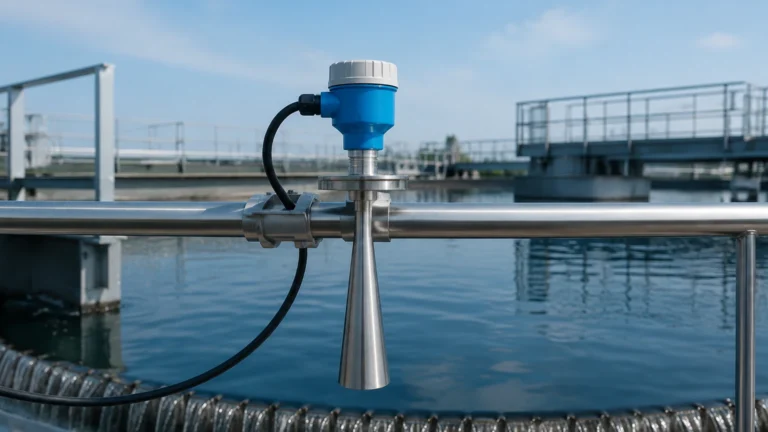
For example, if you are using a Welk radar level meter to monitor a chemical storage tank, the data can be fed into the same PLC (Programmable Logic Controller) as your flow meter. This integrated approach allows for automated mass balance calculations, ensuring that the "Standard" cubic feet of gas consumed matches the volume lost from the storage vessel.
Frequently Asked Questions (FAQs)
Why is my SCFM reading different from my compressor's rating?
Compressors are often rated in ICFM (Inlet Cubic Feet per Minute) or FAD (Free Air Delivery). These ratings are based on the ambient conditions at the compressor inlet. If your facility is at a high altitude or in a very hot environment, the mass of air the compressor takes in will be lower than the standard rating, resulting in a lower SCFM reading at the point of use.
Can I use an SCFM flow meter for liquids?
No. SCFM is a unit specifically for gases. For liquids, flow is typically measured in GPM (Gallons Per Minute) or LPM (Liters Per Minute). Since liquids are incompressible, there is no need for "Standard" volumetric units; the volume does not change significantly with pressure.
How often should an scfm flow meter be recalibrated?
In clean gas applications like Nitrogen or dry compressed air, recalibration every 2 to 3 years is usually sufficient. In corrosive or dirty environments, annual calibration or monthly sensor cleaning may be required to maintain accuracy.
Does pipe size affect SCFM measurement?
Yes. Most flow meters measure velocity. To calculate volume (SCFM), the transmitter must know the exact cross-sectional area of the pipe. If the pipe schedule (wall thickness) is different from what was programmed into the meter, the flow reading will be incorrect.
Conclusion
Selecting an scfm flow meter is a critical step in optimizing industrial gas systems. By understanding the underlying physics—moving from actual conditions to standard reference points—engineers can ensure consistency across their operations. Whether opting for the direct mass measurement of thermal sensors or the robust versatility of vortex meters, proper installation and a clear understanding of gas properties are the keys to long-term reliability. For those looking to integrate these flow solutions with broader tank and inventory management systems, reviewing high-quality level measurement options on the Main Page is a recommended next step in building a cohesive process control strategy.