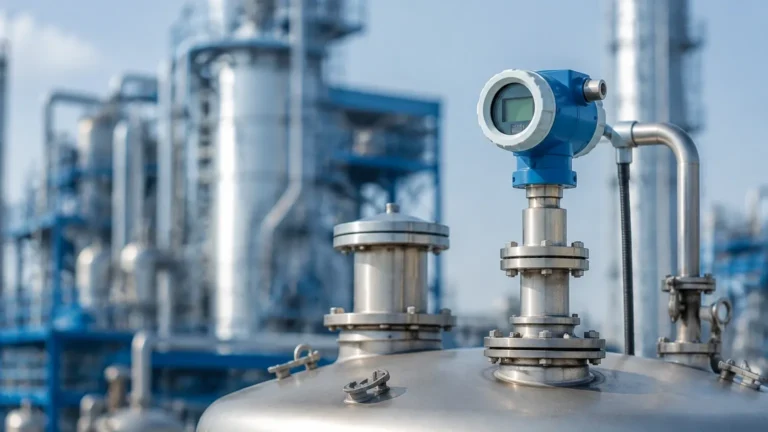
Vegapuls 64 Radar Level Transmitter
Vegapuls 64 Radar Level Transmitter: Engineering Principles and Application Guide
In the landscape of industrial process automation, the accuracy and reliability of level measurement are paramount for operational safety and efficiency. Among the various technologies available, non-contact radar measurement has emerged as a preferred solution for liquid applications. The vegapuls 64 radar level transmitter represents a significant technological shift in this category, primarily due to its utilization of the 80 GHz frequency band. This guide provides a comprehensive technical analysis of the 80 GHz radar principle, selection criteria, installation requirements, and practical limitations for engineers and procurement professionals.
1. Understanding the Measurement Principle
To appreciate the capabilities of the vegapuls 64 radar level transmitter, one must first understand the underlying physics of Frequency Modulated Continuous Wave (FMCW) radar. Unlike pulse-based radar, which measures the time-of-flight of a single microwave pulse, FMCW radar emits a continuous signal with a frequency that changes linearly over time (a frequency sweep or "chirp").
The FMCW Process
1. Signal Emission: The transmitter sends out a continuous microwave signal. As the signal travels, its frequency is constantly increasing or decreasing.
2. Reflection: The signal hits the surface of the medium and reflects back toward the sensor.
3. Frequency Comparison: The transmitter receives the reflected signal. Because of the time taken for the signal to travel to the surface and back, there is a frequency difference between the signal currently being transmitted and the signal being received.
4. Distance Calculation: This frequency difference ($Δf$) is directly proportional to the distance. Advanced digital signal processing (DSP) converts this frequency shift into a precise distance measurement.
The 80 GHz Advantage
The transition from traditional 26 GHz Radar Level Meters to 80 GHz technology is a leap in signal focus. The wavelength of an 80 GHz signal is approximately 3.75 mm, significantly shorter than the 11.5 mm wavelength of a 26 GHz signal. This allows for a much smaller antenna size while achieving a narrower beam angle—often as tight as 3 degrees. This narrow beam is critical for avoiding internal tank obstructions like agitators, heating coils, and ladders.
2. Technical Specifications and Performance Capabilities
When evaluating the vegapuls 64 radar level transmitter for industrial integration, engineers must consider the following technical boundaries:
* Measuring Range: Capable of measuring distances up to 30 meters (approx. 98 feet).
* Measurement Accuracy: Typically within ±1 mm, making it suitable for high-precision inventory management.
* Beam Angle: Depending on the antenna size (e.g., 80 mm or 3"), the beam angle can be reduced to 3°, minimizing signal interference from vessel walls.
* Process Temperature: Standard units handle temperatures from -40°C to +200°C (-40°F to +392°F).
* Process Pressure: Suitable for environments ranging from vacuum (-1 bar) up to 20 bar (290 psi), with specialized versions for higher pressures.
* Dielectric Constant (dk): The device can measure media with dielectric constants as low as 1.1, though signal strength decreases with lower dk values.
3. Selection Guide for Radar Level Meters
Selecting the correct instrument requires a comparison of the process environment against the sensor's strengths. The following table provides a selection matrix for 80 GHz radar transmitters compared to traditional lower-frequency models.
Selection Table: 80 GHz vs. 26 GHz Radar
| Feature | 80 GHz (e.g., Vegapuls 64) | 26 GHz Radar | Engineering Consideration |
| :— | :— | :— | :— |
| Beam Width | Narrow (approx. 3°) | Wide (8° – 20°) | Narrower beams avoid internal obstructions. |
| Antenna Size | Small (starts at ¾") | Large (typically 1.5"+) | Smaller antennas fit into smaller nozzles. |
| Accuracy | ±1 mm | ±2 mm to ±5 mm | Critical for custody transfer/dosing. |
| Sensitivity | High (better for low dk) | Moderate | 80 GHz detects weak reflections better. |
| Condensation | High Resistance | Moderate Resistance | 80 GHz signal is less affected by droplets. |
| Dust/Steam | Excellent Penetration | Good Penetration | Higher frequency handles heavy vapor well. |
4. Installation and Engineering Considerations
Proper installation is the most critical factor in ensuring the longevity and accuracy of the vegapuls 64 radar level transmitter. Engineers should adhere to the following checklists during the design and commissioning phases.
Positioning and Mounting
* Avoid the Center: Never mount the sensor in the exact center of a cylindrical tank. This can lead to multiple reflections (parabolic effect) that amplify noise.
* Nozzle Height: Ensure the antenna extends slightly below the bottom of the mounting nozzle. If the antenna is recessed deep within a nozzle, the signal may reflect off the nozzle walls, creating a "ringing" effect that masks the true level.
* Obstruction Clearance: Even with a 3-degree beam, the "signal footprint" grows with distance. Ensure the path to the liquid surface is clear of agitator blades or intake pipes.
Dead Zones (Blocking Distance)
Every radar sensor has a minimum measuring distance, often called the "dead zone" or blocking distance. For the vegapuls 64, this is typically very small (often 0 mm from the antenna end), but it is good practice to allow for a safety margin of 50 mm to 100 mm to prevent the medium from touching the antenna during overfill conditions.
Vessel Internals
If the vessel contains an agitator, the radar should be programmed with a "false signal suppression" or "static background map." This allows the transmitter to recognize the fixed reflections from the agitator and ignore them, focusing only on the moving level of the liquid.
5. Application Scenarios and Industry Use Cases
Chemical Industry
In chemical processing, vessels are often cluttered with heating coils and baffles. The narrow beam of the 80 GHz transmitter allows for precise measurement in these tight spaces. Furthermore, the use of PTFE or PEEK antenna covers provides the necessary chemical resistance against aggressive acids and bases.
Food and Beverage
Hygiene is paramount in food production. The vegapuls 64 offers small process connections (as small as ¾" thread or hygienic clamps) that meet CIP (Clean-in-Place) and SIP (Steam-in-Place) requirements. The 80 GHz frequency is particularly effective at ignoring the heavy condensation often found in milk tanks or brewing kettles.
Pharmaceutical
Small-scale reactors used in pharmaceutical manufacturing require high precision. The ability of the 80 GHz radar to measure accurately through plastic vessel walls (non-conductive) or in very small containers makes it a versatile tool for biotech applications.

6. Limitations and Application Risks
While the vegapuls 64 radar level transmitter is highly advanced, it is not a universal solution for every process. Engineers must be aware of the following risks:
* Heavy Foam: Radar signals are reflected by the surface of the liquid. If a dense, thick foam layer (like shaving cream) forms, the radar signal may be absorbed or reflected by the top of the foam rather than the liquid. In cases of extremely light, airy foam, the signal may pass through to the liquid. Testing is often required for high-foam applications.
* Dielectric Constant (dk) Limits: If the medium has an extremely low dielectric constant (e.g., liquid nitrogen or certain pure hydrocarbons), the reflection may be too weak for the sensor to detect reliably. In these instances, a guided wave radar (GWR) or a larger antenna might be necessary.
* Turbulence: Extreme surface turbulence can scatter the radar signal. While 80 GHz units have high dynamic range and can often track turbulent surfaces, a stilling well may be required in extreme cases to provide a calm surface for measurement.
7. Comparison with Alternative Radar Level Meters
In the broader market of Radar Level Meters, the 80 GHz FMCW technology is positioned at the high end of the performance spectrum.
1. Guided Wave Radar (GWR): Unlike the non-contact vegapuls 64, GWR uses a physical probe (cable or rod) to guide the microwave. GWR is superior for applications with heavy foam or very low dielectric constants but is susceptible to coating and mechanical stress.
2. Ultrasonic Sensors: These are cost-effective but limited by air temperature, pressure, and vacuum. Radar is generally preferred for process vessels where temperature and pressure fluctuate.
3. Hydrostatic Pressure: This measures the weight of the liquid column. It is reliable but requires contact with the medium and is affected by changes in the liquid's density.
8. Frequently Asked Questions (FAQs)
Q: Can the vegapuls 64 measure through a plastic tank lid?
A: Yes. Because microwaves pass through non-conductive materials, the transmitter can be mounted outside a plastic or fiberglass tank to measure the level inside without a process penetration.
Q: How does the 80 GHz frequency handle condensation on the antenna?
A: The shorter wavelength of 80 GHz makes the signal less sensitive to the interference caused by water droplets on the antenna lens compared to 6 GHz or 26 GHz models. This results in a more stable signal in humid environments.
Q: Is it necessary to recalibrate the device if the medium changes?
A: Generally, no. Radar measures the distance based on the time-of-flight or frequency shift, which is independent of the medium's density or viscosity. However, if the new medium has a significantly lower dielectric constant, the signal strength should be verified.
Q: What is the significance of the "Beam Angle" in narrow tanks?
A: A narrow beam angle (e.g., 3°) ensures that the microwave energy stays concentrated on the liquid surface and does not hit the side walls of the tank. Reflections from the walls can cause measurement errors or "ghost" echoes.
9. Conclusion for International Buyers
For international buyers and plant engineers, the vegapuls 64 radar level transmitter offers a robust solution for complex liquid level challenges. When specifying this equipment, it is essential to confirm the process connection standards (NPT, BSP, or Flange), the required hazardous area certifications (ATEX, IECEx, etc.), and the communication protocol (4…20mA HART, Profibus PA, or Foundation Fieldbus). By focusing on the 80 GHz advantage, facilities can achieve higher precision and lower maintenance requirements compared to legacy level measurement technologies.