Tank Level Probe
Tank Level Probe
In industrial process automation, a tank level probe serves as the primary interface between the physical liquid state and the control system. These instruments are engineered to provide continuous or point-level data, ensuring that storage tanks, process vessels, and sumps operate within safe and efficient parameters. Selecting the correct probe requires a deep understanding of the underlying physical principles, as the interaction between the sensor and the medium determines the accuracy and longevity of the measurement system.
Welk, as a professional manufacturer of industrial level measurement instruments, provides a diverse range of probing technologies designed to meet the rigors of water treatment, chemical processing, and oil and gas industries. When evaluating a tank level probe, engineers must look beyond basic dimensions and consider the chemical compatibility, pressure ratings, and the specific physics of the measurement method.
Fundamental Measurement Principles
Before selecting a specific instrument from the Main Page, it is essential to understand how different probes interpret the level of a liquid. Most industrial probes fall into one of four categories: hydrostatic, ultrasonic, radar, or electromechanical.
Hydrostatic Pressure Measurement
Hydrostatic probes operate on the principle that the pressure at a specific depth in a static liquid is proportional to the height of the liquid column above it. This relationship is defined by the formula:
P = ρ · g · h
Where *P* is pressure, *ρ* is the density of the liquid, *g* is the gravitational constant, and *h* is the height of the liquid.
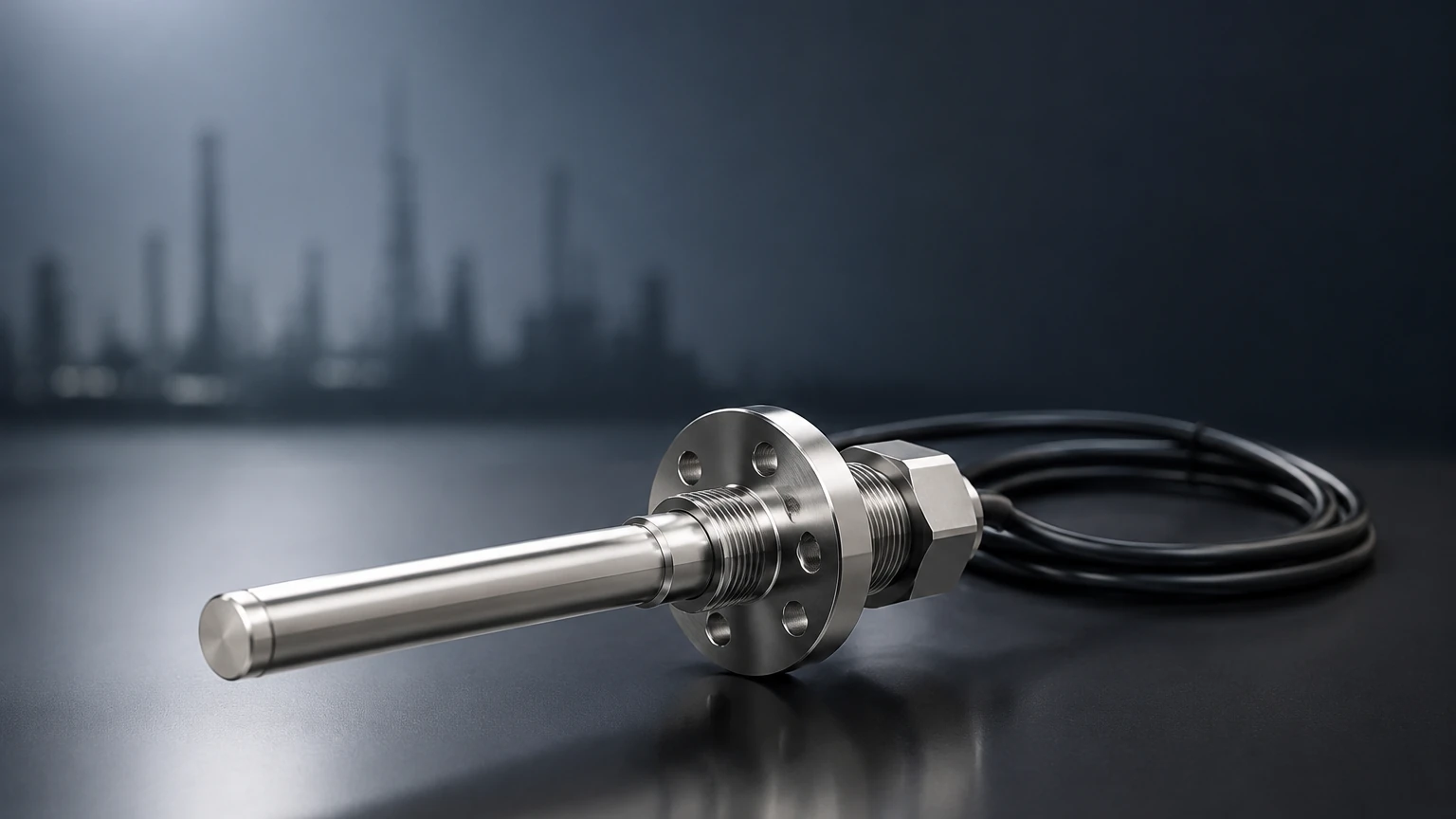
A submersible hydrostatic probe consists of a pressure-sensitive diaphragm (usually stainless steel or ceramic) and a vented cable. The cable includes a small capillary tube that allows the internal side of the sensor to reference atmospheric pressure, compensating for changes in weather or altitude. This method is highly reliable for water and wastewater applications where the density of the fluid remains relatively constant.
Ultrasonic Time-of-Flight
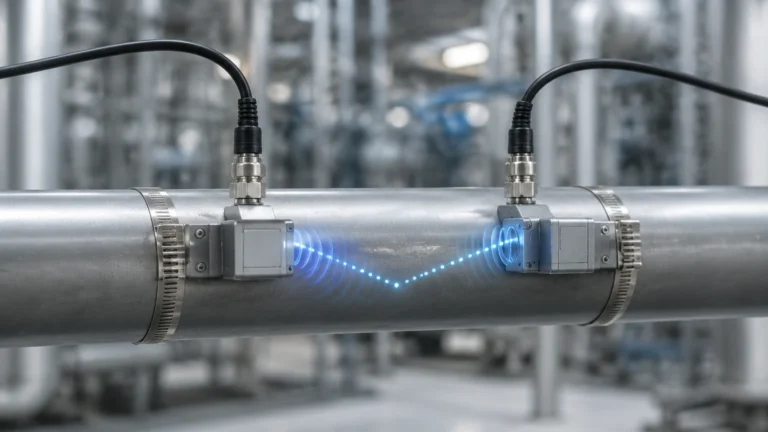
Ultrasonic probes are non-contact instruments that emit high-frequency sound waves (typically 20 kHz to 70 kHz). These waves travel through the air space above the liquid, reflect off the surface, and return to the sensor. The instrument calculates the distance by measuring the time elapsed between transmission and reception.
Because the speed of sound is affected by air temperature, most high-quality ultrasonic probes include an integrated temperature sensor to perform real-time compensation. These probes are ideal for open-channel flow and storage tanks containing non-foaming liquids.
Radar (Microwave) Technology
Radar probes utilize electromagnetic waves rather than sound. There are two primary types: Guided Wave Radar (GWR) and Non-Contact Radar.
* Guided Wave Radar: Uses a physical probe (rod or cable) to guide the microwave pulse to the liquid surface. This is effective in tanks with low dielectric constants or where heavy foam is present.
* Non-Contact Radar: Emits microwaves through the air. Modern 80GHz radar probes offer extremely narrow beam angles, allowing them to ignore internal tank obstructions like agitators or ladders.
Radar is generally preferred for high-temperature or high-pressure environments where the speed of sound (ultrasonic) would be too inconsistent.
Magnetic and Float-Based Probes
Magnetic level probes utilize a float containing an internal magnet. As the liquid level changes, the float moves along a non-magnetic guide tube. Inside the tube, reed switches or a magnetostrictive wire detect the position of the float. This provides a clear, mechanical-to-electrical conversion that is immune to vapor, foam, or dielectric changes.
Technical Selection Criteria
Choosing a tank level probe involves more than identifying the liquid. The following factors must be confirmed before procurement:
1. Medium Characteristics: Is the liquid corrosive, viscous, or prone to crystallization? For corrosive acids, a probe with a PTFE or PVDF coating is necessary. For high-viscosity fluids, non-contact radar is often superior to prevent material buildup on the sensor.
2. Process Environment: What are the maximum operating temperatures and pressures? Hydrostatic probes are limited by the temperature rating of their cables (often up to 80°C), while specialized radar probes can handle over 250°C.
3. Tank Geometry: Narrow, tall tanks may require probes with small beam angles or guided wave structures to avoid false reflections from the tank walls.
4. Accuracy Requirements: Standard industrial applications may accept an error of ±5 mm, whereas custody transfer in the oil industry requires precision within ±1 mm.
Comparative Selection Table
| Technology | Typical Accuracy | Max Range | Contact/Non-Contact | Best For |
| :— | :— | :— | :— | :— |
| Hydrostatic | ±0.25% to ±0.5% FS | 200m | Contact | Deep wells, water reservoirs |
| Ultrasonic | ±0.25% of range | 15m – 30m | Non-Contact | Wastewater, sumps, open channels |
| Radar (80GHz) | ±1mm to ±3mm | 120m | Non-Contact | Chemical reactors, high-pressure tanks |
| Guided Wave Radar| ±2mm | 30m | Contact | Low dielectric fluids, foam |
| Magnetic Float | ±5mm to ±10mm | 6m | Contact | High-pressure boilers, fuel tanks |
Installation and Configuration Guidelines
Proper installation is critical to the performance of any tank level probe. An incorrectly mounted sensor will produce erratic readings regardless of its quality.
Mounting Position
The probe should generally be mounted away from the tank's inlet to avoid turbulence and false readings caused by the incoming flow. For non-contact sensors (ultrasonic and radar), the sensor must be mounted perpendicular to the liquid surface. If the sensor is tilted, the signal may reflect away from the receiver, leading to a "lost signal" error.
Dead Zones (Blocking Distance)
Every non-contact probe has a "dead zone" or "blocking distance" directly beneath the sensor face (typically 0.1m to 0.5m). The liquid level cannot be measured accurately within this zone. When installing a probe, ensure the maximum expected liquid level does not enter this area, or use a mounting nozzle to raise the sensor higher.
Stilling Wells and Bypass Pipes
In tanks with heavy agitation, boiling surfaces, or thick foam, a stilling well (a vertical pipe submerged in the liquid) can be used. The probe is mounted at the top of the pipe, which acts as a mechanical filter to provide a calm surface for measurement. This is a common practice for both radar and ultrasonic installations in process reactors.
Limitations and Operational Risks
While modern probes are robust, they are not universal solutions. Engineers should be aware of the following risks:
* Vapor and Condensation: For ultrasonic probes, heavy steam or chemical vapors can change the speed of sound, leading to significant errors. In these cases, radar is the more stable choice.
* Build-up and Scaling: Contact probes, such as hydrostatic sensors or guided wave radar rods, are susceptible to material build-up. In wastewater applications, fats, oils, and grease (FOG) can coat the sensor diaphragm, requiring regular cleaning.
* Dielectric Constant (εr): Radar technology relies on a difference in dielectric constants between the air and the liquid. If a liquid has an extremely low dielectric constant (like certain liquefied gases), the signal may pass through the surface without reflecting. High-sensitivity radar or guided wave radar with a coax probe is required for these media.
Frequently Asked Questions (FAQ)
Q: Can a hydrostatic probe be used in a pressurized tank?
A: Standard submersible hydrostatic probes are designed for vented (atmospheric) tanks. If used in a pressurized tank, the sensor will measure the sum of the liquid head pressure and the headspace gas pressure, leading to an incorrect level reading. In pressurized vessels, a differential pressure (DP) transmitter or a radar probe should be used.
Q: How often should a tank level probe be calibrated?
A: Calibration frequency depends on the industry and the medium. For non-critical water storage, an annual check is sufficient. For chemical dosing or custody transfer, quarterly calibration or verification against a manual dip tape is recommended.
Q: What is the benefit of 80GHz radar over 26GHz radar?
A: 80GHz radar operates at a higher frequency, which allows for a much smaller antenna and a narrower beam angle (as small as 3°). This makes it significantly easier to install in tanks with internal obstructions or narrow nozzles without interference.
Q: Does foam affect ultrasonic probes?
A: Yes. Foam is an excellent absorber of sound waves. In many cases, the foam will dissipate the ultrasonic pulse, resulting in a loss of signal. For applications with heavy foam, Guided Wave Radar is the industry-standard solution.
Conclusion
Selecting the right tank level probe is a balance of physics, material science, and budget. By understanding the measurement principles—whether it is the pressure-based approach of a hydrostatic sensor or the high-frequency precision of a radar meter—engineers can ensure long-term reliability. For a comprehensive review of specific probe models and technical data sheets, professionals are encouraged to visit the Main Page to match their application requirements with the appropriate technology. Proper attention to installation details, such as avoiding dead zones and accounting for medium density, will ultimately determine the success of the level control system.