Storm Sewer Flow Monitoring
Storm Sewer Flow Monitoring
Storm sewer flow monitoring is a critical component of urban water management, flood prevention, and environmental compliance. Unlike sanitary sewers, which maintain relatively predictable diurnal patterns, storm sewers are subject to rapid, high-volume fluctuations driven by precipitation events. Accurate data collection in these environments is essential for hydraulic modeling, sizing infrastructure, and managing combined sewer overflows (CSOs).
For engineers and municipal operators, selecting the correct instrumentation requires an understanding of both hydraulic principles and the physical constraints of the monitoring site. This guide explores the technologies, selection criteria, and installation best practices for effective storm sewer flow monitoring.
Fundamental Principles of Flow Measurement
In most storm sewer applications, flow is not measured directly by a single sensor. Instead, it is calculated using the relationship between the liquid level (head), the cross-sectional area of the conduit, and the velocity of the fluid. Understanding these principles is the first step in designing a monitoring station.
The Level-to-Flow Relationship
In open-channel environments or partially filled pipes, flow is often determined by measuring the water level and applying a mathematical formula.
1. Primary Elements (Weirs and Flumes): These are hydraulic structures with known dimensions. By measuring the level at a specific point upstream, the flow rate can be calculated using standardized discharge equations.
2. Manning’s Equation: In the absence of a weir or flume, flow can be estimated using the pipe's slope, roughness coefficient (n), and the measured depth of the water. However, this method assumes "steady uniform flow," which is rarely the case during peak storm events.
The Area-Velocity (A-V) Method
For more complex hydraulics, such as surcharged pipes or areas with significant backwater effects, the Area-Velocity method is preferred. This requires two distinct measurements:
* Level: To determine the cross-sectional area (A) of the water.
* Velocity (V): To determine how fast the water is moving.
The total flow (Q) is then calculated as $Q = A \times V$.
Key Technologies for Storm Sewer Flow Monitoring
Choosing the right sensor depends on the site conditions, such as the presence of debris, the expected flow range, and the physical accessibility of the manhole or outfall. As a professional manufacturer, Welk provides several core technologies suitable for these applications. For a comprehensive overview of available hardware, you may visit the Main Page of our product catalog.
1. Radar Level Meters (Non-Contact)
Radar technology uses high-frequency microwave pulses to measure the distance to the water surface. Because the sensor is mounted above the flow, it is not subject to fouling by debris or corrosive chemicals.
* Principle: The time-of-flight between the emission of the pulse and the reception of the echo determines the level.
* Advantages: Extremely low maintenance; unaffected by air temperature, steam, or wind.
* Limitations: Requires a clear line of sight and may struggle with very low levels (below 50 mm) depending on the frequency.
2. Ultrasonic Level Sensors (Non-Contact)
Ultrasonic sensors emit sound waves that reflect off the water surface. These are a cost-effective alternative to radar for many municipal applications.
* Principle: The sensor measures the time it takes for a sound pulse to return. Since the speed of sound varies with air temperature, these sensors typically include an integrated temperature probe for compensation.
* Advantages: Economical and easy to install in standard manholes.
* Limitations: Can be affected by heavy foam, high winds, or significant temperature gradients within the sewer shaft.
3. Hydrostatic Level Transmitters (Contact)
These sensors are submerged at the bottom of the channel or pipe and measure the pressure exerted by the liquid column above them.
* Principle: Pressure is proportional to the depth of the liquid (e.g., 10 kPa $\approx$ 1.02 m of water).
* Advantages: Highly accurate for deep wells and unaffected by surface foam or floating debris.
* Limitations: Prone to "silting over" or being damaged by heavy debris during high-velocity storm events. They require periodic cleaning to ensure the pressure sensing diaphragm remains clear.
Practical Selection Table
The following table provides a comparison of common technologies used in storm sewer flow monitoring to assist in the selection process.
| Feature | Radar Level Meter | Ultrasonic Sensor | Hydrostatic Transmitter | Area-Velocity Sensor |
| :— | :— | :— | :— | :— |
| Installation | Above Flow (Non-contact) | Above Flow (Non-contact) | Submerged (Contact) | Submerged (Contact) |
| Maintenance | Very Low | Low | Moderate | High |
| Accuracy | $\pm$2 mm to $\pm$5 mm | $\pm$0.25% of range | $\pm$0.1% to $\pm$0.5% | $\pm$2% to $\pm$5% |
| Foam Tolerance | High | Low | Excellent | Excellent |
| Debris Resistance | Excellent | Excellent | Poor | Moderate |
| Primary Use | High-precision outfalls | Standard manholes | Deep sumps/Lift stations | Surcharged pipes |
Installation Considerations and Best Practices
The reliability of storm sewer flow monitoring depends heavily on the quality of the installation. Even the most expensive sensor will provide poor data if placed in a sub-optimal location.
Sensor Positioning
* Dead Zones: All non-contact sensors (radar and ultrasonic) have a "dead zone" or "blanking distance" directly beneath the sensor face (typically 0.2 m to 0.5 m). Ensure the sensor is mounted high enough that the maximum expected flood level does not enter this zone.
* Centering: In circular pipes, sensors should be mounted along the center axis to ensure the signal reflects off the deepest part of the flow.
* Turbulence: Avoid installing sensors directly above drops, junctions, or areas with significant turbulence. Smooth, laminar flow provides the most consistent echoes.
Manhole Environment
Storm sewers are harsh environments. Sensors and cabling must be rated for at least IP68 (submersible) protection, as even non-contact sensors may be temporarily submerged during extreme flood events. Furthermore, consider the mounting hardware; stainless steel (304 or 316) is recommended to prevent corrosion over long-term deployments.
Data Integration
Most modern monitoring systems use cellular telemetry to transmit data from the field to a central server. When configuring your storm sewer flow monitoring system, ensure the level meter's output (typically 4-20mA, Modbus RTU, or HART) is compatible with your data logger or RTU (Remote Terminal Unit).
Common Risks and Limitations
Engineers must account for several operational risks when designing a monitoring network:
1. Siltation and Sediment: In storm sewers, heavy rain washes sand and grit into the system. This can change the physical profile of the pipe bottom, leading to errors in level-to-flow calculations. Periodic site inspections are necessary to verify the "zero point" of the sensor.
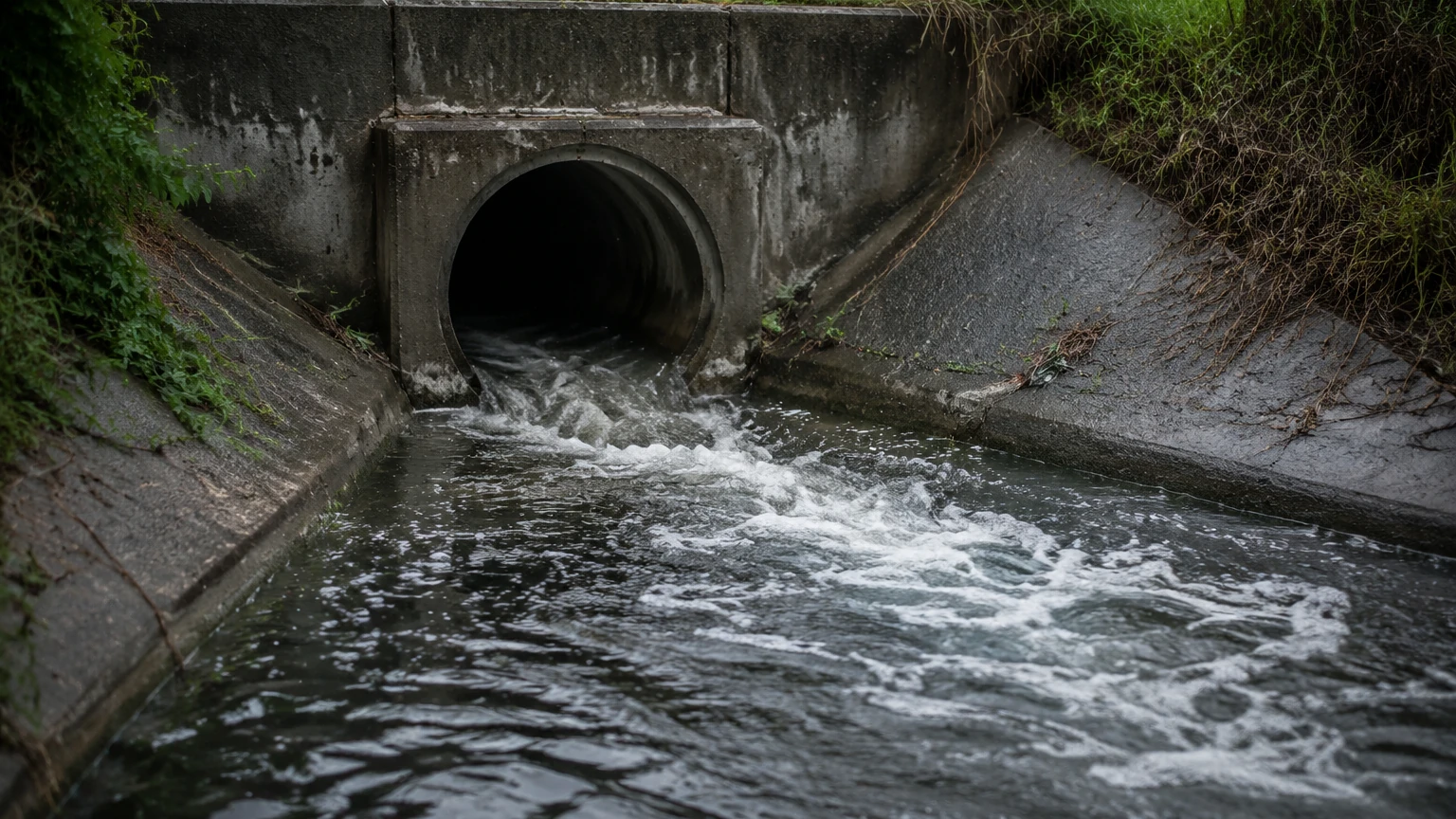
2. Surcharging: During intense storms, a pipe may become full, and the water may even rise up the manhole shaft (surcharging). Standard level-to-flow formulas fail in these conditions because the pipe is under pressure. If surcharging is expected, an Area-Velocity sensor or a redundant pressure sensor is required.
3. Environmental Interference: In large culverts or open outfalls, spider webs, nesting birds, or rapid temperature changes can interfere with ultrasonic signals. Radar is generally immune to these factors, making it the preferred choice for critical infrastructure.
Frequently Asked Questions (FAQ)
Q: How often should storm sewer flow monitoring equipment be calibrated?
A: We recommend a physical site verification every 3 to 6 months. This involves manually measuring the water level with a ruler or tape and comparing it to the sensor's output. If the deviation exceeds the acceptable tolerance (e.g., >10 mm), the sensor should be recalibrated.
Q: Can I use a magnetic flow meter for storm sewer flow monitoring?
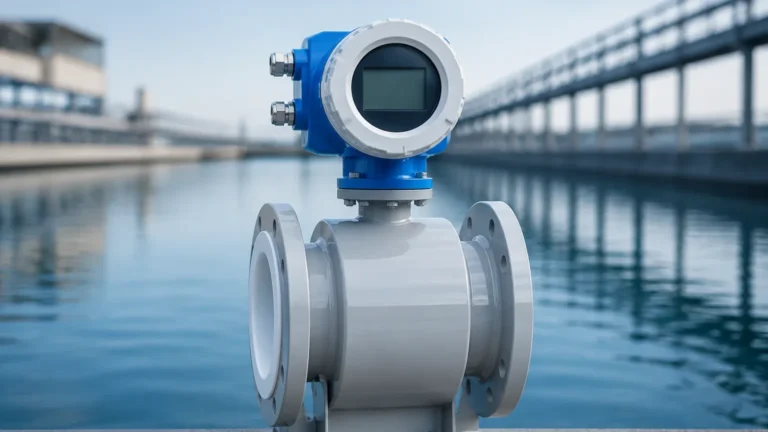
A: Magnetic flow meters (magmeters) are highly accurate but generally require a full pipe to function. Since most storm sewers are partially filled, a standard magmeter is not suitable unless a "U-trap" is installed to keep the sensor flooded, which can lead to sediment buildup.
Q: How do I handle data during a power outage?
A: Most industrial level meters can be powered by DC battery systems or solar panels. For remote storm sewer monitoring, using low-power sensors with integrated data loggers ensures that data is captured even if the primary grid fails.
Q: What is the impact of heavy rain on ultrasonic sensor accuracy?
A: Heavy rain can create noise and surface turbulence, which may scatter ultrasonic waves. Additionally, the high humidity during a storm changes the speed of sound. If high precision is required during the peak of a storm, radar is the superior technology as it is unaffected by atmospheric conditions.
Conclusion
Effective storm sewer flow monitoring is a balance between technology selection and site engineering. By understanding the hydraulic characteristics of the site—whether it is an open channel, a circular pipe, or a location prone to surcharging—operators can select the instrumentation that minimizes maintenance while maximizing data accuracy. For technical specifications on radar, ultrasonic, and hydrostatic instruments, engineers are encouraged to review the Main Page for detailed product data sheets and application support.