Stormwater Flow Meter
Stormwater Flow Meter
Stormwater management is a critical component of modern urban infrastructure and industrial environmental compliance. Monitoring the volume and velocity of runoff during rain events requires specialized instrumentation capable of handling highly variable flow rates, debris, and challenging outdoor environments. A stormwater flow meter is not a single device but a system designed to calculate flow based on level, velocity, or a combination of both in open channels or partially filled pipes.
For engineers and site managers, selecting the correct technology is essential to ensure regulatory compliance, prevent localized flooding, and manage the load on downstream treatment facilities. This guide examines the principles of stormwater measurement, technology options, and practical installation considerations.
Measurement Principles in Stormwater Applications
Stormwater typically flows through open channels, culverts, or gravity-fed pipes that are rarely full. Unlike closed-pipe pressurized systems where electromagnetic or ultrasonic meters are standard, stormwater requires methods suited for "free surface flow."
Open Channel Flow and Primary Devices
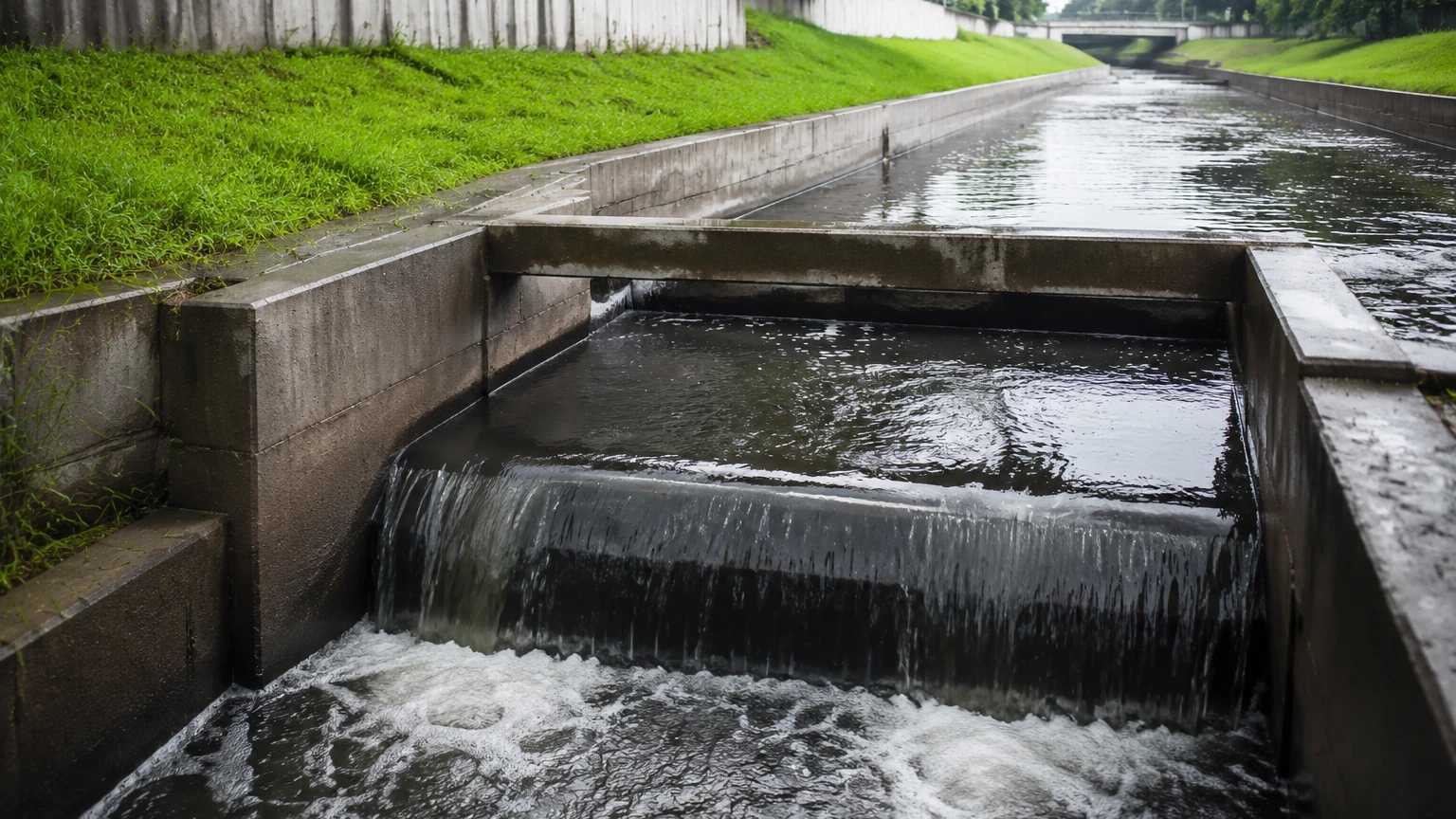
In many permanent installations, a primary device such as a flume or a weir is used. These structures have known hydraulic characteristics. By measuring the liquid level (head) at a specific point upstream of the device, the flow rate can be calculated using a standardized mathematical formula.
* Weirs: A dam-like obstruction across the channel. Common types include V-notch (for low flows) and rectangular weirs.
* Flumes: A shaped contraction in the channel (e.g., Parshall or Palmer-Bowlus flumes) that accelerates flow. Flumes are often preferred for stormwater because they are self-cleaning and cause less head loss than weirs.
Area-Velocity (AV) Principle
In applications where a primary device cannot be installed, such as in existing large-diameter concrete pipes, the Area-Velocity method is employed. This requires measuring two variables:
1. Level: To determine the cross-sectional area of the water.
2. Velocity: To determine how fast that area is moving.
Flow (Q) is then calculated as $Q = Area \times Velocity$.
Level-to-Flow Conversion (Manning Equation)
In uniform channels where the slope and roughness are known, the Manning Equation can estimate flow based solely on a level measurement. However, this assumes "normal flow" conditions, which are often disrupted in stormwater systems by backwater effects or debris, making direct velocity measurement or primary devices more reliable.
Technology Options for Stormwater Flow Metering
Modern industrial solutions, such as those featured on the Welk Main Page, utilize advanced sensing technologies to provide the level and velocity data required for accurate flow calculation.
1. Radar Level Meters (Non-Contact)
Radar sensors emit microwave pulses that reflect off the water surface. They are increasingly favored for stormwater because they are mounted above the flow, away from debris and corrosive elements.
* Advantages: High accuracy (often ±2 mm), unaffected by air temperature gradients, wind, or steam. Since they are non-contact, they require almost no maintenance.
* Limitations: Requires a stable mounting structure above the channel.
2. Ultrasonic Level Sensors (Non-Contact)
Ultrasonic sensors use sound waves to measure the distance to the water surface. They are a cost-effective alternative to radar for many municipal applications.
* Advantages: Lower initial cost, easy to integrate with standard flow-logging electronics.
* Limitations: Sound velocity is affected by air temperature; therefore, integrated temperature compensation is required. High winds or heavy foam on the water surface can interfere with the signal.
3. Submerged Pressure Transducers (Hydrostatic)
These sensors measure the liquid level by sensing the pressure exerted by the water column above them. They are often used in deep manholes or areas where overhead mounting is impossible.
* Advantages: Unaffected by surface foam or floating debris.
* Limitations: Contact-based, meaning they are prone to fouling from silt, grease, or "ragging" (debris wrapping around the sensor). They require periodic cleaning to maintain accuracy.
4. Area-Velocity Sensors (Submerged or Radar-Based)
* Submerged AV: Uses Doppler ultrasound to measure the velocity of particles or bubbles in the water while a pressure sensor measures the level.
* Radar AV: Uses a dual-sensor approach—one radar for level and another (using the Doppler shift) for surface velocity. This provides a completely non-contact flow measurement solution.
Technical Selection Criteria
When evaluating a stormwater flow meter system, engineers should use the following table to align technology with site conditions:
| Feature | Radar (Non-Contact) | Ultrasonic (Non-Contact) | Submerged AV (Contact) |
| :— | :— | :— | :— |
| Best Application | Large channels, high accuracy needs | Standard flumes/weirs, budget-conscious | Pipes with no flume/weir, manholes |
| Maintenance Level | Very Low | Low | Moderate to High |
| Debris Resistance | Excellent | Excellent | Poor (Fouling risk) |
| Accuracy | ±2 mm to ±5 mm | ±0.25% of range | ±2% to ±5% of flow |
| Power Consumption | Moderate (Loop-powered available) | Low | Moderate |
| Max Range | Up to 30m or more | Typically 10m to 15m | Depth dependent |
Installation Considerations
Proper installation is more critical than the choice of sensor for achieving accurate stormwater data.
1. Straight Run Requirements
For Area-Velocity measurements and Manning Equation calculations, the sensor should be placed in a straight section of the pipe or channel. Ideally, there should be a straight run of 10 times the pipe diameter (10D) upstream and 5 times the diameter (5D) downstream to ensure a laminar flow profile without excessive turbulence.
2. Dead Band Management
Non-contact sensors (ultrasonic and radar) have a "dead band" or "blanking distance" directly beneath the sensor where they cannot measure. Ensure the sensor is mounted high enough so that even during peak flow (100-year storm events), the water level does not enter this dead band.
3. Mounting Alignment
For radar and ultrasonic sensors, the transducer face must be perfectly parallel to the water surface. Even a few degrees of tilt can cause the signal to bounce away from the receiver, leading to intermittent data loss.
4. Environmental Protection
Stormwater sensors are often located in remote areas. Use IP68-rated housings for submerged components and NEMA 4X enclosures for transmitters. If the site is off-grid, ensure the system is compatible with 12V or 24V DC solar power systems.
Common Risks and Limitations
* Siltation and Sediment: In many stormwater systems, heavy rain washes sand and grit into the channels. This can bury submerged sensors or change the cross-sectional area of a flume, leading to over-reporting of flow.
* Backwater Effects: If a downstream pipe is blocked or a river level rises, water may back up into the monitoring point. A level-only sensor will interpret this rising water as an increase in flow, even if the water is stationary or moving backward. In these cases, an Area-Velocity meter is mandatory.
* Extreme Turbulence: High-velocity flow can create waves and surface turbulence. Radar sensors with advanced software filtering are best suited to average these fluctuations and provide a stable reading.
Frequently Asked Questions (FAQ)
Q: How often should a stormwater flow meter be calibrated?
A: For regulatory compliance, most jurisdictions require an annual calibration check. However, for systems using primary devices (flumes/weirs), the "calibration" usually involves verifying the accuracy of the level sensor against a manual staff gauge measurement.
Q: Can I measure stormwater flow in a pipe that is sometimes completely submerged?
A: Yes, but you cannot use a standard open-channel level-to-flow calculation. You must use a submerged Area-Velocity sensor or a combination of sensors that can transition between open-channel math and full-pipe (surcharge) math.
Q: What is the impact of foam on measurement?
A: Foam can absorb ultrasonic signals, causing the sensor to lose the echo. Radar is generally more effective at penetrating foam, though extremely thick, dense foam may still cause a slight reduction in signal strength.
Q: Is data logging necessary for stormwater meters?
A: Absolutely. Stormwater events are unpredictable and often occur outside of working hours. A system with integrated data logging or cellular telemetry allows for the capture of hydrographs (flow over time), which are essential for engineering analysis and reporting.
By understanding the hydraulic requirements of the site and the strengths of different sensing technologies, engineers can implement a stormwater flow meter system that provides reliable data through both droughts and deluges. For detailed specifications on the sensors used in these systems, refer to the technical documentation available on the manufacturer's Main Page.