Vega Bar
Vega Bar
In the field of industrial automation and process control, hydrostatic level measurement remains one of the most reliable and widely adopted methods for monitoring liquids in tanks and vessels. The Vega Bar series of pressure transmitters serves as a benchmark for this technology, offering a range of sensors designed to convert physical pressure into precise level data. Understanding the engineering principles behind these devices, their specific sensor cell technologies, and their application-specific configurations is essential for process engineers seeking to optimize plant efficiency and safety.
This guide provides a technical overview of the Vega Bar series, focusing on the measurement principles, selection criteria, and installation best practices required for successful deployment in industries ranging from water treatment to chemical processing.
Understanding Hydrostatic Level Measurement Principles
Hydrostatic level measurement is based on the principle that the pressure at a specific point within a liquid is directly proportional to the height of the liquid column above that point. This relationship is defined by the hydrostatic pressure formula:
P = ρ · g · h
Where:
* P is the hydrostatic pressure (measured in Pascals or bar).
* ρ (rho) is the density of the medium (kg/m³).
* g is the acceleration due to gravity (approximately 9.81 m/s²).
* h is the height of the liquid column (meters).
Because gravity is constant and the density of the medium is typically known, the pressure measured by a sensor at the bottom of a tank can be accurately converted into a level reading. However, it is important to distinguish between gauge pressure and absolute pressure. In vented (open) tanks, a gauge pressure sensor compensates for atmospheric pressure changes. In pressurized (closed) tanks, a differential pressure measurement or an electronic differential pressure (eDP) system is required to subtract the top-side gas pressure from the total pressure at the bottom.
As a professional manufacturer of industrial level measurement instruments, Welk emphasizes that selecting the right pressure transmitter involves more than just calculating the height; it requires an understanding of how different sensor cells interact with the process media. For those exploring a wide range of instrumentation, you can Review product options and application support on our Main Page.
Key Technologies in the Vega Bar Series
The Vega Bar series is categorized primarily by the type of measuring cell used. The choice between a ceramic cell and a metallic cell is the most critical decision in the specification process.
CERTEC® Ceramic Measuring Cells
Ceramic cells, such as those found in the VEGABAR 82, are "dry" measuring cells. They consist of a ceramic base body and a ceramic diaphragm. Unlike metallic cells, they do not use an internal transmission fluid (oil). This offers several advantages:
* Abrasion Resistance: Ceramic is significantly harder than most metals, making it ideal for slurries or media containing sand and grit.
* Chemical Compatibility: High-purity sapphire-ceramic (99.9% Al2O3) is nearly inert and resists aggressive acids and alkalis.
* Overload Resistance: Ceramic cells can withstand pressure surges significantly higher than their nominal range without permanent deformation.
* Vacuum Resistance: Because there is no oil to outgas, ceramic cells perform exceptionally well in vacuum applications.
Metallic Measuring Cells
Metallic cells, utilized in the VEGABAR 83 and 81, use a thin metal diaphragm (typically stainless steel, Hastelloy, or Tantalum) and a piezoresistive or strain gauge sensor. The pressure is transmitted from the diaphragm to the sensor via a small volume of fill oil.
* High Pressure Ranges: Metallic cells are better suited for extremely high-pressure applications (up to 1,000 bar).
* Hydrogen Permeation: For applications involving hydrogen, metallic diaphragms can be gold-plated to prevent hydrogen atoms from diffusing through the metal and causing sensor drift.
* Small Process Fittings: Metallic cells can be manufactured in smaller diameters than ceramic cells, allowing for more compact process connections.
Selection Criteria for Pressure Transmitters
Choosing the correct Vega Bar model requires a systematic evaluation of the process conditions. The following table provides a comparison of common models used in industrial applications.
Selection Table: Vega Bar Series Comparison
| Feature | VEGABAR 81 | VEGABAR 82 | VEGABAR 83 |
| :— | :— | :— | :— |
| Measuring Cell | Metallic with Chemical Seal | Ceramic (CERTEC®) | Metallic (Internal Oil) |
| Measuring Range | 0.1 to 1000 bar | 0.025 to 100 bar | 0.1 to 1000 bar |
| Process Temp. | -90 to +400 °C | -40 to +150 °C | -40 to +200 °C |
| Accuracy | 0.2% | 0.05% | 0.2% |
| Best For | Extreme temps, aggressive media | Abrasive, vacuum, standard liquids | High pressure, small fittings |
| Key Advantage | Remote diaphragm seal | Dry cell, high overload | Robust metallic design |
Environmental and Media Factors
1. Temperature: If the process temperature exceeds 150 °C, a VEGABAR 81 with a chemical seal or a metallic cell with a cooling neck is often necessary.
2. Corrosiveness: For highly corrosive media like hydrochloric acid, a ceramic cell (VEGABAR 82) is the standard choice. If a metallic cell is required, exotic materials like Tantalum must be specified.
3. Hygiene Requirements: In food and pharmaceutical applications, flush-mounted diaphragms are required to prevent bacterial growth in "dead spaces." Both ceramic and metallic options offer hygienic fittings (e.g., Clamp, Varivent).

Installation and Mounting Considerations
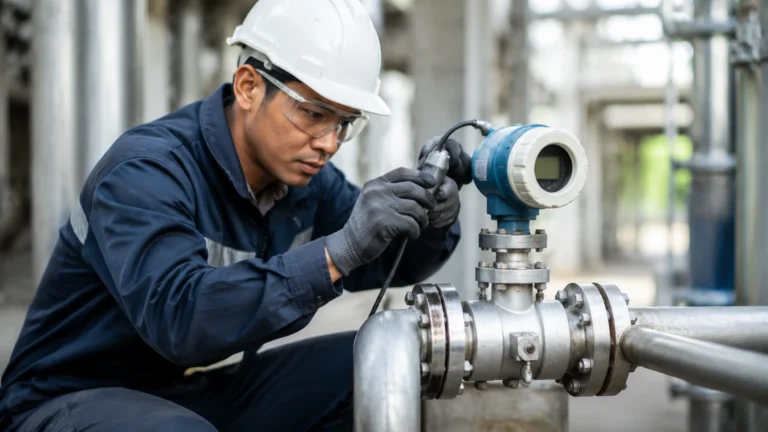
Proper installation is vital to ensure the longevity and accuracy of the pressure transmitter. Even the most advanced sensor will provide inaccurate data if mounted incorrectly.
Mounting Position
* Liquid Applications: The sensor should be mounted at or below the lowest level to be measured. In pipelines, it should be mounted on the side or bottom to ensure it remains filled with liquid and avoids air pockets.
* Gas Applications: The sensor should be mounted above the tap point so that condensate can drain back into the process.
Impulse Lines and Chemical Seals
When using the VEGABAR 81 with chemical seals, the capillary tubes (impulse lines) must be protected from mechanical damage and extreme temperature fluctuations. Temperature changes along the capillary can cause the fill oil to expand or contract, leading to a "temperature error" in the level reading.
Moisture and Venting
For gauge pressure sensors, the reference air must reach the back of the sensor diaphragm via a vented cable or a vent filter on the housing. In high-humidity environments, ensure the vent is protected by a Gore-Tex filter or similar breathable membrane to prevent moisture ingress, which can lead to internal corrosion or sensor drift.
Limitations and Operational Challenges
While hydrostatic pressure transmitters like the Vega Bar are versatile, they have specific limitations that engineers must account for:
1. Density Variations: Since the sensor measures weight (pressure), any change in the liquid's density will directly affect the level reading. If a tank holds different liquids or if the temperature causes significant density shifts, the system must be compensated using a temperature sensor or a second pressure sensor for density calculation.
2. Mechanical Damage: Ceramic diaphragms are brittle. While they resist abrasion, they can be shattered by sharp mechanical impacts. Metallic diaphragms are very thin (often <0.1 mm) and can be easily dented or deformed if touched during cleaning.
3. Build-up and Clogging: In heavy slurries or wastewater, solids can accumulate in front of the diaphragm. While flush-mounted sensors mitigate this, periodic inspection is required to ensure the diaphragm can move freely.
4. Turbulence: In tanks with high-speed agitators, the dynamic pressure caused by the moving liquid can interfere with the static hydrostatic pressure reading. In such cases, a stilling well or a different technology, such as radar, may be more appropriate.
Frequently Asked Questions (FAQ)
Q: Can a Vega Bar sensor be used for both level and pressure measurement?
A: Yes. While this guide focuses on level, these devices are fundamentally pressure transmitters. They can be configured to output pressure (e.g., bar, PSI) or converted level units (e.g., meters, liters, kilograms) via the local interface or software.
Q: What is the difference between VEGABAR 82 and 83?
A: The primary difference is the measuring cell. The 82 uses a ceramic cell (dry), which is better for vacuum, abrasion, and chemicals. The 83 uses a metallic cell (oil-filled), which is better for very high pressures and applications where a metallic diaphragm is preferred for specific chemical compatibility.
Q: How often should the sensor be calibrated?
A: Calibration frequency depends on the criticality of the process and the stability of the environment. Many modern sensors exhibit very low long-term drift (e.g., <0.1% per year), allowing for calibration cycles of 2 to 5 years in stable applications.
Q: Is it possible to use these sensors in hazardous areas?
A: Yes, the Vega Bar series is available with various global certifications, including ATEX, IECEx, and FM, for use in intrinsically safe (Ex i) or explosion-proof (Ex d) zones.
Q: How does electronic differential pressure (eDP) work?
A: Instead of using a single sensor with mechanical capillary tubes to measure a pressurized tank, two Vega Bar sensors are used. One measures the bottom pressure and the other measures the top gas pressure. The two sensors are linked electronically, and the primary sensor calculates the difference. This eliminates the temperature errors associated with oil-filled capillaries.
For engineers and procurement professionals looking for reliable measurement solutions, understanding these nuances ensures that the selected instrument provides accurate data throughout its service life. Whether you are managing water treatment facilities or complex chemical reactors, the integration of high-quality pressure transmitters is a vital step in industrial modernization. For further technical details and to view our full range of level measurement products, please Review product options and application support on our Main Page.