Vegamet 842
Vegamet 842
In the field of industrial automation, the accuracy of a level measurement system depends not only on the sensor mounted atop the vessel but also on how the resulting data is processed, visualized, and integrated into control logic. The Vegamet 842 serves as a specialized signal conditioning instrument and controller designed to bridge the gap between field-level sensors and high-level process management. As a dual-channel controller, it is frequently employed in applications where complex calculations, such as differential level measurement or pump control, are required.
For engineers and plant operators, selecting a signal processing unit like the Vegamet 842 involves understanding the underlying measurement principles, the integration of HART communication, and the specific logic required for local control tasks. This guide examines the technical architecture of the Vegamet 842, its practical applications, and the criteria for selecting it over standard PLC-based solutions.
Measurement and Control Principles
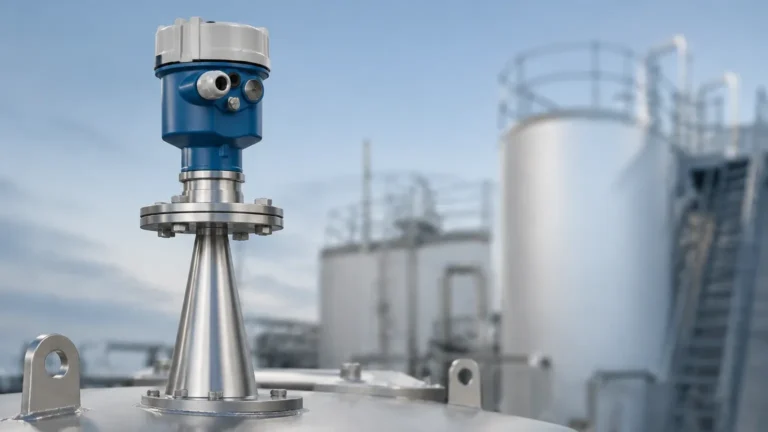
Before implementing a controller, it is essential to understand the signal chain. In a typical industrial setup, a level sensor—such as a radar level meter, ultrasonic sensor, or hydrostatic transmitter—detects the physical distance to the medium or the pressure exerted by the liquid column. This physical value is converted into an electrical signal, most commonly a 4…20 mA current loop.
Signal Conditioning
The Vegamet 842 acts as the power supply and signal evaluator for these sensors. It provides the necessary loop power (typically 24V DC) to the connected transmitters. Once the 4…20 mA signal is received, the controller scales this current to a meaningful engineering unit, such as meters (m), liters (L), or percentage (%).
The Role of HART Communication
Unlike basic signal converters, the Vegamet 842 supports HART (Highway Addressable Remote Transducer) communication. This protocol allows digital information to be superimposed on the analog 4…20 mA signal. Through HART, the controller can access diagnostic data from the sensor, perform remote parameterization, and receive multiple process variables over a single pair of wires. This is particularly useful when using advanced instruments found on the Main Page of industrial catalogs, where multi-variable data is often available.
Dual-Channel Logic
The "842" designation signifies its dual-channel capability. This allows the unit to process two independent sensor inputs simultaneously. In practical terms, this enables the controller to perform mathematical operations between the two inputs, such as:
* Differential Measurement: Calculating the difference between two levels (e.g., across a filter or screen).
* Summation: Adding the volumes of two separate tanks.
* Average: Calculating the mean level in a large vessel monitored by two sensors.
Technical Specifications and Selection Criteria
When evaluating the Vegamet 842 for a project, technical compatibility with the existing infrastructure is paramount. The following table outlines the primary selection criteria compared to other common signal conditioning configurations.
Selection Table: Controller Comparison
| Feature | Vegamet 842 | Single-Channel Controller | Standard PLC Input Card |
| :— | :— | :— | :— |
| Sensor Inputs | 2 x 4…20 mA / HART | 1 x 4…20 mA / HART | Multiple (requires external power) |
| Relay Outputs | 3 x SPDT (Configurable) | 1 or 2 Relays | None (requires output card) |
| Display | Backlit LCD with Graphing | Basic Numeric | Requires HMI |
| Pump Control | Integrated Lead-Lag Logic | Basic On/Off | Custom Programming Required |
| Flow Calculation | Integrated Flume/Weir Curves | Limited | Manual Math Blocks |
| Mounting | DIN Rail or Panel Mount | DIN Rail | Rack Mount |
Input and Output Configuration
The Vegamet 842 is equipped with three programmable relays and two current outputs (4…20 mA). The relays are typically used for limit signaling (high-high or low-low alarms) or for direct control of small pumps and valves. The analog outputs allow the processed signal to be re-transmitted to a SCADA system or a secondary recorder, ensuring that the local control logic does not isolate the data from the rest of the facility.
Key Applications in Process Industries
1. Water and Wastewater Management
In wastewater treatment plants, the Vegamet 842 is often used for screen control. By measuring the level before and after a mechanical screen, the controller calculates the head loss (differential). When the difference exceeds a set threshold, indicating the screen is clogged, the controller activates the cleaning mechanism via its integrated relays.
2. Pump Station Automation
The unit features specialized software for pump control. It can manage up to two pumps in an alternating fashion (lead-lag). This ensures that pump wear is distributed evenly. Furthermore, it includes "pump cycling" logic to prevent sediment buildup and can incorporate delay timers to prevent rapid cycling caused by surface turbulence.
3. Open Channel Flow Measurement
When paired with an ultrasonic sensor, the Vegamet 842 functions as a highly accurate flow meter for open channels. It contains pre-programmed linearization curves for standard flumes (e.g., Parshall, Khafagi) and weirs. The controller converts the measured head (level) into a flow rate (e.g., m³/h) and can totalize the volume over time.
4. Chemical Tank Monitoring
For chemical storage, the unit provides linearization for non-linear tank shapes, such as horizontal cylindrical tanks or vessels with conical bottoms. This ensures the display shows the actual volume remaining rather than just the liquid height.
Installation and Wiring Considerations
Successful deployment of the Vegamet 842 requires adherence to specific electrical and mechanical guidelines to ensure signal integrity and device longevity.
Electrical Connection
* Cable Shielding: To prevent electromagnetic interference (EMI) from affecting the 4…20 mA signal, shielded twisted-pair cabling should be used. The shield should be grounded at the controller end only to avoid ground loops.
* Power Supply: The Vegamet 842 is available in various power versions, including wide-range AC (20…253V AC) and DC (20…72V DC). Confirming the available site power is a critical first step.
* HART Resistance: If the loop resistance is too low, HART communication may fail. The Vegamet 842 typically includes an internal 250-ohm resistor that can be switched into the circuit to facilitate digital communication.
Mechanical Mounting
The device is designed for carrier rail (DIN rail) mounting according to EN 60715. For outdoor installations or harsh environments, the unit must be housed in an additional IP66/67 rated enclosure. The front-facing display and keys allow for local configuration without the need for a PC, although Bluetooth and PC-based software (such as PACTware) are often supported for faster setup.

Limitations and Operational Risks
While the Vegamet 842 is a versatile tool, it has specific limitations that engineers must account for:
* Output Capacity: The integrated relays are designed for control signals, not for powering large industrial motors directly. Interposing contactors must be used for heavy loads.
* Environment: The unit itself is typically rated for IP20. It is not suitable for direct exposure to moisture or corrosive atmospheres without a secondary protective housing.
* Complexity vs. Simplicity: For a single tank with a simple high-level alarm, a dual-channel controller may be over-engineered. Conversely, for a plant with fifty tanks, a centralized PLC system is more cost-effective than fifty individual controllers.
Frequently Asked Questions (FAQ)
Q: Can the Vegamet 842 power two-wire and four-wire sensors?
A: Yes. It provides 24V DC loop power for standard two-wire transmitters. For four-wire sensors that have their own power source, the Vegamet 842 can be configured to receive the 4…20 mA signal passively.
Q: How does the unit handle sensor errors?
A: The Vegamet 842 monitors the 4…20 mA signal for out-of-range conditions (e.g., < 3.6 mA or > 21 mA). In the event of a sensor failure, the relays can be programmed to a "safe state" to prevent tank overflows or dry-running of pumps.
Q: Is it possible to configure the device remotely?
A: Yes, if the version supports Bluetooth or is connected via a HART modem to a PC. This allows for configuration through the VEGA Tools app or PACTware/FDT/DTM environments.
Q: Can it be used for custody transfer?
A: While highly accurate, the Vegamet 842 is generally intended for process control and inventory monitoring. Official custody transfer applications usually require specific weights-and-measures approved systems.
Conclusion and Next Steps
The Vegamet 842 remains a staple in industrial level control due to its reliability and the ease with which it handles dual-input logic. By consolidating power supply, display, and control functions into a single DIN-rail module, it reduces the complexity of control cabinet wiring and simplifies the commissioning process for technicians.
When planning a level measurement project, it is vital to confirm the compatibility of your sensors with the controller's input specifications. For those seeking high-quality radar, ultrasonic, or hydrostatic sensors to pair with such controllers, exploring the comprehensive range of instruments on the Main Page is recommended. Ensuring that the sensor and controller are matched in terms of signal output and communication protocol is the most effective way to guarantee long-term system stability and measurement accuracy.